
How Neuroaesthetics is Turning Interior Design into a Science of Well-Being
Emerging research shows that interior design is not just about aesthetics—it is a biological intervention that directly alters brain chemistry, stress levels, and cognitive function.
By Factlen Editorial Team
- Interior Designers & Architects
- Practitioners translating scientific principles into functional, beautiful spaces.
- Neuroaesthetic Researchers
- Scientists focused on the biological and measurable impacts of space on the human brain.
- Public Health Advocates
- Voices pushing for equitable access to brain-friendly environments.
What's not represented
- · Real estate developers balancing the cost of neuro-inclusive design with profit margins.
- · Neurodivergent individuals who may have highly specific or differing sensory needs in built environments.
Why this matters
With people in urban societies spending over 90% of their time indoors, our built environments act as an invisible interface to our nervous systems. Understanding how to optimize these spaces can passively reduce daily stress, improve focus, and support long-term mental health.
Key points
- Neuroaesthetics studies how the brain responds to beauty and spatial environments.
- Interior design choices directly impact heart rate, cortisol levels, and serotonin production.
- Natural light and circadian lighting systems are crucial for regulating mood and sleep.
- Biophilic design, which incorporates nature, can reduce stress hormones by up to 20%.
- The brain prefers curved, organic shapes over sharp angles, interpreting them as safe.
- Balancing visual complexity prevents cognitive overload and mental fatigue.
For decades, interior design has been treated primarily as an exercise in aesthetics and personal expression. If a room felt good, it was credited to a designer's intuitive eye for color and proportion. But a quiet revolution is reframing the industry: the realization that interior design is actually a biological intervention. Every texture, light source, and spatial layout in a room continuously signals safety or tension to the human nervous system, altering brain chemistry in real time.[1][2]
This shift is driven by neuroaesthetics, an emerging scientific discipline that studies how the brain perceives and responds to beauty, art, and spatial environments. Advanced brain-scanning technology now allows researchers to measure exactly what happens physiologically when a person enters a room. The data reveals that thoughtful design decisions trigger measurable biological responses, including lowered blood pressure, decreased cortisol levels, and elevated serotonin.[2][6]
According to researchers, human interaction with a building is shaped by three distinct neural networks. The sensory-motor system processes physical features like light and acoustics; the knowledge-meaning network handles our cognitive interpretation of the space based on memory and culture; and the emotion-valuation system integrates these inputs to produce an aesthetic and emotional experience. When these networks are harmoniously engaged, the brain registers the environment as a sanctuary.[4]

One of the most powerful tools in neuroaesthetic design is the manipulation of light. The human circadian clock is deeply tethered to natural daylight. Environments that maximize natural light exposure in the morning help balance dopamine levels, boosting motivation and mental clarity. Conversely, poorly lit spaces or harsh artificial glare can disrupt circadian rhythms, elevate cognitive load, and increase anxiety. Designers are increasingly using dynamic lighting systems that mimic the sun's progression, shifting from cool, bright light during work hours to warm, dim tones in the evening to support melatonin production.[6][7]
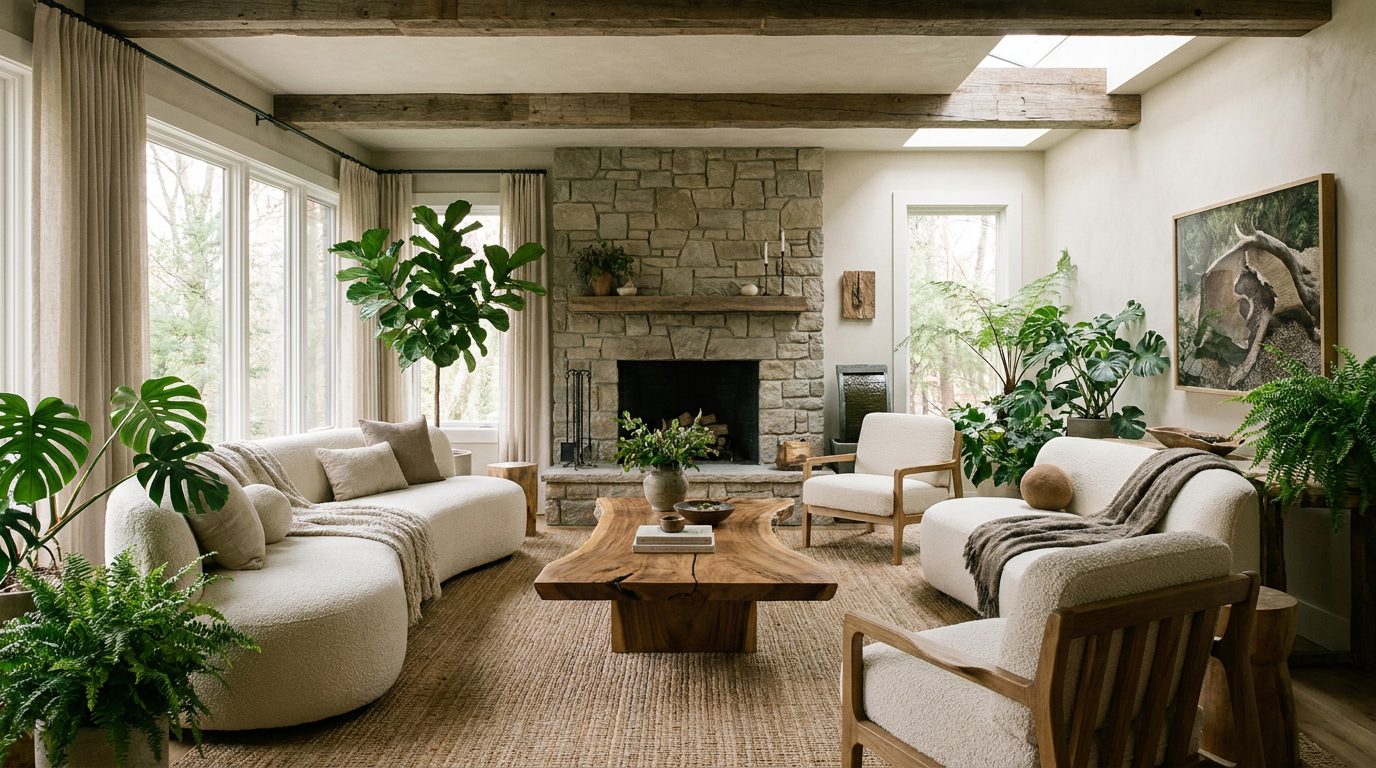
Biophilic design—the integration of nature into the built environment—is another cornerstone of neuroaesthetics. The human brain evolved outdoors, and it still subconsciously scans for the safety signals provided by the natural world. Incorporating organic materials like wood and stone, indoor plants, and natural textures has been shown to reduce stress hormones by 15 to 20 percent. The brain does not even require these elements to be literal; it responds positively to the mere representation of nature, such as botanical patterns or earthy color palettes.[2][5]
Biophilic design—the integration of nature into the built environment—is another cornerstone of neuroaesthetics.
The geometry of a space also plays a critical role in emotional regulation. Studies in neuroaesthetics suggest that the brain strongly prefers curvilinear forms—smooth, flowing lines and rounded edges—over sharp, angular shapes. Curves mimic the organic contours found in nature, from riverbeds to leaves, and the brain interprets them as nurturing and non-threatening. Integrating curved furniture or arched doorways can instantly soften a room's psychological impact.[5]

Another evolutionary concept gaining traction in modern design is the "prospect and refuge" theory. Humans feel most secure when they have a clear view of their surroundings (prospect) while feeling protected from behind (refuge). In practical terms, this means arranging a home office desk so the occupant faces the door with a solid wall behind them, or placing a high-backed reading chair in a cozy corner overlooking a larger room. These subtle spatial cues prevent the brain's threat-detection systems from quietly running in the background.[5]
Visual complexity must also be carefully managed to avoid cognitive overload. While a completely sterile room can feel under-stimulating and clinical, excessive clutter forces the brain to constantly process visual noise, leading to fatigue and irritability. Neuroaesthetic design seeks a "moderate visual complexity"—a balance between order and variety. This can be achieved through clean architectural lines paired with rich, tactile materials, or by using fractal patterns—complex, repeating geometries found in snowflakes and tree branches—which naturally captivate and relax the mind.[6][7]

The implications of this research extend far beyond luxury home renovations. At recent industry gatherings like the Global Wellness Summit, leaders in science and architecture have pushed to redefine wellness as a systems-based approach that includes the built environment. Initiatives like the Intentional Spaces Roadmap aim to provide architects with science-backed frameworks to create environments that actively support health and human flourishing.[3]
As urban populations spend upwards of 90 percent of their lives indoors, the ethical imperative for brain-friendly design is growing. Advocates argue that neuroaesthetic principles should be embedded into public policy, ensuring that schools, hospitals, and affordable housing are designed to support cognitive function and emotional resilience. By translating the language of the brain into the materials of our homes and cities, design is evolving from a decorative art into a fundamental tool for public health.[3][8]
How we got here
1990s
Advances in brain-scanning technology allow researchers to observe real-time neural responses to aesthetic experiences.
2013
Publication of foundational texts on the 'aesthetic brain' helps formalize the intersection of neuroscience and architecture.
2021
Researchers map the three specific neural networks that govern human-building interactions.
2025–2026
Major design institutions and the Global Wellness Summit adopt neuroaesthetics as a core framework for future architecture.
Viewpoints in depth
Neuroaesthetic Researchers
Scientists focused on the biological and measurable impacts of space on the human brain.
This camp views the built environment as a continuous biological intervention. Using functional MRI scans and biometric sensors, they track how specific design choices—from ceiling height to color temperature—alter heart rates, cortisol levels, and brain wave patterns. For these researchers, design is not subjective; it is a predictable mechanism for modulating the human nervous system, and they advocate for evidence-based standards in all architectural planning.
Interior Designers & Architects
Practitioners translating scientific principles into functional, beautiful spaces.
Design professionals are increasingly using neuroaesthetics to validate their intuitive practices. They focus on the practical application of the science, balancing a client's personal taste with neurological best practices. For this group, the challenge lies in seamlessly integrating elements like circadian lighting, acoustic dampening, and biophilic textures without compromising the visual elegance or functional flow of a home or office.
Public Health Advocates
Voices pushing for equitable access to brain-friendly environments.
Public health experts argue that if interior design directly impacts mental health and cognitive development, then neuroaesthetic principles cannot be reserved solely for luxury real estate. They advocate for updating building codes and public policy to ensure that schools, hospitals, workplaces, and affordable housing are designed to minimize cognitive load and environmental stress, framing spatial design as a matter of public health equity.
What we don't know
- How individual neurodivergence (such as ADHD or autism) alters the baseline neurological response to specific aesthetic stimuli.
- The long-term, compounding health effects of living in a fully neuro-optimized environment over decades.
- How rapidly AI and smart-home technologies will be able to adapt spatial conditions (like light and sound) to a user's real-time biometric data.
Key terms
- Neuroaesthetics
- The scientific study of how the brain perceives, processes, and responds to beauty, art, and spatial environments.
- Biophilic Design
- An architectural approach that connects building occupants more closely to nature through natural lighting, ventilation, landscape features, and organic materials.
- Prospect and Refuge
- An evolutionary theory suggesting humans feel most comfortable in spaces where they have an unobstructed view of their surroundings while their back is protected.
- Cognitive Load
- The amount of mental effort and working memory required to process information in an environment; high visual clutter increases cognitive load.
- Fractals
- Complex, repeating geometric patterns found in nature (like ferns or snowflakes) that have been shown to naturally soothe the human brain.
Frequently asked
Do I need to be a minimalist to have a brain-friendly home?
No. Neuroaesthetics encourages 'moderate visual complexity.' While excessive clutter causes stress, overly sterile environments can be under-stimulating. The goal is a balance of organized space with rich, natural textures.
How does biophilic design actually affect the brain?
The human brain evolved outdoors and subconsciously associates natural elements with safety and resources. Viewing natural textures, plants, or organic patterns triggers the parasympathetic nervous system, lowering heart rate and cortisol.
Can I apply neuroaesthetics to a small apartment?
Yes. Small changes like maximizing natural light, adding a few indoor plants, using warm-toned lamps in the evening, and arranging your seating to face the room's entrance can significantly improve how the space feels.
Is neuroaesthetics just a design trend?
Unlike aesthetic trends that change by the decade, neuroaesthetics is based on human biology and evolutionary psychology, focusing on measurable physiological responses rather than stylistic preferences.
Sources
Source coverage
8 outlets
3 viewpoints surfaced








[1]Factlen Editorial Team
Synthesis by Factlen editorial team
Read on Factlen Editorial Team →[2]Science in DesignNeuroaesthetic Researchers
What is Neuroaesthetics?
Read on Science in Design →[3]ArchiExpo e-MagazinePublic Health Advocates
Designing the Future of Wellness: Neuroaesthetics at the Global Wellness Summit
Read on ArchiExpo e-Magazine →[4]ModulyssNeuroaesthetic Researchers
Neuroaesthetics: Transforming Commercial Spaces Through Thoughtful Design
Read on Modulyss →[5]Kate Bendewald DesignInterior Designers & Architects
How we Apply Neuroaesthetics in Interior Design
Read on Kate Bendewald Design →[6]Flooring SurgeonsInterior Designers & Architects
The Science Behind Interior Design and Mental Health
Read on Flooring Surgeons →[7]VI DesignInterior Designers & Architects
Neuroaesthetics: 7 principles you can apply at home
Read on VI Design →[8]BIFMAPublic Health Advocates
The Science of Feeling: What Is Neuroaesthetics?
Read on BIFMA →


Every angle. Every day.
Get lifestyle stories with full source coverage and perspective breakdowns delivered to your inbox.