
How Heat Pump Dryers Are Quietly Revolutionizing the American Laundry Room
Ventless heat pump dryers use up to 60% less energy and operate at lower temperatures, saving money and preserving fabrics. As the technology becomes standard in 2026, understanding the mechanism and trade-offs can help consumers make smarter appliance choices.
By Factlen Editorial Team
- Energy Efficiency Advocates
- Focus on the massive reduction in household carbon footprints and grid strain.
- Appliance Technicians
- Emphasize the importance of regular maintenance and the complexity of repairs.
- High-Volume Households
- Express concern over longer cycle times and the pace of laundry day.
- Retailers & Manufacturers
- Highlight the fabric care benefits and the flexibility of ventless installation.
What's not represented
- · Landlords and property developers evaluating the cost of retrofitting buildings for ventless laundry.
Why this matters
The clothes dryer is typically the second-largest energy consumer in a home, trailing only the HVAC system. Upgrading to a heat pump model can drastically cut utility bills, eliminate the need for exterior venting, and extend the lifespan of your wardrobe.
Key points
- Heat pump dryers use a closed-loop refrigeration system to dry clothes, eliminating the need for an exterior vent.
- The technology uses 50% to 60% less energy than traditional vented dryers, saving households hundreds of dollars annually.
- Because they operate at lower temperatures, heat pump dryers are significantly gentler on fabrics and reduce shrinkage.
- While highly efficient, they come with a higher upfront cost and longer drying times compared to conventional models.
- The ventless design allows the dryers to be installed in closets, apartments, and interior rooms with ease.
For decades, the American laundry routine has relied on a brute-force approach to drying clothes: pulling in conditioned room air, heating it to scorching temperatures, tumbling the wet laundry, and blasting the hot, moisture-laden air out through a hole in the wall. It is a process that wastes massive amounts of energy. In fact, the traditional vented clothes dryer is often the most energy-hungry appliance in a home, second only to the heating and cooling system.[1][2]
But in 2026, a quieter, cooler, and vastly more efficient technology is rapidly replacing the old standard. Heat pump dryers, which have been commonplace in Europe for years, are now taking over the North American market. By treating laundry drying as a closed-loop refrigeration cycle rather than a simple heating exercise, these machines are fundamentally changing how households manage their chores and their utility bills.[4][6]
To understand why heat pump dryers are so revolutionary, it helps to look at the flaws of the traditional vented model. A standard electric or gas dryer acts like a giant hair dryer. It continuously generates new heat, which requires a massive electrical draw or gas combustion. Worse, because it exhausts that air outside, it creates a negative pressure vacuum in the home, pulling in outside air through cracks and gaps that the home's HVAC system then has to heat or cool.[1][2][7]
A heat pump dryer eliminates this wasteful cycle entirely. Instead of generating heat with electric resistance coils or gas burners, it uses a closed-loop refrigeration system to move thermal energy from one place to another. It is essentially an air conditioner running in reverse, contained entirely within the chassis of the appliance.[3][8]

The mechanism relies on two sets of coils: a cold evaporator coil and a hot condenser coil, both filled with circulating refrigerant. The cycle begins when the hot condenser coil warms the air inside the drum. This warm, dry air passes through the tumbling wet clothes, absorbing the moisture.[2][3][7]
In a traditional dryer, that warm, wet air would be expelled outside. In a heat pump dryer, it is instead routed over the cold evaporator coil. Because cold air cannot hold as much moisture as warm air, the water instantly condenses out of the air and drips into a collection pan or drain line.[3][7]
The newly dehumidified, cool air is then passed back over the hot condenser coil, reheated, and sent right back into the drum to absorb more moisture. The air never leaves the machine. By recycling the same air continuously, the heat pump dryer operates as a completely sealed, ventless system.[3][8]
The newly dehumidified, cool air is then passed back over the hot condenser coil, reheated, and sent right back into the drum to absorb more moisture.
This closed-loop mechanism yields staggering efficiency gains. According to state energy authorities and appliance experts, heat pump dryers use 50% to 60% less energy than conventional vented models. For a household doing average amounts of laundry, this can translate to annual electricity savings of $175 to over $330, depending on local utility rates.[1][3]

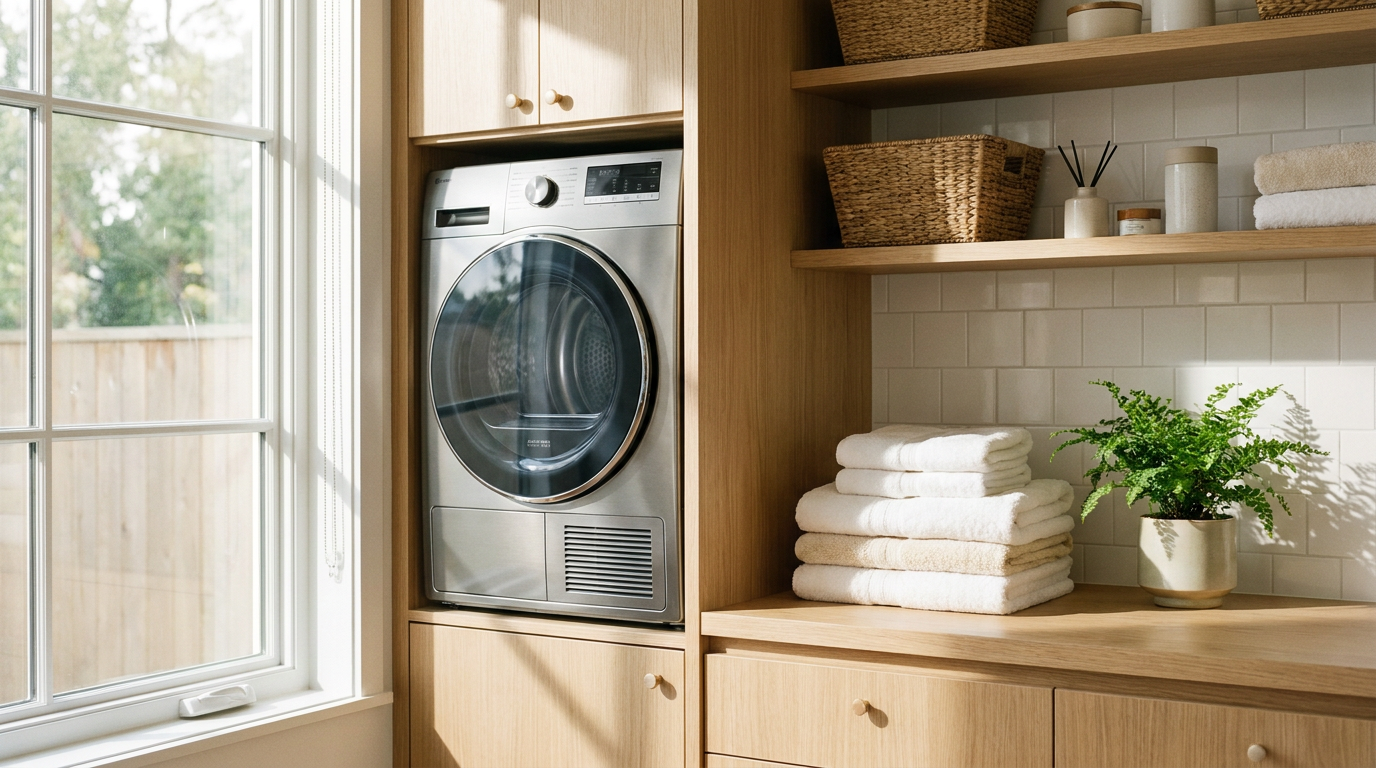
Beyond the utility bill, the ventless design offers unprecedented flexibility for home layouts. Because there is no need to run a four-inch exhaust duct to the exterior of the building, a heat pump dryer can be installed anywhere with a standard electrical outlet and a water drain. They are increasingly being placed in primary bedroom closets, hallway alcoves, and high-rise apartments where exterior venting is structurally impossible.[5][7]
The technology also profoundly changes how fabrics are treated. Traditional dryers often bake clothes at temperatures exceeding 170 degrees Fahrenheit, which breaks down elastic, shrinks cottons, and accelerates the shedding of microplastics. Heat pump dryers operate at much lower temperatures, typically between 120 and 140 degrees Fahrenheit.[5][8]
This gentler, cooler drying environment is significantly better for garment longevity. Delicate fabrics, wools, and activewear that would normally require air-drying can safely tumble in a heat pump unit without the risk of severe shrinkage or heat damage. The clothes emerge feeling soft and completely dry, rather than stiff and overheated.[6][8]
The technology has also enabled the rise of the 110-volt all-in-one washer-dryer combo, a massive trend in recent years. Because the heat pump drying mechanism requires so little electricity, manufacturers have successfully combined a front-load washer and a heat pump dryer into a single drum that plugs into a standard wall outlet. Users can put dirty clothes in before work and return home to clean, dry laundry without ever transferring a load.[1]

However, the transition to heat pump technology does come with distinct trade-offs that consumers must navigate. The most immediate hurdle is the upfront cost. Heat pump dryers typically carry a premium of $400 to $650 over their traditional vented counterparts. While energy savings and state rebates often offset this premium over the appliance's lifespan, the initial sticker shock remains a barrier for budget-conscious buyers.[1][5][6]
Time is another factor. Because heat pump dryers rely on lower temperatures and dehumidification rather than brute-force heat, the drying cycles are noticeably longer. A standard load that might take 45 minutes in a vented dryer will typically take 90 to 120 minutes in a heat pump model. For large families accustomed to rapid-fire laundry days, this slower pace requires an adjustment in household routines.[5][6]
Maintenance requirements are also slightly more involved. While all dryers require lint trap cleaning, heat pump models feature a secondary filter to protect the delicate evaporator and condenser coils from dust. This secondary filter must be cleaned regularly—usually once a month—to maintain the machine's efficiency and prevent the coils from clogging.[1][5]
Despite these adjustments, the environmental and economic momentum is firmly behind heat pump technology. As building codes increasingly prioritize airtight, energy-efficient home construction, punching a hole in the wall for a dryer vent is becoming an obsolete practice. By adopting the heat pump dryer, consumers are not just upgrading an appliance; they are closing a major loophole in their home's energy envelope.[7]
How we got here
1997
The first heat pump clothes dryer is invented and introduced in Switzerland, beginning a slow adoption across Europe.
2014
Heat pump dryers are introduced to the United States market for the first time, initially as niche, compact models.
2024
Major appliance brands launch full-size, 110-volt heat pump washer-dryer combos, sparking widespread consumer interest in the US.
Jan 2025
The European Union officially bans the production of new vented tumble dryers, cementing heat pump technology as the standard.
Viewpoints in depth
Energy Efficiency Advocates
Focus on the massive reduction in household carbon footprints and grid strain.
Environmental and energy policy experts view the heat pump dryer as a critical piece of the home electrification puzzle. Because traditional dryers are such massive energy sinks, transitioning millions of households to heat pump models can drastically reduce peak load demands on local power grids. Furthermore, by eliminating the exhaust vent, these appliances prevent conditioned indoor air from being blown outside, which indirectly lowers the energy burden on the home's heating and cooling systems.
Appliance Technicians
Emphasize the importance of regular maintenance and the complexity of repairs.
Repair professionals acknowledge the superior efficiency of heat pump dryers but caution consumers about their complexity. Unlike a traditional dryer, which relies on a simple, easily replaceable heating element, a heat pump dryer contains a sealed refrigeration system with a compressor and coils. If the secondary lint filters are neglected, dust can coat the evaporator coils, severely degrading performance and leading to costly service calls. Technicians stress that buyers must commit to the monthly maintenance routine to realize the appliance's promised lifespan.
High-Volume Households
Express concern over longer cycle times and the pace of laundry day.
For large families or households that generate multiple loads of laundry per day, the slower drying times of heat pump technology can be a logistical bottleneck. Because cycles can take up to two hours, the washer often finishes long before the dryer is ready for the next load. These users sometimes prefer the brute-force speed of traditional vented gas or electric dryers, prioritizing rapid turnaround over long-term energy savings.
What we don't know
- How the long-term reliability and repair costs of the sealed refrigeration systems will compare to traditional dryers over a 15-year lifespan.
- Whether the upfront cost of heat pump dryers will eventually drop to match traditional vented models as manufacturing scales up.
Key terms
- Heat Pump
- A device that transfers thermal energy from one place to another using a refrigeration cycle, rather than generating heat directly.
- Evaporator Coil
- The cold part of the refrigeration loop where warm, moist air is cooled, causing the water to condense and separate from the air.
- Condenser Coil
- The hot part of the refrigeration loop that reheats the newly dehumidified air before it is sent back into the dryer drum.
- Closed-Loop System
- A mechanism that continuously recycles the same air within the machine, rather than pulling in fresh air and exhausting it outside.
- Ventless Dryer
- A dryer that does not require an exhaust duct to the outside of the building, relying instead on condensation to remove moisture.
Frequently asked
Do heat pump dryers need a vent?
No. Heat pump dryers are completely ventless. They extract moisture into a collection tank or pump it directly into a drain line, meaning they can be installed anywhere in a home.
How much longer do they take to dry clothes?
A heat pump dryer typically takes 90 to 120 minutes for a standard load, compared to 45 to 60 minutes for a traditional vented dryer.
Do they heat up the room they are in?
While they do emit a small amount of ambient warmth, they do not exhaust hot, humid air into the room like an older condenser dryer would. The system is self-contained.
Are they safe for delicate clothes?
Yes. Because they operate at lower temperatures (around 120 to 140 degrees Fahrenheit), they are much gentler on fabrics, reducing shrinkage and wear.
Sources
Source coverage
8 outlets
4 viewpoints surfaced








[1]Yale ApplianceAppliance Technicians
Vented vs Condenser vs Heat Pump Dryers (2025): Real Costs, Pros & Trade-Offs
Read on Yale Appliance →[2]New York State Energy Research and Development AuthorityEnergy Efficiency Advocates
Everything You Need to Know About Heat Pump Clothes Dryers
Read on New York State Energy Research and Development Authority →[3]Massachusetts Clean Energy CenterEnergy Efficiency Advocates
Heat Pump Clothes Dryers: Ventless Convenience and Energy Efficiency
Read on Massachusetts Clean Energy Center →[4]SlipstreamEnergy Efficiency Advocates
Field Monitoring of Heat Pump Clothes Dryers
Read on Slipstream →[5]East Coast ApplianceHigh-Volume Households
Pros & Cons of Heat Pump Dryers
Read on East Coast Appliance →[6]JoycesRetailers & Manufacturers
The Future of Laundry: Advantages and Disadvantages of Heat Pump Dryers
Read on Joyces →[7]PalmettoRetailers & Manufacturers
What Is a Heat Pump Dryer and Are They Worth It?
Read on Palmetto →[8]Bosch Home AppliancesRetailers & Manufacturers
Why Choose a Heat Pump Tumble Dryer?
Read on Bosch Home Appliances →


Every angle. Every day.
Get shopping stories with full source coverage and perspective breakdowns delivered to your inbox.