
From Niche to Norm: How Zero-Waste Kitchens Are Reshaping the Restaurant Industry
Driven by economic pressures and consumer demand, the restaurant industry is rapidly adopting zero-waste practices and regenerative sourcing. Highlighted by the 2026 James Beard Awards, sustainability has become a core metric for culinary and financial success.
By Factlen Editorial Team
- Climate-Conscious Chefs
- Chefs who view sustainability as a moral imperative and the future of culinary arts.
- Industry Analysts
- Financial and market experts who view zero-waste practices through the lens of margin protection.
- Restaurant Tech Providers
- Innovators who argue that true sustainability is impossible without advanced data and hardware.
- Sustainability Advocates
- Focus on the broader environmental impact, urging a complete shift to circular economies in hospitality.
What's not represented
- · Small-scale farmers navigating the increased demand for regenerative produce
- · Back-of-house staff adapting to the increased labor required for zero-waste prep
Why this matters
As restaurants overhaul their supply chains to eliminate waste, diners can expect menus that creatively utilize whole ingredients and support climate-friendly farming. This shift not only reduces the hospitality sector's massive environmental footprint but also helps local eateries survive in a high-inflation economy.
Key points
- The 2026 James Beard Awards heavily highlighted chefs focused on climate change and regenerative agriculture.
- Economic pressures and inflation are driving restaurants to adopt zero-waste cooking to maximize ingredient yield and protect margins.
- A 2026 industry survey found that 80% of UK restaurant owners are prioritizing sustainable and ethical sourcing.
- Consumer demand is accelerating the trend, with 91% of diners preferring businesses that actively reduce food waste.
- Artificial intelligence and smart refrigeration are becoming essential tools for predicting demand and preventing ingredient spoilage.
The traditional restaurant model is notoriously resource-intensive, operating on razor-thin margins while historically generating massive amounts of food waste. But in 2026, the culinary landscape is undergoing a profound transformation. Driven by a combination of economic pressure, technological advancement, and shifting consumer values, the industry is rapidly embracing a "zero-waste" ethos.[7]
This shift was unmistakably clear at the 2026 James Beard Awards, held on June 15 in Chicago. Often dubbed the Oscars of the food world, the ceremony served as a bellwether for the industry's new priorities. Climate-conscious cooking and regenerative sourcing were not relegated to side categories; they were the main event.[1][6]
A standout moment occurred when Taylor Montgomery of Montgomery Sky Farm won the award for Best Chef: Southeast. In a powerful statement of purpose, Montgomery accepted his award surrounded by 15 of his farm employees. His acceptance speech focused entirely on the urgent need for chefs to combat food waste and actively participate in climate change mitigation.[1]
This high-profile recognition reflects a broader, systemic movement across the hospitality sector. "Zero-waste" has officially transitioned from a niche marketing slogan into a vital business metric. Kitchens are no longer just tracking sales; they are meticulously measuring their environmental footprint and ingredient utility.[5]

The economic realities of 2026 are a major catalyst for this change. According to a recent analysis by McKinsey & Company, persistent inflation and economic uncertainty continue to squeeze restaurant margins. Diners are becoming more budget-conscious, forcing operators to find creative ways to balance affordability with profitability.[2]
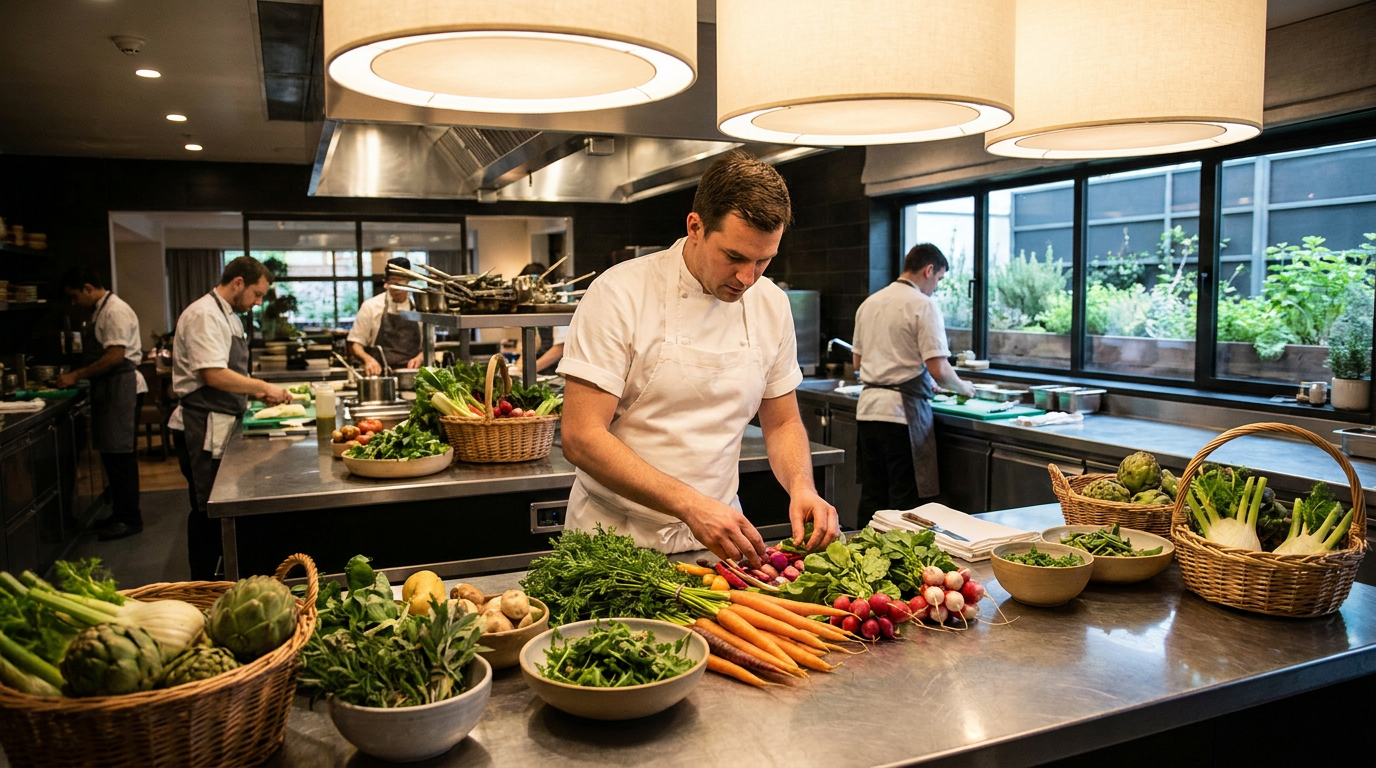
To survive and thrive, chefs are turning to "root-to-stem" and "nose-to-tail" cooking methodologies. These practices maximize the yield of every single ingredient that enters the kitchen. Instead of discarding vegetable scraps, kitchens are upcycling them into rich broths, while fruit peels are fermented into high-value cocktail syrups.[4][5]
Leftover bread, once a major source of daily waste, is now routinely transformed into creative desserts or house-made misos. By extracting multiple uses from a single purchase, restaurants can significantly lower their cost of goods sold, insulating themselves against volatile commodity prices.[4]
Industry data underscores the speed of this adoption. A 2026 survey conducted by Expert Market revealed that a staggering 80% of restaurant owners are now prioritizing sustainable and ethical sourcing above traditional menu trends. The shift is no longer confined to high-end gastronomy; it is permeating fast-casual chains and local independents.[3]
The shift is no longer confined to high-end gastronomy; it is permeating fast-casual chains and local independents.
Consumer demand is the other powerful engine driving this transition. Diners are more educated than ever about the environmental impact of their food choices. Data from GloriaFood indicates that 91% of customers now actively prefer to patronize businesses that are demonstrably working to reduce food waste.[4]

Crucially, this demographic is willing to put its money where its values are. Analysts note that climate-conscious consumers are often willing to pay a "sustainability premium" of around 10% for meals that align with their ethical standards. In a challenging economic environment, this premium offers a rare and valuable opportunity for margin protection.[3]
Technology is playing an indispensable role in enabling these green operations. Artificial intelligence is no longer a futuristic concept but a quiet, essential piece of kitchen infrastructure. AI-driven inventory management systems are now capable of predicting customer demand with remarkable accuracy, drastically reducing the over-ordering that leads to spoilage.[5]
Smart refrigeration and IoT-enabled appliances are also standardizing waste prevention. Modern commercial fridges feature predictive maintenance sensors that can detect temperature fluctuations or failing compressors before they break, saving thousands of dollars in delicate, high-cost ingredients.[5]
The zero-waste movement is simultaneously redefining the concept of plant-based dining. Moving away from the highly processed meat substitutes that dominated the early 2020s, chefs are now focusing on whole-food, regenerative ingredients. Menus are highlighting items like mushroom scallops and carrot salmon, celebrating the natural versatility of vegetables.[7]
Sourcing strategies have also evolved, with "regenerative agriculture" becoming the new gold standard. Restaurants are increasingly partnering with farms that go beyond organic certification to actively restore soil health, improve local biodiversity, and capture atmospheric carbon.[7]

Pioneers of this movement, such as London's Silo—widely cited as the world's first zero-waste restaurant—have spent years proving that a fully circular hospitality model is viable. Their early experiments with on-site composting, direct-trade sourcing, and eliminating single-use packaging have provided a blueprint that larger hospitality groups are now scaling.[3]
Challenges certainly remain. Transitioning to a zero-waste model requires significant upfront investment, from overhauling established supply chains to training staff in advanced preservation techniques like fermentation and curing.[5][7]
How we got here
2014
Silo opens in the UK, widely recognized as the world's first zero-waste restaurant, proving the circular model's viability.
2020-2023
Pandemic-era supply chain disruptions force restaurants to streamline menus and rethink ingredient sourcing.
2024-2025
Inflation and rising food costs accelerate the adoption of waste-reduction technologies to protect shrinking profit margins.
June 2026
The James Beard Awards heavily feature climate-conscious chefs, cementing sustainability as a hallmark of culinary excellence.
Viewpoints in depth
Climate-Conscious Chefs
Chefs who view sustainability as a moral imperative and the future of culinary arts.
For this vanguard of the culinary world, reducing waste is not merely a cost-saving measure; it is a fundamental responsibility. Chefs championing this viewpoint argue that the traditional restaurant model is inherently extractive and unsustainable. By embracing root-to-stem cooking and partnering directly with regenerative farms, they aim to prove that fine dining can actively heal the food system rather than deplete it. They frequently use their platforms, such as the James Beard Awards, to advocate for systemic change and transparency in sourcing.
Industry Analysts
Financial and market experts who view zero-waste practices through the lens of margin protection.
Market analysts emphasize the stark economic realities driving the sustainability trend. With persistent inflation, rising labor costs, and volatile commodity prices, traditional restaurant margins are under severe pressure. From this perspective, zero-waste operations and AI-driven inventory management are essential survival tactics. By maximizing the yield of every purchased ingredient and capitalizing on the 'sustainability premium' that climate-conscious diners are willing to pay, restaurants can protect their bottom line in a challenging macroeconomic environment.
Restaurant Tech Providers
Innovators who argue that true sustainability is impossible without advanced data and hardware.
Technology providers argue that good intentions are not enough to eliminate food waste at a commercial scale. They posit that the complexities of a modern kitchen require artificial intelligence and IoT-enabled hardware to truly optimize operations. By deploying predictive ordering algorithms and smart refrigeration systems that prevent spoilage before it happens, these providers believe that technology is the critical bridge between a restaurant's sustainable ideals and its practical, day-to-day execution.
What we don't know
- Whether the 'sustainability premium' consumers are currently willing to pay will hold up if macroeconomic conditions worsen.
- How quickly independent, lower-margin restaurants can afford the upfront technology investments required for AI inventory tracking.
Key terms
- Root-to-stem cooking
- A culinary philosophy that utilizes every edible part of a plant, including leaves, stems, and peels, to minimize waste.
- Circular economy
- An economic system aimed at eliminating waste and the continual use of resources, often applied in restaurants through composting and upcycling.
- Regenerative agriculture
- Farming practices designed to reverse climate change by rebuilding soil organic matter and restoring degraded soil biodiversity.
- Sustainability premium
- The additional amount of money consumers are willing to pay for products or services that align with their environmental and ethical values.
- Dark kitchen
- A delivery-only restaurant model that operates without a traditional dining room, often utilizing highly efficient, modular kitchen designs.
Frequently asked
What is a zero-waste restaurant?
A zero-waste restaurant aims to eliminate food and material waste entirely. This involves using every part of an ingredient (like vegetable peels for broth), composting, and eliminating single-use plastics.
How does AI help reduce food waste?
AI-driven inventory systems predict customer demand with high accuracy, ensuring restaurants only order the ingredients they actually need, which drastically cuts down on spoilage.
What is regenerative agriculture?
Regenerative agriculture goes beyond organic farming by actively restoring soil health, improving biodiversity, and capturing carbon from the atmosphere.
Are zero-waste practices profitable for restaurants?
Yes. While there are upfront costs, maximizing the yield of every ingredient and reducing disposal fees helps protect profit margins, especially during periods of high inflation.
Sources
Source coverage
7 outlets
4 viewpoints surfaced







[1]ForbesClimate-Conscious Chefs
2026 James Beard Awards: Restaurant And Chef Winners
Read on Forbes →[2]McKinsey & CompanyIndustry Analysts
Restaurant industry trends to watch in 2026
Read on McKinsey & Company →[3]Expert MarketIndustry Analysts
Sustainability & Ethical Sourcing To Dominate Restaurant Industry in 2026
Read on Expert Market →[4]GloriaFoodRestaurant Tech Providers
8 Restaurant Sustainability Trends in 2026
Read on GloriaFood →[5]Just RefrigerationRestaurant Tech Providers
Zero-Waste as a Business Metric in 2026
Read on Just Refrigeration →[6]Fine Dining LoversClimate-Conscious Chefs
The James Beard Foundation Announces 2026 Winners
Read on Fine Dining Lovers →[7]Factlen Editorial TeamSustainability Advocates
Synthesis by Factlen editorial team
Read on Factlen Editorial Team →

Every angle. Every day.
Get food drink stories with full source coverage and perspective breakdowns delivered to your inbox.