
France Captain Alexis Gilme Completes Remarkable ACL Recovery to Lead Team at 2026 Beach Handball World Championship
After delaying surgery to secure his team's qualification, French beach handball captain Alexis Gilme has successfully returned to the sand, guiding France to the main round in their World Championship debut. His comeback highlights evolving approaches to ACL rehabilitation in elite handball.
By Factlen Editorial Team
- Sports Medicine Researchers
- Advocate for rigorous post-operative screening and caution against premature returns.
- Players & Team Management
- Prioritize tournament qualification and competitive readiness, sometimes taking calculated medical risks.
- Sports Analysts
- Focus on the on-court impact of returning stars and the tactical shifts required to accommodate them.
What's not represented
- · Orthopedic Surgeons
- · Opposing Team Coaches
Why this matters
Anterior cruciate ligament (ACL) tears are among the most devastating injuries in handball, often ending careers or causing permanent deficits. Gilme’s calculated risk to play through the rupture, followed by a successful surgical recovery, offers a blueprint for injury management and resilience in high-impact sports.
Key points
- France captain Alexis Gilme successfully returned to the court at the 2026 IHF Men's Beach Handball World Championship after ACL surgery.
- Gilme originally ruptured his ACL in early 2025 but delayed surgery to help France qualify for the World Championship.
- France secured 2-0 victories over Australia and Oman to advance to the main round in their tournament debut.
- Recent sports medicine studies highlight that over a third of elite handball players face ACL reinjury risks upon returning to play.
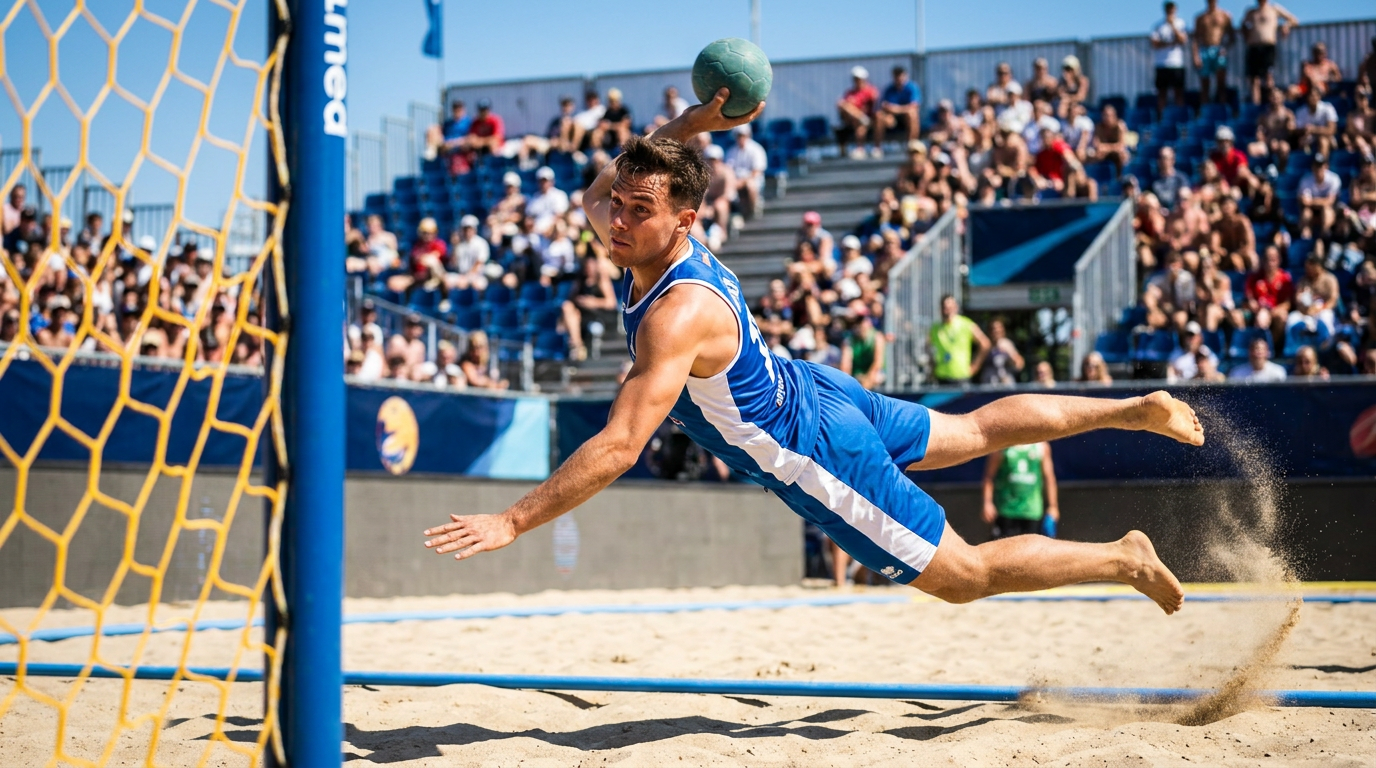
Alexis Gilme's return to the sand in Zagreb this week marks the culmination of a grueling, high-stakes medical gamble. The captain of the French men's beach handball team led his squad onto the court for their debut at the 2026 IHF Men's Beach Handball World Championship, just months after undergoing reconstructive surgery on his anterior cruciate ligament (ACL).[1]
The ordeal began in early 2025 when Gilme ruptured his ACL just two months before the EHF Beach Handball EURO in Turkiye. Faced with the prospect of missing the tournament that served as the sole qualifier for the World Championship, Gilme made an unconventional choice: he deferred surgery.[1]
Playing through the instability of a torn ACL, Gilme relied on intense, accelerated rehabilitation to strengthen his surrounding leg musculature. His leadership proved vital as France shattered their previous continental ranking of 13th, finishing in fifth place and securing their historic ticket to the global stage in Croatia.[1]
Immediately following the European Championship, Gilme finally went under the knife. The timing left him with a tight window to recover for the June 2026 World Championship, requiring a meticulously planned rehabilitation protocol to ensure he would be ready for the grueling demands of the sand.[1][7]

The stakes of ACL recovery in elite handball are notoriously high. A May 2026 study published in the Journal of Human Sport and Exercise tracked elite handball players for 24 months post-ACL reconstruction. The researchers found that athletes often return to high-level competition despite incomplete neuromuscular recovery, leading to an alarming 35.3% reinjury rate.[2]
Furthermore, a June 2026 systematic review in MDPI Sports emphasized that technical and muscular deficits—rather than direct opponent contact—are the primary triggers for severe knee injuries in the sport, making rigorous post-operative screening and biomechanical retraining essential.[3]

Against these medical odds, Gilme's rehabilitation was a resounding success. He arrived in Zagreb fully cleared to play, anchoring a young French squad that ranks as the second youngest in the men's tournament.[1]
Against these medical odds, Gilme's rehabilitation was a resounding success.
The on-court impact of his return was immediate. In the preliminary group stage at Lake Jarun, France secured decisive 2-0 victories over both Australia (24:14, 23:19) and Oman (20:18, 23:18).[1]
Although they dropped their final group game to host nation Croatia, the two dominant wins were more than enough to propel the debutants into the main round of the competition.[1]
Gilme's journey underscores a broader shift in how elite handball players manage severe injuries. While some players, like Aalborg's Marinus Munk, opt for immediate minor procedures to address acute issues mid-season, the management of catastrophic ligament tears requires a delicate balance between immediate team needs and long-term joint health.[6][7]

The European Handball Federation has increasingly focused on this balance, recently releasing comprehensive injury prevention manuals designed to help athletes integrate targeted neuromuscular exercises into their micro-cycles to prevent the very injuries Gilme had to overcome.[4]
For Gilme, who transitioned from an indoor career to beach handball while earning degrees in Sports Science and Sports Management, the scientific approach to his own recovery paid dividends on the world stage.[1]
"We have a very young team, but with my experience... I have to help for the mentality, in the games, playing good and helping the young generation," Gilme noted in Zagreb, reflecting on his role as both a tactical leader and a physical anchor.[1]
How we got here
Early 2025
Alexis Gilme ruptures his ACL two months before the EHF Beach Handball EURO.
Mid 2025
Gilme plays the European Championship without surgery, helping France finish fifth and qualify for the World Championship.
Late 2025
Gilme undergoes ACL reconstruction surgery immediately after the EURO.
June 2026
Gilme returns to the court, leading France to the main round at the IHF Men's Beach Handball World Championship in Zagreb.
Viewpoints in depth
Sports Medicine Researchers
Focusing on the long-term joint health and the risks of returning to play with neuromuscular deficits.
Medical professionals emphasize that while playing through a torn ACL is possible with intense muscular compensation, it carries significant risks. Studies published in 2026 highlight that even after surgery, over a third of elite handball players suffer reinjuries due to persistent asymmetries in quadriceps and hamstring strength. Researchers advocate for strict, objective performance-based criteria before athletes are cleared for high-level competition.
National Team Management
Balancing immediate tournament qualification goals with the long-term availability of key players.
For federations and coaching staffs, a captain's availability can be the difference between qualifying for a World Championship and missing out entirely. Management often works closely with players to weigh the risks of delaying surgery. In France's case, Gilme's presence at the 2025 EURO was deemed critical for securing their debut World Championship berth, justifying the delayed surgical intervention.
What we don't know
- Whether Gilme will experience any long-term neuromuscular deficits as his career progresses.
- How the young French squad will fare against more established beach handball nations in the later stages of the tournament.
Key terms
- Anterior Cruciate Ligament (ACL)
- A key ligament in the knee that provides rotational stability, frequently injured in sports requiring sudden changes of direction.
- Neuromuscular Deficits
- Imbalances or weaknesses in the communication between the nervous system and muscles, often persisting after surgery and increasing reinjury risk.
- Main Round
- The second group stage of a handball tournament, which teams advance to after successfully navigating the preliminary group.
Frequently asked
Did Alexis Gilme play with a torn ACL?
Yes. He delayed his reconstructive surgery to play in the 2025 EHF EURO, relying on intense rehabilitation to stabilize his knee and help France qualify.
How did France perform at the 2026 World Championship?
In their debut appearance, France defeated Australia and Oman in the preliminary group stage to advance to the main round.
What is the reinjury risk for handball players after ACL surgery?
A May 2026 study found that 35.3% of elite handball players experience an ACL reinjury after returning to play, often due to incomplete neuromuscular recovery.
Sources
Source coverage
7 outlets
3 viewpoints surfaced







[1]International Handball FederationPlayers & Team Management
France captain Alexis Gilme is living his dream in Zagreb
Read on International Handball Federation →[2]Journal of Human Sport and ExerciseSports Medicine Researchers
Persistent neuromuscular deficits and injury risk after return to play: A 24-month prospective follow-up in elite handball players following ACL reconstruction
Read on Journal of Human Sport and Exercise →[3]MDPI SportsSports Medicine Researchers
Preseason Screening Tests and Physical Assessments as Predictors of Injury in Handball Players: A Systematic Review
Read on MDPI Sports →[4]European Handball FederationSports Medicine Researchers
Injury Prevention Manual
Read on European Handball Federation →[5]Handball PlanetPlayers & Team Management
The OFF season begins, and in it we will still hear the echo of the final weekends of June 2026
Read on Handball Planet →[6]FlashscoreSports Analysts
Danish international from Aalborg forced to undergo surgery after clash against Sporting
Read on Flashscore →[7]Factlen Editorial TeamSports Analysts
Synthesis by Factlen editorial team
Read on Factlen Editorial Team →

More in sports
See all 29 stories →Standings
The Race for Number One: How the New GAMX System is Reshaping Global Weightlifting Standings
7 sources

MLS Transfers
Robert Lewandowski Agrees to Join Chicago Fire in Landmark MLS Transfer
4 sources

Injury
Global Fencing Injury Report: Kiefer's Recovery, Gilliver's Return, and Cannone's Mental Health Break
7 sources

Standings
The Ultimate Men's Foil Showdown: Italy, Japan, and USA Deadlocked Atop FIE Standings
8 sources
Every angle. Every day.
Get sports stories with full source coverage and perspective breakdowns delivered to your inbox.