
Why Neurologists Are Prescribing Tai Chi to Prevent Falls and Protect Aging Brains
Recent clinical trials and AI-guided research are cementing Tai Chi as a frontline medical intervention for older adults, proving the ancient martial art can significantly reduce fall risk and slow cognitive decline.
By Factlen Editorial Team
- Geriatric Researchers
- Focus on the biomechanical and neurological mechanisms that make mind-body exercises effective for aging populations.
- Public Health Officials
- Prioritize scalable, cost-effective interventions to reduce the massive systemic burden of fall-related injuries.
- Integrative Medicine Advocates
- Champion the blending of traditional holistic practices with modern clinical validation.
What's not represented
- · Insurance Providers evaluating reimbursement models
- · Traditional Tai Chi Masters concerned about the clinical reduction of the art
Why this matters
Falls are a leading cause of fatal and non-fatal injuries among older adults, costing the U.S. healthcare system billions annually. Validating an accessible, low-impact intervention like Tai Chi gives seniors a proven tool to maintain their independence and cognitive health without relying solely on pharmaceuticals.
Key points
- Tai Chi is increasingly being prescribed by neurologists and physical therapists to prevent falls in older adults.
- Dementia patients face a three times higher risk of falling, making dual-action physical and cognitive interventions critical.
- Recent clinical trials demonstrate that Tai Chi significantly improves dynamic balance, mobility, and executive cognitive function.
- Researchers are using AI and motion tracking to distill the martial art into optimized, 8-minute daily clinical routines.
- The practice reduces the psychological fear of falling, encouraging seniors to maintain their independence and activity levels.
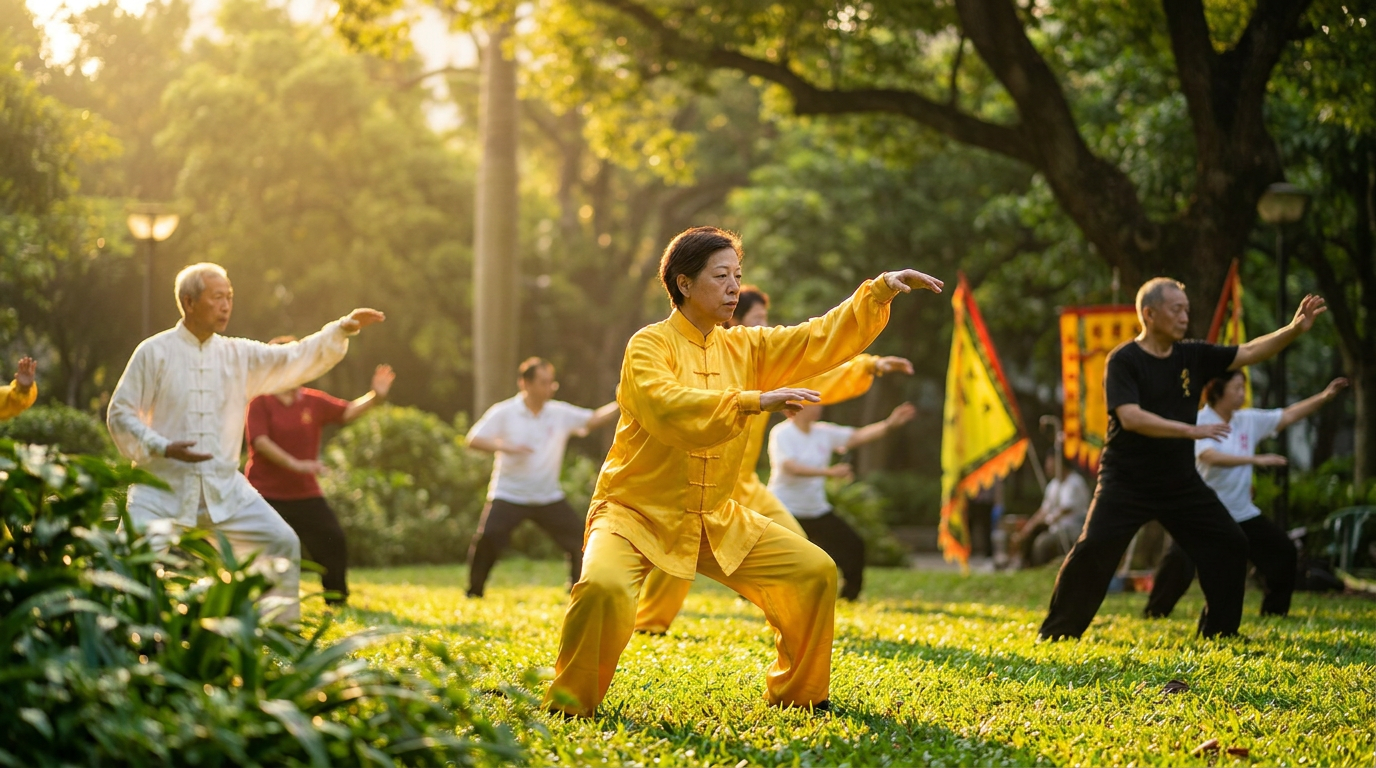
The quiet revolution in geriatric medicine isn't a new pharmaceutical breakthrough or a high-tech surgical procedure. It is a 17th-century Chinese martial art characterized by slow, deliberate, animal-inspired movements. Across the United States, neurologists, physical therapists, and geriatricians are increasingly writing prescriptions for Tai Chi, moving the practice out of community center recreation rooms and into the center of evidence-based clinical care. This shift represents a profound acknowledgment by the Western medical establishment that holistic, mind-body interventions can deliver measurable, life-saving physiological results for aging populations. The stakes driving this clinical shift are enormous. According to the Centers for Disease Control and Prevention (CDC), falls are a leading cause of fatal and non-fatal injuries among older Americans, triggering a cascade of health crises that often end in a permanent loss of independence. The financial toll on the healthcare infrastructure is equally staggering; in Texas alone, falls among older adults cost the medical system an estimated $2.4 billion annually. Finding a scalable, low-cost intervention is no longer just a wellness goal—it is an urgent public health imperative.[5][6]
For individuals living with Alzheimer's disease or early cognitive decline, the danger of falling is severely magnified. Dementia patients are up to three times more likely to suffer a severe fall than those without cognitive impairment, as their brains struggle to process spatial awareness and react to environmental hazards. This dangerous intersection of physical frailty and cognitive vulnerability has sent researchers scrambling for interventions that can address both the body and the brain simultaneously, rather than treating them as isolated systems. Enter Tai Chi. Long categorized as a complementary or alternative medicine, the practice is now backed by a mountain of rigorous, peer-reviewed clinical data. A January 2026 systematic review and meta-analysis published in the journal Frontiers in Public Health evaluated dozens of randomized controlled trials, concluding that Tai Chi significantly improves dynamic balance, walking speed, and fall-prevention confidence in healthy older adults. The data proved so compelling that researchers recommended it as a primary preventive strategy for the aging population.[1][3]

But the most groundbreaking discoveries involve how Tai Chi actively affects the brain. A November 2025 randomized controlled trial published in Clinical Interventions in Aging tracked 135 community-dwelling older adults over a comprehensive 12-week period. The researchers found that structured Tai Chi programs yielded significant improvements not just in physical mobility metrics—such as the standard 'Timed Up and Go' test—but also in cognitive function assessments, demonstrating a clear neuroprotective effect. The mechanism behind this dual benefit lies in the fundamental nature of the exercise itself. Tai Chi is a true 'mind-body' practice that requires immense focus, spatial awareness, and memory to execute the curated sequences of forms. Unlike walking on a treadmill or riding a stationary bike, which can quickly become automatic, passive activities, Tai Chi forces the brain to actively map the body's position in space while continuously shifting weight from one leg to the other.[2][4]
"The hypothesis is that if people with dementia learn how to challenge their balance, then they begin to get used to that challenging environment," researchers at the University of Texas Health Science Center at San Antonio (UT Health San Antonio) explained. When these active motor-learning skills translate into daily activities—like navigating a cluttered living room or stepping off a curb—the risk of a catastrophic fall drops significantly. To maximize these clinical benefits, modern medical science is giving the ancient art a high-tech upgrade. At UT Health San Antonio, researchers are currently blending Tai Chi with artificial intelligence to create a personalized, AI-guided therapy specifically tailored for people with Alzheimer's disease and related dementias. This project aims to strip away the intimidating complexity of traditional martial arts training and deliver a highly optimized, medical-grade intervention.[1]
To maximize these clinical benefits, modern medical science is giving the ancient art a high-tech upgrade.
The UT Health San Antonio biomechanics lab utilizes advanced markerless motion tracking technology and biomechanical modeling to study exactly how specific Tai Chi forms affect gait, joint load, and dynamic balance. By isolating the most biomechanically effective movements, they are able to distill centuries of martial arts tradition into highly targeted, evidence-based clinical interventions that deliver maximum benefit with minimal physical strain. The results of this targeted, data-driven approach are highly encouraging for both patients and providers. Studies have shown that even eight minutes a day of optimized, AI-curated Tai Chi can produce significant physiological responses, improving lower-limb strength, dynamic balance, and executive cognitive function without exhausting the patient.[1]

This efficiency is absolutely crucial for long-term patient compliance. By narrowing the practice to a curated set of movements, the clinical program provides comparable physiological outcomes to longer, more demanding routines. This makes the intervention vastly more accessible for individuals dealing with the chronic fatigue, joint pain, and cognitive confusion often associated with advancing dementia. Furthermore, the AI-powered mobile application being developed by the San Antonio team evaluates a patient's specific health data and mobility limitations to "prescribe" tailored routines. This level of personalization represents a massive leap forward in the field of alternative medicine, successfully bridging the gap between holistic wellness philosophies and the rigorous demands of precision healthcare.[1][6]
The clinical integration of Tai Chi also addresses a critical, often-overlooked gap in fall prevention: the psychological fear of falling. The recent Frontiers meta-analysis highlighted that older adults who practice Tai Chi experience a marked reduction in their fear of movement. This psychological shift is vital, as fear often leads seniors to severely restrict their physical activity, which paradoxically accelerates muscle atrophy and increases their actual risk of suffering a fall. By safely challenging their balance in a controlled, low-impact environment, participants rebuild their physical confidence and reclaim their independence. The gentle, continuous nature of the movements ensures that the joints are not overstressed, making Tai Chi an ideal intervention even for those managing severe osteoarthritis or long-term mobility disabilities who cannot participate in traditional strength training.[3][4]

The cognitive benefits extend beyond just fall prevention. Researchers studying mild cognitive impairment (MCI) have noted that the meditative breathing and focused attention required in Tai Chi lower cortisol levels and reduce systemic inflammation, both of which are known contributors to neurodegeneration. By engaging multiple cognitive domains simultaneously—including visuospatial processing, sustained attention, and episodic memory—Tai Chi acts as a comprehensive workout for the aging brain. This multimodal stimulation is proving to be far more effective at preserving neural plasticity than isolated brain-training games or passive physical therapies, offering a beacon of hope for families navigating the early stages of dementia.[4][6]
As the clinical evidence mounts, the broader healthcare infrastructure is beginning to adapt to this new reality. While Medicare currently limits its alternative medicine coverage primarily to acupuncture for chronic lower back pain, the overwhelming data supporting Tai Chi for fall prevention is sparking serious conversations among policymakers about expanding reimbursement models to include structured mind-body therapies. Ultimately, the rise of clinical Tai Chi represents a broader, highly optimistic paradigm shift in how Western medicine approaches the aging process. Rather than viewing cognitive decline and physical frailty as separate, inevitable conditions to be managed with separate pharmaceutical regimens, researchers are embracing holistic interventions that treat the mind and body as a unified, resilient system capable of continuous adaptation.[6]
How we got here
17th Century
Tai Chi originates in China as a martial art blending animal-inspired movements with deep breathing.
Early 2000s
Western medical studies begin observing anecdotal benefits of Tai Chi for balance in older adults.
2023-2024
Major meta-analyses confirm Tai Chi's efficacy in reducing fall risk, prompting interest from geriatricians.
Late 2025
Clinical trials demonstrate that structured Tai Chi also yields significant improvements in cognitive function for patients with mild cognitive impairment.
May 2026
UT Health San Antonio launches an AI-guided study to prescribe optimized 8-minute Tai Chi routines for dementia patients.
Viewpoints in depth
Geriatric Researchers
Tai Chi's dual-action nature makes it uniquely suited to combat the interconnected decline of body and brain.
Medical researchers argue that aging cannot be treated in silos. Because Tai Chi requires both physical balance and the cognitive memorization of forms, it acts as a comprehensive workout for the aging nervous system. They point to markerless motion tracking and cognitive assessments as proof that the brain and body must be challenged simultaneously to preserve independence.
Healthcare Economists
Scalable, low-tech interventions are crucial to reducing the massive financial burden of fall-related hospitalizations.
With falls costing the U.S. healthcare system billions of dollars annually, economists emphasize the cost-saving potential of community-based or app-guided Tai Chi programs. Unlike expensive surgical interventions or long-term pharmaceutical regimens, Tai Chi requires minimal equipment and can be practiced anywhere, making it a highly scalable tool to reduce hospital admissions across diverse socioeconomic demographics.
Integrative Medicine Advocates
The clinical validation of Tai Chi proves that traditional holistic practices belong in standard allopathic care.
Advocates view the growing body of peer-reviewed evidence as a vindication of traditional Chinese medicine. They argue that the medical establishment's historical skepticism of "alternative" therapies is fading as data proves these ancient practices offer tangible, measurable benefits. They are now pushing for broader insurance reimbursement models to make mind-body therapies accessible to all patients.
What we don't know
- Whether Medicare and private insurers will universally adopt reimbursement codes for AI-guided Tai Chi therapies.
- How the long-term cognitive benefits of Tai Chi compare head-to-head with emerging pharmaceutical treatments for early-stage Alzheimer's.
- The exact minimum threshold of practice required to maintain cognitive benefits once the initial 12-week clinical interventions conclude.
Key terms
- Dynamic Balance
- The ability to remain upright and stable while moving or shifting weight, a critical factor in preventing falls.
- Markerless Motion Tracking
- A technology that uses cameras and artificial intelligence to analyze a person's movement and biomechanics without requiring them to wear physical sensors.
- Mild Cognitive Impairment (MCI)
- An early stage of memory loss or other cognitive ability loss in individuals who maintain the ability to independently perform most activities of daily living.
- Mind-Body Intervention
- Practices that focus on the interactions among the brain, mind, body, and behavior, using the mind to affect physical functioning and promote health.
Frequently asked
Do I need to learn a long, complex Tai Chi routine to see benefits?
No. Recent research indicates that even eight minutes a day of optimized, targeted Tai Chi movements can produce significant improvements in balance and cognitive function.
Is Tai Chi safe for people with arthritis or limited mobility?
Yes. Tai Chi is a low-impact exercise with gentle, continuous movements that do not overstress the joints. Seated modifications are also available for those unable to stand.
How does an exercise improve cognitive function?
Tai Chi requires active mental focus, spatial awareness, and memory to execute the specific forms, which stimulates neural pathways and improves executive function more than passive exercises like walking.
Does Medicare cover Tai Chi classes?
Currently, Original Medicare does not broadly cover Tai Chi classes, though some Medicare Advantage (Part C) plans may offer fitness benefits that include it. However, physical therapists can incorporate Tai Chi movements into covered rehabilitation sessions.
Sources
Source coverage
6 outlets
3 viewpoints surfaced






[1]UT Health San AntonioGeriatric Researchers
Blending ancient movement with AI to prevent falls in dementia patients
Read on UT Health San Antonio →[2]Clinical Interventions in AgingGeriatric Researchers
Efficacy of Tai Chi on Balance, Mobility, and Cognitive Function in Community-Dwelling Older Adults
Read on Clinical Interventions in Aging →[3]Frontiers in Public HealthGeriatric Researchers
The effects of Tai Chi on fall prevention in older adults: A systematic review and meta-analysis
Read on Frontiers in Public Health →[4]MDPIGeriatric Researchers
Tai Chi Interventions for Slowing Cognitive Decline in Mild Cognitive Impairment
Read on MDPI →[5]Centers for Disease Control and PreventionPublic Health Officials
Older Adult Fall Prevention
Read on Centers for Disease Control and Prevention →[6]Factlen Editorial TeamIntegrative Medicine Advocates
Synthesis by Factlen editorial team
Read on Factlen Editorial Team →


Every angle. Every day.
Get health stories with full source coverage and perspective breakdowns delivered to your inbox.