
Time-Restricted Eating vs. Calorie Counting: What the Latest Clinical Data Reveals
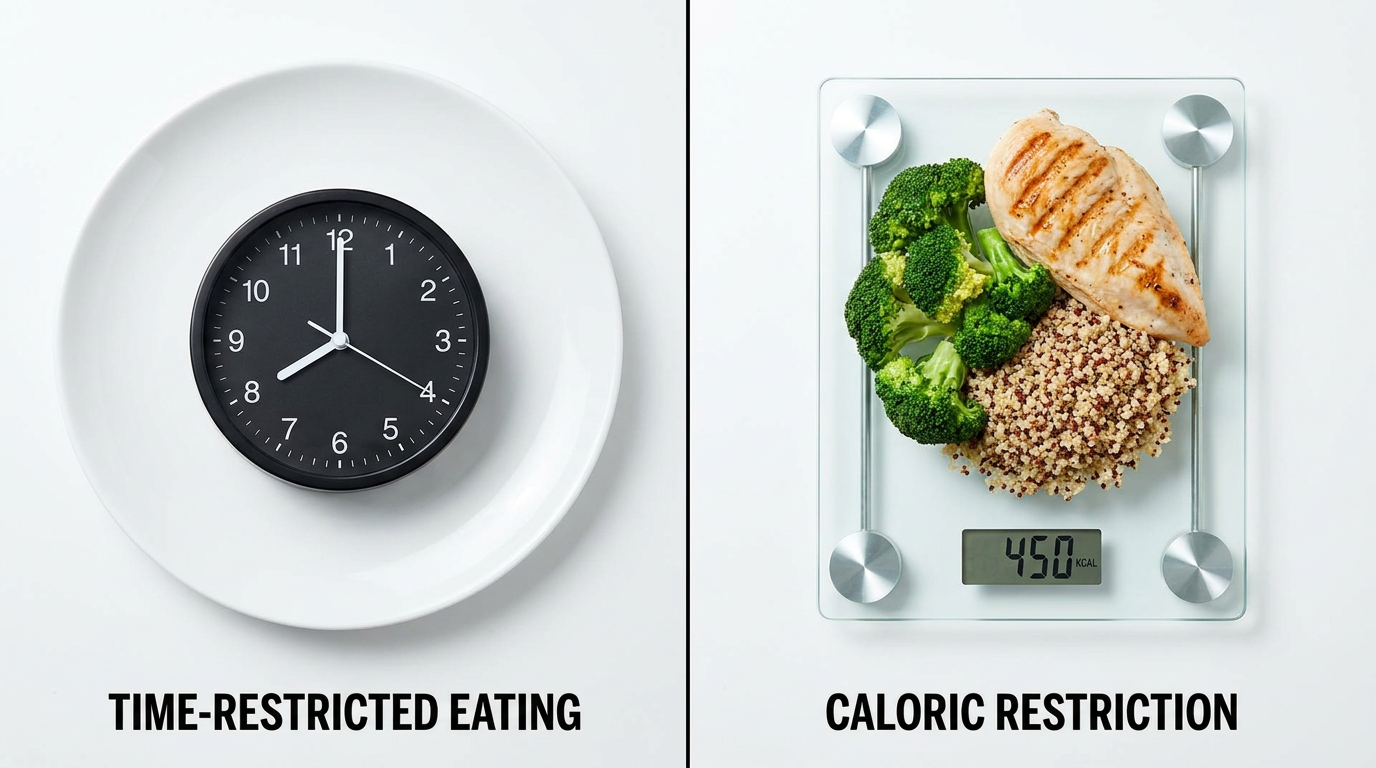
A wave of new clinical trials and meta-analyses directly compares the trade-offs of intermittent fasting against traditional daily caloric restriction, revealing that the best approach depends entirely on behavioral psychology.
By Factlen Editorial Team
- Fasting Protocol Researchers
- Focuses on the behavioral simplicity and unique metabolic adaptations of time-restricted eating.
- Evidence Synthesis Analysts
- Evaluates the aggregate data across hundreds of trials to find population-level truths.
- Energy Balance Traditionalists
- Emphasizes that total caloric deficit is the sole driver of fat loss, regardless of meal timing.
What's not represented
- · Registered Dietitians handling eating disorder recovery
- · Shift workers with irregular circadian rhythms
Why this matters
Choosing the wrong diet strategy often leads to burnout and rebound weight gain. Understanding the specific behavioral and metabolic trade-offs between fasting and calorie counting empowers you to select the method that actually fits your lifestyle and psychology.
Key points
- Both intermittent fasting and continuous caloric restriction drive weight loss primarily through a sustained energy deficit.
- Continuous restriction offers greater flexibility in food choices but carries a high psychological burden of tracking.
- Intermittent fasting simplifies decision-making but can cause social friction and intense hunger during fasting windows.
- A 2025 trial found a 4:3 fasting protocol yielded 7.6% weight loss over a year, beating daily restriction's 5.0%.
- Fasting protocols show a slight edge in improving short-term fasting insulin levels, even when weight loss is matched.
- The optimal diet depends entirely on an individual's lifestyle, psychological preferences, and metabolic health.
The fitness industry has spent the last decade debating the optimal path to weight loss, pitting the traditional method of daily calorie counting against the rising popularity of intermittent fasting. For years, the arguments relied on short-term studies and anecdotal success stories, leaving dieters confused about which approach actually yielded superior long-term results. By 2026, a wave of high-quality clinical data—including a massive Cochrane review and several landmark randomized trials—has finally provided enough evidence to directly compare the trade-offs of each approach. Rather than declaring a universal winner, the latest science reveals that the optimal diet depends entirely on an individual's psychological profile, metabolic health, and daily schedule.[2][7]
At the physiological level, both continuous caloric restriction and intermittent fasting drive weight loss through the exact same mechanism: a sustained negative energy balance. Whether a dieter reduces their intake by 500 calories every day or eliminates 2,000 calories by fasting entirely for two days a week, the thermodynamic result dictates the reduction of fat mass. The body must pull from stored energy reserves to make up the deficit. Because the underlying biology of fat oxidation remains constant, the true difference between the two strategies lies in behavioral adherence, lifestyle friction, and secondary metabolic effects that occur when insulin levels remain low for extended periods.[5][7]
The primary argument for continuous caloric restriction centers on flexibility and precision. By calculating a daily energy target and tracking intake, individuals can eat any food group at any time of day, provided they remain under their caloric ceiling. This prevents the social isolation of skipping family dinners or the physical discomfort of prolonged fasting windows. It allows for a more normalized relationship with daily meals, empowering individuals to incorporate treats or heavy carbohydrates as long as the math aligns. For many, this quantitative approach removes the guilt associated with eating, replacing it with a predictable, data-driven system.[5][6]
The argument against this traditional approach highlights the psychological burden of "diet fatigue." Tracking every macronutrient requires relentless mental math, weighing portions on a kitchen scale, and logging every snack into a smartphone app. Over months or years, this hyper-vigilance often leads to burnout. Adherence tends to plummet as dieters grow exhausted by the daily friction of monitoring their food environment. Furthermore, continuous restriction often leaves individuals in a state of chronic, low-grade hunger, which can slowly erode willpower and lead to rebound weight gain once the tracking stops. For those with busy lifestyles, the sheer administrative burden of calorie counting can make the diet feel like a second job.[1][7]

The clinical evidence for daily restriction is anchored by decades of literature, most notably the landmark CALERIE trials and the New England Journal of Medicine's TREATY study. The NEJM trial demonstrated that when total calories are strictly matched, adding a time-restricted eating window provides no additional weight loss benefit over continuous restriction alone. Both groups lost roughly 6 to 8 kilograms over 12 months, cementing daily restriction as the gold standard for predictable fat loss. The data consistently shows that if a patient can actually stick to the daily deficit, the biological results are virtually guaranteed.[5]
Both groups lost roughly 6 to 8 kilograms over 12 months, cementing daily restriction as the gold standard for predictable fat loss.
The case for intermittent fasting—whether through a 16:8 daily window or a 4:3 weekly split—centers on absolute simplicity. By using the clock as the only boundary, dieters eliminate the need to weigh food or track calories. Furthermore, proponents point to unique metabolic adaptations during fasting periods. They argue that extended periods without food allow insulin levels to drop to baseline, which signals the body to more efficiently mobilize stored fat. This binary "eating or fasting" rule removes the cognitive load of portion control, allowing individuals to eat to satiety during their feeding windows while still achieving a net caloric deficit.[1][4]
The argument against fasting models focuses on the physical and social friction of rigid eating windows. Prolonged fasting can trigger intense hunger, irritability, and a compensatory binge-eating response once the feeding window finally opens. Socially, it can be highly disruptive to skip morning brunches or late-night dinners to appease a fasting timer. Additionally, athletes and highly active individuals often struggle to consume adequate protein and fuel their training sessions when their eating opportunities are severely compressed, potentially risking the loss of lean muscle mass if their feeding window is too short to support recovery.[2][7]
The evidence for fasting has grown highly nuanced in recent years. A 2026 Cochrane systematic review concluded that intermittent fasting produces meaningful weight loss, but generally does not outperform traditional dieting. However, a 2025 randomized trial published in the Annals of Internal Medicine found that a specific 4:3 fasting protocol—eating normally for four days and restricting heavily for three—resulted in a 7.6 percent body weight loss over a year, compared to just 5.0 percent for daily restrictors. A separate 2025 BMJ network meta-analysis of 99 trials confirmed that alternate-day fasting was the only fasting strategy to statistically beat continuous restriction, while standard 16:8 windows tied.[1][2][3]

Beyond the scale, the data reveals subtle metabolic tie-breakers. A 2025 meta-analysis in the journal Nutrients found that while both diets reduce body fat equally, fasting protocols drive slightly deeper short-term improvements in fasting insulin, dropping levels by an additional 7.5 picomoles per liter compared to daily restriction. Insulin resistance, measured by the HOMA-IR index, also saw marginal improvements. This suggests that fasting might offer a slight metabolic edge for individuals dealing with prediabetes or metabolic syndrome, even if the total amount of weight lost remains identical to traditional calorie counting.[4]
Ultimately, continuous caloric restriction fits well when an individual thrives on data, prefers grazing or eating multiple small meals, and wants the flexibility to participate in social dining without watching the clock. It is the superior choice for athletes who need to space their protein intake evenly throughout the day to maximize muscle protein synthesis. It also serves as an excellent educational tool, teaching individuals the actual caloric density of their favorite foods, which builds long-term nutritional awareness that outlasts the diet itself.[5][7]

Conversely, intermittent fasting fits well when an individual suffers from tracking fatigue, prefers eating larger, more satiating meals, and has a schedule that naturally accommodates skipping breakfast or dinner. It is highly effective for those who need a binary rule rather than the gray area of portion control. Neither approach fits well when taken to extremes or forced upon a lifestyle that fundamentally resists it. The ultimate victor in the diet debate is whichever method a patient can seamlessly integrate into their life for years, rather than just weeks.[1][2][7]
How we got here
2010s
Intermittent fasting surges in popularity as a mainstream alternative to traditional calorie counting.
2022
The NEJM TREATY trial demonstrates that time-restricted eating offers no additional weight loss benefit when calories are matched.
Jan 2025
A meta-analysis in Nutrients reveals fasting protocols drive slightly deeper short-term improvements in fasting insulin.
Mar 2025
A randomized trial in the Annals of Internal Medicine finds a 4:3 fasting protocol outperforms daily restriction over 12 months.
2026
A Cochrane systematic review concludes that while fasting is effective, it generally does not beat traditional dieting for long-term weight loss.
Viewpoints in depth
Fasting Protocol Researchers
Focuses on the behavioral simplicity and unique metabolic adaptations of time-restricted eating.
This camp argues that human biology is not designed for continuous grazing. By compressing the eating window, they believe patients can naturally reduce caloric intake without the psychological burden of tracking. They point to recent trials showing superior adherence in alternate-day fasting models and highlight the secondary benefits of extended low-insulin periods, such as improved cellular autophagy and insulin sensitivity.
Energy Balance Traditionalists
Emphasizes that total caloric deficit is the sole driver of fat loss, regardless of meal timing.
Traditionalists rely on decades of metabolic ward studies demonstrating that when calories and protein are strictly matched, meal timing has virtually no impact on total fat lost. They view intermittent fasting simply as a behavioral trick to achieve a caloric deficit, warning that compressed eating windows can lead to muscle loss if protein intake is not carefully managed. Their focus remains on sustainable, flexible dietary habits.
Evidence Synthesis Analysts
Evaluates the aggregate data across hundreds of trials to find population-level truths.
This perspective, championed by organizations like the Cochrane Library, looks past individual study hype to examine the broader consensus. Their analysis reveals that while fasting is a valid and effective tool, it is not a magic metabolic shortcut. They emphasize that long-term adherence is the primary failure point for all diets, advocating for personalized nutrition plans rather than dogmatic adherence to either fasting or continuous restriction.
What we don't know
- Whether the slight metabolic advantages of fasting, such as improved insulin sensitivity, translate into longer lifespans in humans.
- How decades-long adherence to strict alternate-day fasting impacts bone density and lean muscle mass in older adults.
- Which specific genetic markers might predispose an individual to succeed on one dietary approach over the other.
Key terms
- Time-Restricted Eating (TRE)
- A dietary pattern that limits daily food intake to a specific window of time, typically 8 to 10 hours, fasting for the remainder of the day.
- Continuous Caloric Restriction (CCR)
- The traditional dieting method of reducing daily energy intake by a consistent percentage (usually 20-30%) every day.
- Alternate-Day Fasting (ADF)
- A protocol alternating between days of normal eating and days of complete fasting or severe caloric restriction.
- HOMA-IR
- A clinical measurement used to quantify insulin resistance and beta-cell function.
- Energy Balance
- The biological relationship between calories consumed through diet and calories burned through metabolism and physical activity.
Frequently asked
Does intermittent fasting cause muscle loss?
Both diets can cause muscle loss if protein intake and resistance training are inadequate. Studies show no significant difference in lean mass retention between the two if total daily protein is matched.
Can I drink coffee during a fasting window?
Yes. Black coffee, plain tea, and water do not break a fast or trigger an insulin response, making them safe to consume during fasting windows.
Is 16:8 better than alternate-day fasting?
The 16:8 method is generally easier to sustain long-term, but 2025 meta-analyses indicate that alternate-day fasting produces slightly more total weight loss.
Sources
Source coverage
7 outlets
3 viewpoints surfaced






[1]University of Colorado AnschutzFasting Protocol Researchers
Comparing intermittent fasting with traditional daily calorie restriction
Read on University of Colorado Anschutz →[2]Cochrane LibraryEvidence Synthesis Analysts
Intermittent fasting for adults with overweight or obesity
Read on Cochrane Library →[3]BMJEvidence Synthesis Analysts
Intermittent fasting strategies and their effects on body weight: network meta-analysis
Read on BMJ →[4]NutrientsFasting Protocol Researchers
Is Fasting Superior to Continuous Caloric Restriction for Weight Loss and Metabolic Outcomes?
Read on Nutrients →[5]New England Journal of MedicineEnergy Balance Traditionalists
Calorie Restriction with or without Time-Restricted Eating in Weight Loss
Read on New England Journal of Medicine →[6]Harvard HealthFasting Protocol Researchers
Fasting vs. calorie restriction for weight loss: Which one wins?
Read on Harvard Health →[7]Factlen Editorial TeamEvidence Synthesis Analysts
Synthesis by Factlen editorial team
Read on Factlen Editorial Team →


Every angle. Every day.
Get fitness stories with full source coverage and perspective breakdowns delivered to your inbox.