
The Science of Rucking: How Weighted Walking Transforms Cardiovascular and Muscular Health
Originating in military training, 'rucking' has emerged as a scientifically backed fitness protocol that combines cardiovascular endurance with load-bearing strength. Research shows that carrying a weighted pack during a walk can significantly improve bone density, VO2 max, and metabolic health while minimizing joint impact.
By Factlen Editorial Team
- Longevity & Preventative Medicine
- Medical professionals focused on extending healthspan through preventative exercise.
- Biomechanics & Kinesiology
- Researchers analyzing the mechanical forces and metabolic costs of human movement.
- Tactical & Athletic Conditioning
- Experts focused on operational readiness, load-speed indexes, and endurance.
What's not represented
- · Physical Therapists
- · Recreational Hikers
Why this matters
As the population ages, finding low-impact exercises that simultaneously build cardiovascular endurance and preserve bone density is critical. Rucking offers a highly accessible, scalable solution that combats the physical decline associated with modern sedentary lifestyles.
Key points
- Rucking, or walking with a weighted backpack, has transitioned from military conditioning to a mainstream longevity and fitness protocol.
- The practice effortlessly elevates the heart rate into 'Zone 2,' improving cardiovascular endurance and VO2 max without the need for running.
- Rucking burns two to three times the calories of unloaded walking due to the increased mechanical work required to move the center of mass.
- The compressive force of the added weight stimulates osteoblasts, making it a highly effective intervention for increasing bone density and preventing osteoporosis.
- Despite the heavy loads, rucking places significantly less peak impact force on the knee joints compared to running, lowering the risk of acute injury.
- Biomechanists warn against carrying excessive weight or moving too fast, recommending loads under 30% of body weight to maintain efficient gait mechanics.
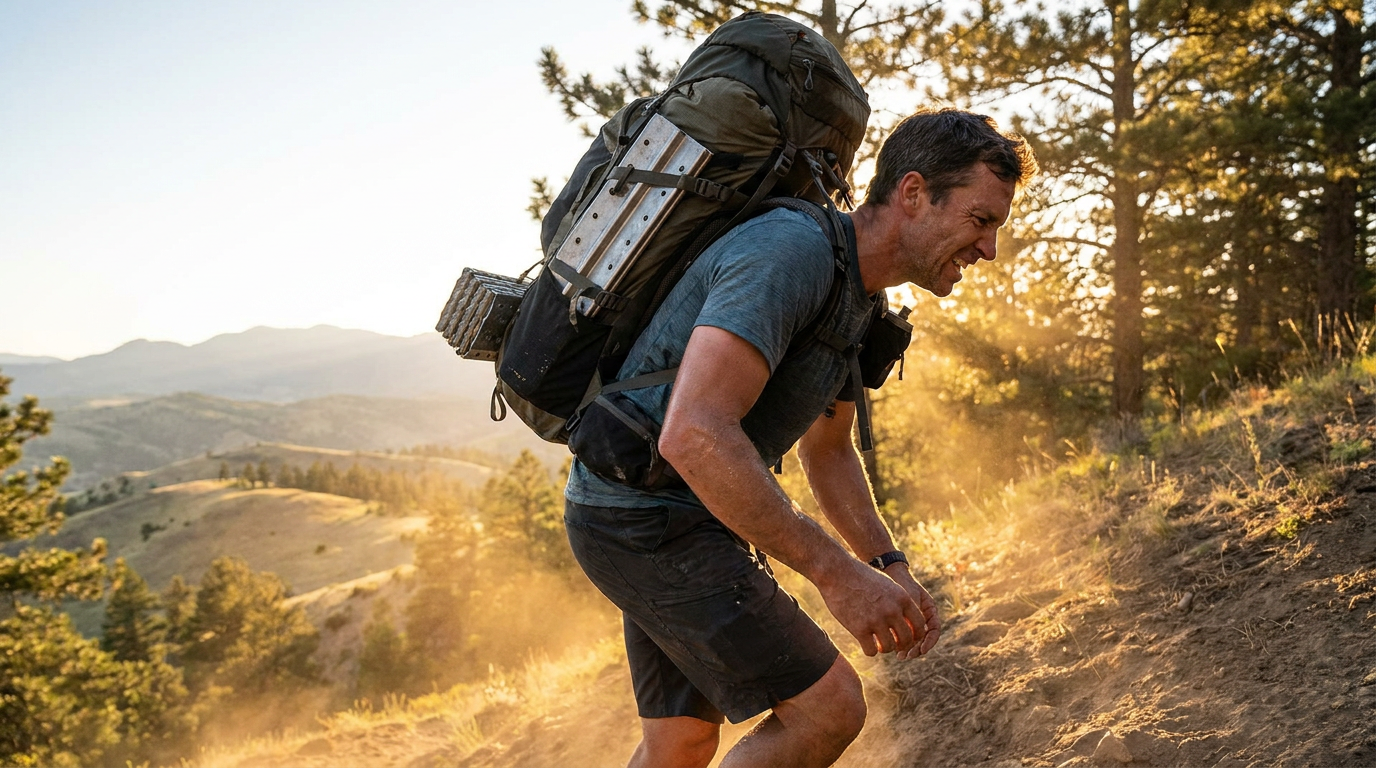
The fitness industry is notoriously cyclical, but the latest trend to capture the attention of longevity experts and exercise physiologists is remarkably simple: walking with a heavy backpack. Known colloquially as "rucking," the practice of weighted walking has transitioned from a niche military conditioning tool into a mainstream health intervention.[1]
At its core, rucking is the modern application of load carriage, a fundamental human movement pattern. Evolutionary anthropologists argue that humans are uniquely adapted not just for distance running, but for carrying heavy loads over long distances. For centuries, military organizations have utilized loaded marching to build resilience and tactical readiness, but civilian science is now quantifying exactly why the practice is so effective for general health.[1][4]
One of the primary drivers of rucking's popularity is its efficiency as a cardiovascular tool. Longevity physicians frequently advocate for "Zone 2" training—a steady-state aerobic intensity that builds mitochondrial density and improves fat oxidation. Achieving this heart rate through unloaded walking is difficult for fit individuals, while running often pushes the heart rate too high. Adding 20 to 40 pounds of weight to the back effortlessly elevates the heart rate into the optimal Zone 2 range at a standard walking pace.[1][5]
The metabolic demands of load carriage are substantial. Research indicates that rucking can burn two to three times the calories of an unloaded walk at the same speed. Furthermore, a consistent load carriage program has been shown to significantly increase VO2 max, which is widely considered one of the strongest predictors of long-term health and lifespan.[1][5]
To understand why rucking is so metabolically demanding, biomechanists have analyzed the mechanical work performed by the body under load. According to data from the National Institutes of Health, the center-of-mass work rate increases by approximately 1.40 watts for every kilogram of added load.[2]
The distribution of this extra work is not uniform across the body. The greatest increase in positive mechanical work is attributable to the ankle during the push-off phase of the stride, and the knee during the rebound phase after the foot strikes the ground. Meanwhile, the hip performs increasing amounts of negative work to stabilize the body near the end of the stance.[2]
The distribution of this extra work is not uniform across the body.
Despite this increased mechanical work, rucking is remarkably gentle on the joints compared to running. Biomechanical analyses reveal that running places a compressive force on the knee equal to roughly eight times a person's body weight. Unloaded walking exerts a force of about 2.7 times body weight. Adding a 30-pound rucksack only marginally increases that force to 3.0 times body weight, making it a highly efficient way to achieve running-level cardiovascular benefits without the corresponding impact trauma.[1]

Beyond cardiovascular fitness, the compressive force generated by rucking is a potent stimulus for bone health. Weight-bearing aerobic exercise signals osteoblasts—the cells responsible for bone formation—to increase bone mineral density. Specialists at the Mayo Clinic specifically recommend weighted walking as a primary intervention to halt or reverse bone loss and prevent osteoporosis, a critical concern for aging populations.[6]
The addition of a weighted pack also forces a biomechanical adaptation in posture. The load shifts the body's center of mass posteriorly and superiorly. To compensate and maintain balance, the body must engage the trunk and postural stabilizers.[4]
This postural demand translates to significantly higher muscle excitation in the abdominals, spinal extensors, and hip flexors. Rucking effectively serves as a continuous, low-intensity isometric core exercise. It also heavily recruits the posterior chain, including the glutes and hamstrings, to propel the added mass forward.[4][7]

While the benefits are clear, sports scientists caution that load and speed must be managed to optimize efficiency and prevent fatigue. Research published in the Military Medicine Journal highlights the "Load-Speed Index," which helps define the thresholds where biomechanical stress outpaces physiological benefit.[3]
The literature suggests that maintaining an exercise intensity of around 45% of VO2 max delays the onset of fatigue during prolonged weighted marches. Pushing the pace too fast under heavy load forces the body toward the "walk-to-run transition," a biomechanically inefficient crossover point that requires disproportionately high mechanical energy output and increases injury risk.[3]
Finally, the psychological benefits of rucking are an integral part of its appeal in the longevity community. Physicians incorporate rucking into their preventative medicine frameworks not just for the physical adaptations, but for the mental resilience it builds. The practice encourages outdoor exposure and introduces a level of controlled discomfort that combats the sedentary nature of modern life.[1][5]

By combining the cardiovascular stimulus of a run, the low-impact nature of a walk, and the load-bearing benefits of resistance training, rucking offers a uniquely comprehensive fitness stimulus. As researchers continue to map the biomechanics of load carriage, weighted walking stands out as a highly accessible, evidence-based tool for extending both healthspan and lifespan.[1][2][6]
How we got here
1980s
Japanese researchers begin quantifying the physiological benefits of outdoor walking and nature exposure, foundational to modern rucking's mental health claims.
2000
Early biomechanical studies on military load carriage demonstrate how heavy backpacks shift the center of mass and alter stride frequency.
2019
The Military Medicine Journal publishes the Load-Speed Index, establishing optimal efficiency thresholds for weighted marching.
2021
Journalist Michael Easter publishes 'The Comfort Crisis,' popularizing the evolutionary and health benefits of rucking for civilian audiences.
2024
Longevity experts heavily promote rucking as a primary intervention for maintaining bone density and VO2 max in aging populations.
Viewpoints in depth
Longevity Physicians
Medical professionals focused on extending healthspan through preventative exercise.
This camp views rucking as a highly effective tool for aging, primarily because it simultaneously addresses two of the most critical vectors of physical decline: cardiovascular capacity (VO2 max) and musculoskeletal integrity (bone density and muscle mass). They argue that traditional cardio like cycling fails to load the skeleton, while heavy weightlifting lacks the sustained aerobic stimulus. For these physicians, rucking perfectly bridges the gap, offering a low-barrier, highly scalable intervention that keeps patients out of the frailty zone.
Biomechanics & Sports Scientists
Researchers analyzing the mechanical forces and metabolic costs of human movement.
Biomechanists focus on the precise gait alterations and energy expenditure required to move external loads. While they acknowledge the metabolic benefits, they caution against the 'more is better' mentality. Their research highlights that loads exceeding 20-30% of body weight significantly alter stride mechanics, shifting excessive work to the ankle and knee joints. They advocate for strict adherence to the Load-Speed Index to maximize cardiovascular efficiency while minimizing the risk of fatigue-induced overuse injuries.
Evolutionary Anthropologists
Scientists studying how human physiology adapted to ancestral environments.
This perspective frames rucking not as a novel exercise hack, but as a return to a fundamental human movement pattern. They point out that early humans evolved to carry heavy loads—such as gathered food or hunted game—over long distances. From this viewpoint, the modern sedentary lifestyle is an evolutionary mismatch, and weighted walking is simply reintroducing the environmental stimulus that our bodies require to maintain optimal metabolic and structural health.
What we don't know
- The long-term effects of civilian rucking on spinal disc compression over decades, as most longitudinal data comes from military populations carrying extreme loads.
- The exact threshold at which the cardiovascular benefits of added weight are outweighed by the biomechanical wear-and-tear on the lower extremities.
- Whether specialized rucking weights (plates) provide a clinically significant injury-prevention advantage over improvised weights (dumbbells or books) in a standard backpack.
Key terms
- Load Carriage
- The biomechanical and physiological study of how the human body transports external weight.
- Zone 2 Training
- A steady-state aerobic exercise intensity (roughly 60-70% of maximum heart rate) that optimizes fat oxidation and mitochondrial function.
- VO2 Max
- The maximum rate at which the heart, lungs, and muscles can effectively use oxygen during exercise; a key indicator of aerobic endurance.
- Osteoblasts
- Cells responsible for synthesizing new bone matrix, which are stimulated by the compressive forces of weight-bearing exercise.
- Posterior Chain
- The group of muscles on the back of the body, including the hamstrings, glutes, and spinal erectors, heavily recruited during weighted walking.
- Center of Mass
- The unique point where the weighted relative position of the distributed mass sums to zero; adding a backpack shifts this point higher and further back on the body.
Frequently asked
What is the recommended starting weight for rucking?
Beginners should start with 10% to 15% of their body weight. As fitness improves, the load can be gradually increased, though experts generally recommend capping the weight at 30% of body weight for general health purposes.
Can rucking replace traditional weightlifting?
No. While rucking builds muscular endurance and significantly improves bone density, traditional resistance training is still required to maximize absolute strength and muscle hypertrophy.
Is rucking safe for people with knee pain?
For many, yes. Rucking is generally safer than running because it lacks the high-impact flight phase, placing significantly less peak force on the knee joint. However, individuals with existing joint issues should consult a physician before adding heavy loads.
Do I need a specialized rucksack to start?
While specialized rucksacks with flat weight plates distribute the load optimally across the back, any sturdy backpack carrying wrapped dumbbells, water bottles, or books works perfectly well for beginners.
Sources
Source coverage
7 outlets
3 viewpoints surfaced







[1]Factlen Editorial TeamLongevity & Preventative Medicine
Synthesis by Factlen editorial team
Read on Factlen Editorial Team →[2]National Institutes of Health (NIH)Biomechanics & Kinesiology
Biomechanics and energetics of load carriage walking
Read on National Institutes of Health (NIH) →[3]Military Medicine JournalTactical & Athletic Conditioning
The Physiology and Biomechanics of Load Carriage Performance
Read on Military Medicine Journal →[4]National Strength and Conditioning AssociationTactical & Athletic Conditioning
Load Marching Performance for Tactical Athletes
Read on National Strength and Conditioning Association →[5]Peter Attia MDLongevity & Preventative Medicine
Rucking: benefits, gear, and the journey to longevity
Read on Peter Attia MD →[6]Mayo ClinicLongevity & Preventative Medicine
Osteoporosis: Exercise for strong bones
Read on Mayo Clinic →[7]Journal of Biomechanical EngineeringBiomechanics & Kinesiology
Personalized Muscle Strength Improves Accuracy of Military Load Carriage Simulations
Read on Journal of Biomechanical Engineering →

Every angle. Every day.
Get fitness stories with full source coverage and perspective breakdowns delivered to your inbox.