
The Science of OTC Glucose Monitors: Do Healthy People Need to Track Every Spike?
Over-the-counter continuous glucose monitors have become a mainstream tool for personalized nutrition. While advocates praise the real-time health insights, medical experts warn that over-analyzing normal biological functions can fuel unnecessary anxiety.
By Factlen Editorial Team
- Precision Nutrition Proponents
- Argue that real-time glucose data allows individuals to tailor their diets and catch metabolic dysfunction early.
- Clinical Skeptics
- Emphasize that normal glucose fluctuations are harmless and warn that OTC monitors can cause unnecessary anxiety.
- Editorial Synthesis
- Weighs the educational benefits of short-term tracking against the risks of long-term data obsession.
What's not represented
- · Individuals recovering from eating disorders who are negatively impacted by the normalization of extreme dietary tracking.
- · Low-income populations who are priced out of the $100/month out-of-pocket cost for metabolic optimization.
Why this matters
Understanding how your unique metabolism responds to food and stress can help you optimize your daily energy and prevent long-term disease. However, misinterpreting this new wave of wearable data can lead to unnecessary food anxiety and expensive, unneeded lifestyle restrictions.
Key points
- Over-the-counter continuous glucose monitors (CGMs) are now widely available for adults without diabetes.
- The devices measure glucose in interstitial fluid, revealing how individual bodies react differently to the same foods.
- Advocates argue this real-time data enables 'precision nutrition' and catches metabolic dysfunction early.
- Skeptics warn that normal, healthy glucose spikes are often misinterpreted, leading to unnecessary anxiety and dietary restriction.
The evolution of health wearables has followed a predictable arc: first we tracked our steps, then our sleep, and then our heart rates. But the latest frontier in self-quantification looks beneath the skin, offering a real-time window into human metabolism.[5]
Over the past two years, Continuous Glucose Monitors (CGMs) have made a decisive leap from specialized medical devices to mainstream wellness tools. Following the FDA's landmark 2024 clearance of over-the-counter systems like the Dexcom Stelo and Abbott Lingo, millions of adults without diabetes are now tracking their blood sugar around the clock.[4][5]
The appeal is rooted in an emerging scientific concept called precision nutrition. For decades, dietary advice was built on universal averages—the assumption that a bowl of oatmeal or a banana would provoke roughly the same metabolic response in everyone.[2][5]
But large-scale studies have dismantled that assumption. Research shows that individual responses to identical foods vary wildly based on genetics, sleep quality, and gut microbiome composition. A meal that keeps one person's blood sugar perfectly stable might send another's soaring.[2]

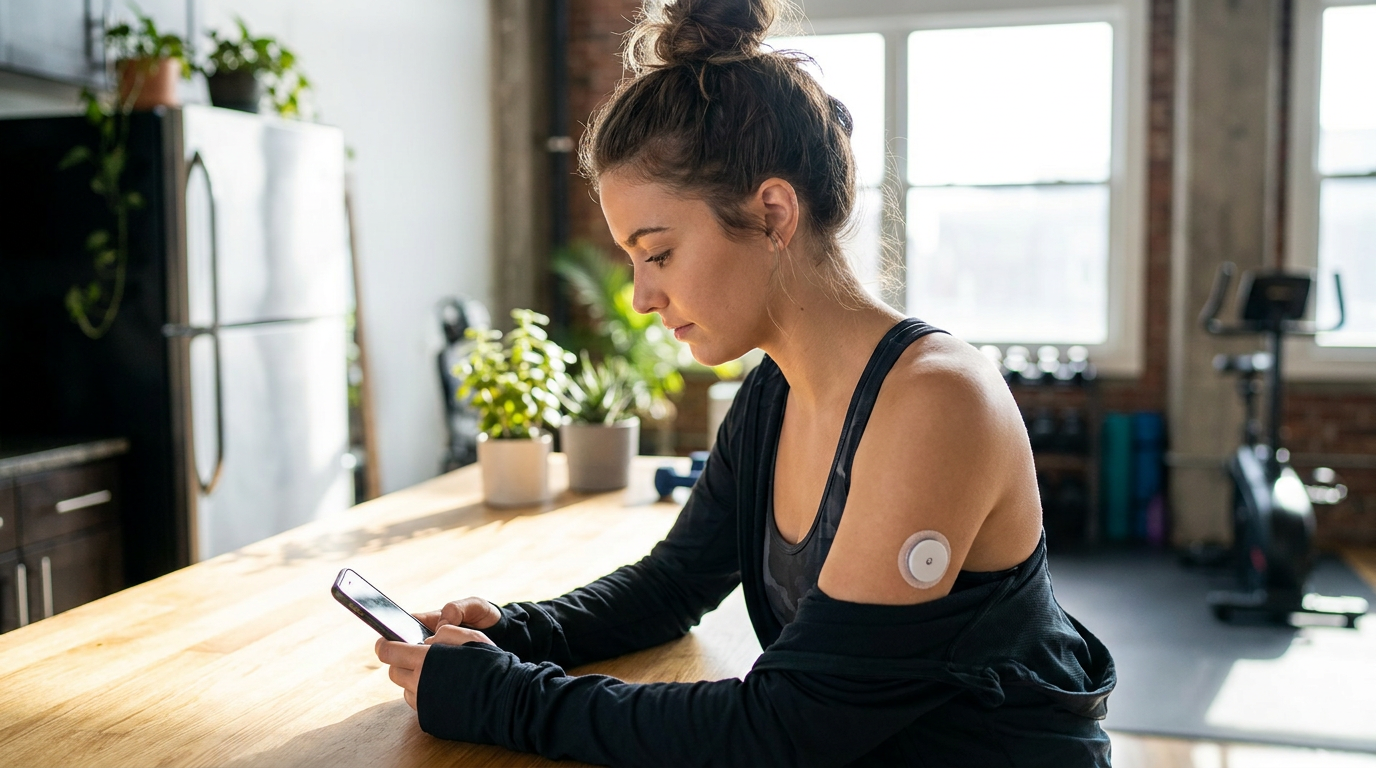
To capture this personalized data, users apply a small, water-resistant sensor patch to the back of their arm. A flexible filament, roughly the thickness of a human hair, sits just beneath the skin.[6]
Crucially, these devices do not measure blood. They measure glucose levels in the interstitial fluid—the liquid that surrounds the body's cells. The sensor reads this fluid every few minutes and beams a continuous curve to a smartphone app.[3][6]
For metabolic optimization advocates, this real-time feedback loop is revolutionary. Standard diagnostics like fasting glucose or A1c tests are backward-looking averages. They can miss the daily spikes and crashes—known as glycemic variability—that accumulate over years before a formal prediabetes diagnosis is ever made.[5]
By wearing a CGM, users can instantly see the consequences of their daily habits. They discover that a 20-minute walk after dinner dramatically blunts a glucose spike, or that a poor night of sleep leaves their body struggling to process carbohydrates the next day.[3]
By wearing a CGM, users can instantly see the consequences of their daily habits.
Stress, too, becomes highly visible. A tense meeting or a spike in cortisol prompts the liver to release stored glucose for quick energy, creating a sharp spike on the monitor even if the user hasn't eaten a single calorie.[3]
However, the mainstreaming of CGMs has sparked fierce debate within the medical community. Many endocrinologists warn that the data is being fundamentally misinterpreted by healthy people who lack clinical context.[3][5]
The human body is designed to experience glucose fluctuations. When a healthy person eats carbohydrates, blood sugar rises, and the pancreas releases insulin to shuttle that energy into cells. A post-meal spike is not inherently dangerous; it is the normal mechanical function of a working metabolism.[5]
Furthermore, the technology itself has limitations when applied to non-diabetics. Because CGMs measure interstitial fluid rather than capillary blood, there is an inherent lag time of about 5 to 15 minutes between what is happening in the bloodstream and what registers on the app.[1][6]

This lag, combined with the devices being calibrated primarily for diabetic ranges, can lead to false alarms. A 2025 randomized crossover trial published in the American Journal of Clinical Nutrition found that CGMs frequently overestimate glucose excursions in healthy individuals.[1]
In that study, the monitors estimated the participants' "time out of range" as four times higher than what simultaneous, highly accurate capillary blood tests showed. Researchers warned that this inaccuracy could lead healthy people to falsely believe they are prediabetic.[1]
This data discrepancy fuels a growing psychological concern: orthorexia, or an unhealthy obsession with eating "perfectly." Nutritionists report seeing patients who unnecessarily cut out nutrient-dense fruits, legumes, and whole grains simply because they cause a temporary, harmless blip on their smartphone screen.[3][5]
Despite these warnings, the ecosystem surrounding OTC CGMs is booming. Companies are building sophisticated coaching apps that layer on top of the raw data, offering "metabolic scores" and AI-driven insights to help users interpret their curves without needing a medical degree.[6]

Accessibility remains a hurdle. Because they are not deemed medically necessary for non-diabetics, these wellness monitors are rarely covered by insurance. Users typically pay between $80 and $100 out of pocket for a month's supply of sensors.[4][6]
Ultimately, the consensus among moderate health professionals is that a CGM can be a powerful short-term educational tool. Wearing one for two to four weeks can provide a fascinating window into how your specific body reacts to your standard diet and lifestyle.[3][5]
But once those personalized patterns are learned—once you know that rice spikes you more than potatoes, or that a morning walk stabilizes your afternoon energy—the most metabolically healthy move might be to take the sensor off and simply live.[5]
How we got here
1999
The FDA approves the first continuous glucose monitor, intended strictly for clinical use by doctors.
2017
Factory-calibrated CGMs hit the market, eliminating the need for daily finger-prick calibrations for diabetics.
2020
Major studies highlight the potential of precision nutrition, showing that healthy individuals have vastly different glucose responses to the same foods.
March 2024
The FDA clears the Dexcom Stelo, the first CGM available over-the-counter without a prescription.
2026
OTC CGMs become mainstream wellness tools, sparking debate over their accuracy and psychological impact on non-diabetics.
Viewpoints in depth
Precision Nutrition Proponents
Advocates who believe real-time data is the key to preventing metabolic disease.
This camp argues that traditional diagnostics like fasting glucose tests are fundamentally flawed because they only capture a single moment in time. By the time a patient's A1c reaches prediabetic levels, years of metabolic damage have already occurred. Proponents believe that giving individuals access to their own continuous data empowers them to make personalized lifestyle changes—such as taking a walk after dinner or avoiding specific carbohydrates—long before medical intervention is required.
Clinical Skeptics
Medical professionals warning about the limitations and psychological risks of OTC monitors.
Skeptics emphasize that the human body is designed to experience glucose spikes; it is the normal physiological response to eating. They point to studies showing that CGMs, which are calibrated for diabetic extremes, often overestimate 'time out of range' in healthy users. This camp warns that hyper-fixating on harmless glucose fluctuations can lead to orthorexia, unnecessary dietary restrictions, and a fundamental misunderstanding of how a healthy metabolism operates.
What we don't know
- Whether long-term use of CGMs by healthy individuals actually reduces the population-level incidence of type 2 diabetes.
- How the algorithms used by consumer wellness apps weigh the relative importance of glucose spikes versus overall nutritional density.
- The exact degree to which the microbiome dictates an individual's glucose response compared to genetics or sleep quality.
Key terms
- Continuous Glucose Monitor (CGM)
- A wearable device that tracks blood sugar levels in real time, day and night, using a small sensor placed under the skin.
- Interstitial Fluid
- The fluid that surrounds the cells in your body, which is what CGMs actually measure rather than direct capillary blood.
- Glycemic Variability
- The degree to which a person's blood sugar fluctuates between high peaks and low crashes throughout the day.
- Precision Nutrition
- An emerging approach to diet that tailors food recommendations to an individual's unique biological and metabolic responses.
- Orthorexia
- An unhealthy obsession with eating foods that one considers healthy, which can sometimes be triggered by over-analyzing biometric data.
Frequently asked
Can I buy a continuous glucose monitor without a prescription?
Yes. In 2024, the FDA cleared the first over-the-counter CGMs, such as the Dexcom Stelo and Abbott Lingo, specifically for adults who do not use insulin.
Does applying the sensor hurt?
Most users report little to no pain. The device uses a small needle to quickly insert a flexible filament just beneath the skin, and the needle retracts immediately.
Are CGMs accurate for people without diabetes?
They provide excellent trend data, but they measure interstitial fluid, not blood. Studies show they can sometimes overestimate glucose spikes or 'time out of range' in metabolically healthy individuals.
Will a CGM help me lose weight?
Not directly. However, the real-time data can help you identify which foods cause energy crashes, potentially leading to better dietary choices and portion control.
Sources
Source coverage
6 outlets
3 viewpoints surfaced






[1]American Journal of Clinical NutritionClinical Skeptics
Continuous glucose monitor overestimates glycemia in healthy individuals
Read on American Journal of Clinical Nutrition →[2]Nature MedicinePrecision Nutrition Proponents
Human postprandial responses to food and potential for precision nutrition
Read on Nature Medicine →[3]UCLA HealthClinical Skeptics
Continuous glucose monitoring is becoming popular among non-diabetics
Read on UCLA Health →[4]U.S. Food and Drug AdministrationPrecision Nutrition Proponents
FDA Clears First Over-the-Counter Continuous Glucose Monitor
Read on U.S. Food and Drug Administration →[5]Factlen Editorial TeamEditorial Synthesis
Synthesis by Factlen editorial team
Read on Factlen Editorial Team →[6]EndotextPrecision Nutrition Proponents
Monitoring Technologies: Continuous Glucose Monitoring
Read on Endotext →


Every angle. Every day.
Get health stories with full source coverage and perspective breakdowns delivered to your inbox.