
The AI Memory Boom: Why Wall Street's Hottest Semiconductor Stocks Still Look Cheap
High-bandwidth memory chips are the unsung heroes of the AI revolution, driving record revenues for manufacturers. Yet despite their explosive growth, these stocks trade at surprisingly low valuations due to the industry's notoriously cyclical history.
By Factlen Editorial Team
- Structural Supercycle Bulls
- Argue that AI demand and the complexity of HBM manufacturing have permanently altered the memory market's economics.
- Historical Cyclical Bears
- Warn that the massive capital expenditures currently underway will inevitably lead to a supply glut and price collapse by 2027.
- Industry Analysts
- Focus on the technical bottlenecks and the cascading effects of the 'Memory Crunch' on consumer electronics.
What's not represented
- · Retail Investors
- · Cloud Infrastructure Providers
Why this matters
Memory chips are the hidden bottleneck of the entire AI revolution. Understanding why these highly profitable companies are trading at steep discounts reveals whether the AI boom is a permanent structural shift in technology or a massive financial bubble waiting to pop.
Key points
- Memory manufacturers are reporting record revenues driven by the AI boom.
- Despite high profits, memory stocks trade at low valuations due to fears of a future supply glut.
- High-Bandwidth Memory (HBM) is entirely sold out through 2026 across major suppliers.
- Producing HBM requires significantly more factory capacity, constraining the supply of standard consumer memory.
The artificial intelligence boom has minted trillion-dollar valuations and turned logic chip designers into the most valuable companies on Earth. Yet, tucked away in the engine room of the AI revolution is a paradox that continues to baffle retail investors and seasoned analysts alike. The companies manufacturing the critical memory chips required to make artificial intelligence function are currently reporting the highest revenues in their corporate histories, boasting growth rates that eclipse the dot-com era. Despite this unprecedented financial windfall, Wall Street seems entirely unconvinced that the good times will last.[1]
Despite this explosive financial performance, the world's dominant memory manufacturers—Micron Technology, SK Hynix, and Samsung Electronics—are trading at valuations that look more like distressed value stocks than cutting-edge tech darlings. While software and logic semiconductor firms routinely command forward price-to-earnings multiples of 30 to 50, memory giants are trading at fractions of that premium. SK Hynix, for instance, recently traded at a forward P/E of roughly 5.8, while Micron hovered near 11. To a casual observer, these companies appear to be the most obvious bargains in the entire technology sector.[5]
This glaring disconnect between record-breaking profits and bargain-basement valuations is the defining debate in semiconductor investing in 2026. To understand why Wall Street is treating the most profitable year in memory history with such deep suspicion, one must look at the brutal, boom-and-bust history of the memory market—and the new, exotic technology that might finally break that cycle. The answer lies in the fundamental difference between building a permanent infrastructure and riding a temporary wave of corporate enthusiasm. Analysts are sharply divided on whether the current supercycle represents a permanent paradigm shift or just another peak before an inevitable crash.[1][6]

The catalyst for the current market frenzy is High-Bandwidth Memory, commonly known as HBM. For decades, memory chips were treated as interchangeable, low-margin commodities. Whether a stick of Dynamic Random Access Memory came from a fabrication plant in Boise or Seoul, it performed essentially the same function in a consumer laptop or enterprise server. Because the products were nearly identical, manufacturers competed almost entirely on price and massive manufacturing scale, leading to razor-thin margins during periods of normal demand.[3]
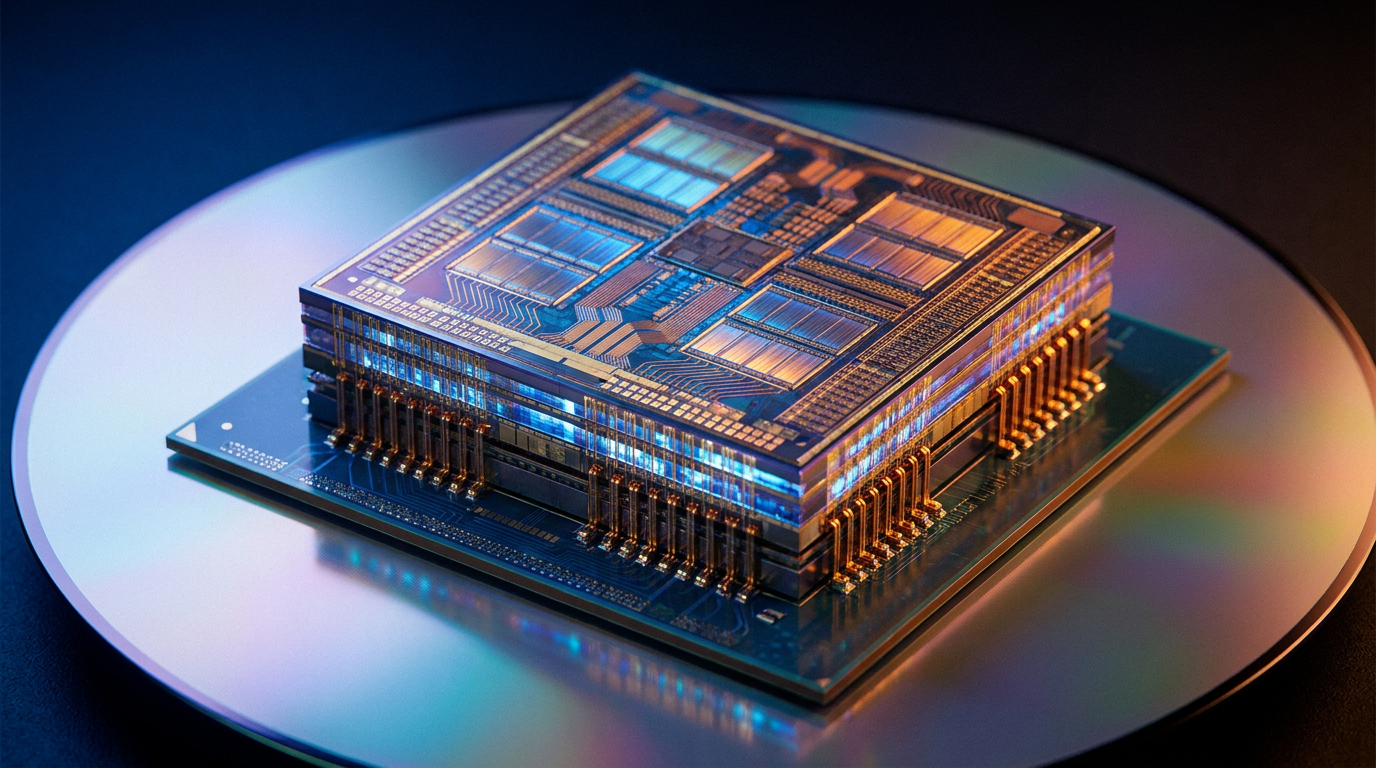
Generative artificial intelligence completely shattered that commodity paradigm. Large language models require massive datasets to be shuttled back and forth to processing cores at lightning speed. Standard memory simply cannot move data fast enough to keep up with modern AI accelerators, creating a severe computational bottleneck. The industry's solution was HBM, a marvel of modern engineering that stacks multiple memory chips vertically, connecting them with microscopic vertical copper wires called Through-Silicon Vias. This complex 3D packaging transforms memory from a simple storage locker into a high-speed data highway.[3]
This 3D-stacked architecture allows data to flow at up to 8 terabytes per second, making it the undisputed lifeblood of modern AI data centers. According to industry analysis, AI training and inference workloads now account for more than 55% of all HBM demand globally. The technology is so critical that the latest generation of AI accelerators requires vastly more HBM than previous iterations, turning memory from a cheap, abundant commodity into a highly strategic and fiercely contested bottleneck for the entire tech industry.[3]

The financial impact on memory makers has been nothing short of staggering. Because of its extreme manufacturing complexity, High-Bandwidth Memory commands profit margins three to five times higher than standard RAM. Driven by relentless hyperscaler investments, the total addressable market for HBM is projected to nearly triple in a remarkably short timeframe, surging from roughly $35 billion in 2025 to over $100 billion by 2028. This high-margin revenue is fundamentally transforming the balance sheets of the companies capable of producing it.[4]
The financial impact on memory makers has been nothing short of staggering.
Consequently, the 'Big Three' memory producers are entirely sold out of their HBM capacity through the end of calendar year 2026. Desperate to secure the components necessary for their AI ambitions, major tech companies are signing binding, multi-year contracts and prioritizing supply security over price negotiations. This dynamic—customers begging for allocation regardless of cost—is virtually unheard of in the traditionally cutthroat memory business, providing manufacturers with unprecedented revenue visibility. It marks a stark departure from the days when buyers could pit suppliers against each other to drive prices down to the floor.[4]
So why do the stock prices remain so cheap? The answer lies in the deep scars of previous market cycles. Historically, the memory industry is notoriously cyclical, operating on a predictable pendulum of feast and famine. During periods of high demand and fat margins, manufacturers inevitably pour billions of dollars into building massive new fabrication plants. By the time those multi-billion-dollar facilities come online two to three years later, the market is usually flooded with new supply, prices crash, and profits evaporate overnight.[1][5]
Wall Street veterans have seen this movie play out multiple times, and they are inherently skeptical that this time is any different. They look at the massive capital expenditures announced for the coming years—with Micron projecting over $25 billion and SK Hynix committing roughly $27 billion—and see the familiar seeds of the next great supply glut. The remarkably low forward P/E ratios reflect a broad market consensus that current earnings are artificially inflated by a temporary shortage and will inevitably collapse when the cycle turns.[5][6]

However, a growing chorus of analysts and industry insiders argues that the 'cyclical trap' thesis fundamentally misunderstands the mechanics of the AI era. They contend that this is not a standard consumer upgrade cycle, but a structural supercycle driven by sovereign and corporate infrastructure spending. Because HBM is incredibly complex to manufacture and package, it suffers from lower production yields than standard memory, meaning supply cannot be ramped up as easily or as recklessly as in previous decades.[2][6]
More importantly, manufacturing High-Bandwidth Memory is highly resource-intensive. Producing a single wafer of HBM requires roughly three times the factory capacity of a standard DRAM wafer. As Samsung, SK Hynix, and Micron aggressively reallocate their factory floors to chase high-margin AI contracts, they are permanently deprioritizing the production of conventional memory used in smartphones, PCs, and standard enterprise servers. This physical constraint means that even with massive new investments, overall memory bit growth will remain structurally limited.[2][4]
This aggressive reallocation has triggered a broader 'Memory Crunch' across the entire technology ecosystem. With the most profitable production lines locked up by AI data centers, the supply of standard consumer memory is artificially constrained. Analysts forecast severe price hikes for conventional DRAM and NAND flash throughout 2026, meaning memory makers are enjoying immense pricing power across their entire product portfolios, not just in their specialized AI chips. The rising tide of AI is lifting every boat in the memory harbor.[2]

The ultimate trajectory of these stocks—and whether they are the bargains of the decade or a classic value trap—depends entirely on the durability of the AI infrastructure build-out. If hyperscalers like Amazon, Microsoft, and Alphabet continue to pour hundreds of billions of dollars into data centers year after year, the memory makers' multi-year contracts will hold firm. In that scenario, the historical boom-bust cycle will have been broken, and current valuations will be remembered as a historic mispricing by a skeptical Wall Street.[5]
Conversely, if AI monetization falters and tech giants are forced to scale back their capital expenditures, the memory industry will find itself with massive new factories and no buyers for their premium chips. Until that multi-billion-dollar question is definitively answered, memory stocks will remain the cheapest tickets to the artificial intelligence revolution—and potentially its most volatile and fascinating ride. Investors are essentially placing a bet on whether the fundamental laws of semiconductor economics have been permanently rewritten by the advent of generative AI. For those willing to stomach the historical volatility, the upside of being right could be generational.[1][6]
How we got here
Pre-2024
Memory chips operate as standard commodities, subject to predictable boom-and-bust pricing cycles.
Late 2024
Generative AI creates a sudden, massive bottleneck in data transfer speeds, spiking demand for High-Bandwidth Memory.
Mid-2025
Major memory manufacturers sell out their entire HBM production capacity through the end of 2026.
Early 2026
Memory stocks report record revenues, yet their valuations remain heavily discounted due to cyclical fears.
2027-2028 (Projected)
New multi-billion-dollar fabrication plants come online, testing whether AI demand can absorb the massive new supply.
Viewpoints in depth
Structural Supercycle Bulls
Investors who believe AI has fundamentally broken the memory market's historical boom-bust cycle.
This camp argues that High-Bandwidth Memory is not a traditional commodity. Because HBM requires complex 3D packaging and significantly more wafer capacity to produce, the barriers to entry are higher and supply is naturally constrained. Bulls point to the fact that hyperscalers are signing binding, multi-year contracts for memory—a rarity in the industry's history—which provides unprecedented revenue visibility and justifies a higher valuation multiple.
Historical Cyclical Bears
Skeptics who warn that the current memory boom will end in a familiar supply glut.
Bears argue that the laws of semiconductor economics have not been suspended. They point to the massive capital expenditures announced by Micron, SK Hynix, and Samsung for 2026 and 2027. Historically, whenever the 'Big Three' simultaneously expand capacity, it results in an oversupplied market two to three years later. If AI infrastructure spending cools even slightly, these new fabs will flood the market with chips, crushing margins and validating the currently low P/E ratios.
Consumer Electronics Makers
Downstream manufacturers facing supply shortages and price hikes.
For companies building smartphones, PCs, and standard servers, the AI memory boom is a crisis. Because fabs are reallocating their production lines to chase high-margin HBM, the supply of conventional DRAM and NAND flash is shrinking. This 'Memory Crunch' forces consumer electronics makers to pay significantly higher prices for older technology, squeezing their margins and potentially driving up the cost of everyday consumer devices.
What we don't know
- Whether hyperscalers will maintain their current massive pace of AI infrastructure spending into 2027 and 2028.
- How quickly competitors in China might scale up their own High-Bandwidth Memory production to challenge the 'Big Three'.
- The exact impact the 'Memory Crunch' will have on the retail pricing of next-generation smartphones and PCs.
Key terms
- High-Bandwidth Memory (HBM)
- A specialized type of computer memory that stacks chips vertically to drastically increase the speed at which data travels to a processor.
- Forward P/E Ratio
- A valuation metric that compares a company's current stock price to its expected earnings per share over the next 12 months.
- Through-Silicon Via (TSV)
- Microscopic vertical copper connections that pass completely through a silicon wafer, allowing stacked memory chips to communicate instantly.
- Cyclicality
- The tendency of an industry to experience predictable periods of massive profitability followed by severe downturns, often driven by overproduction.
- Wafer Capacity
- The maximum number of silicon wafers a semiconductor fabrication plant can process in a given timeframe.
Frequently asked
Why are memory stocks considered cheap?
Despite reporting record revenues, memory stocks trade at low price-to-earnings multiples because investors fear the current boom will inevitably lead to overproduction and a future crash in chip prices.
What makes HBM different from regular computer memory?
Unlike the standard memory in a laptop, HBM stacks multiple chips vertically and connects them with microscopic wires, allowing it to feed data to AI processors at vastly higher speeds.
Will the AI memory shortage affect regular consumers?
Yes. Because manufacturers are dedicating their factory space to high-margin AI memory, the supply of standard memory for PCs and smartphones is shrinking, which is driving up prices for consumer electronics.
Sources
Source coverage
6 outlets
3 viewpoints surfaced






[1]MarketWatchHistorical Cyclical Bears
Memory stocks are having their best year ever. Why do they still look so cheap?
Read on MarketWatch →[2]TradingKeyStructural Supercycle Bulls
The 2026 Memory Crunch: Why AI is Rewriting Semiconductor Economics
Read on TradingKey →[3]PatSnap InsightsIndustry Analysts
High Bandwidth Memory — key questions answered
Read on PatSnap Insights →[4]IntrolStructural Supercycle Bulls
The AI memory supercycle: HBM capacity sold out through 2026
Read on Introl →[5]XTBHistorical Cyclical Bears
Is 'low valuation' a cyclical trap for memory stocks?
Read on XTB →[6]Factlen Editorial TeamIndustry Analysts
Synthesis by Factlen editorial team
Read on Factlen Editorial Team →
Every angle. Every day.
Get finance stories with full source coverage and perspective breakdowns delivered to your inbox.