
NASA's Perseverance Rover Completes a Marathon on Mars in Record Time
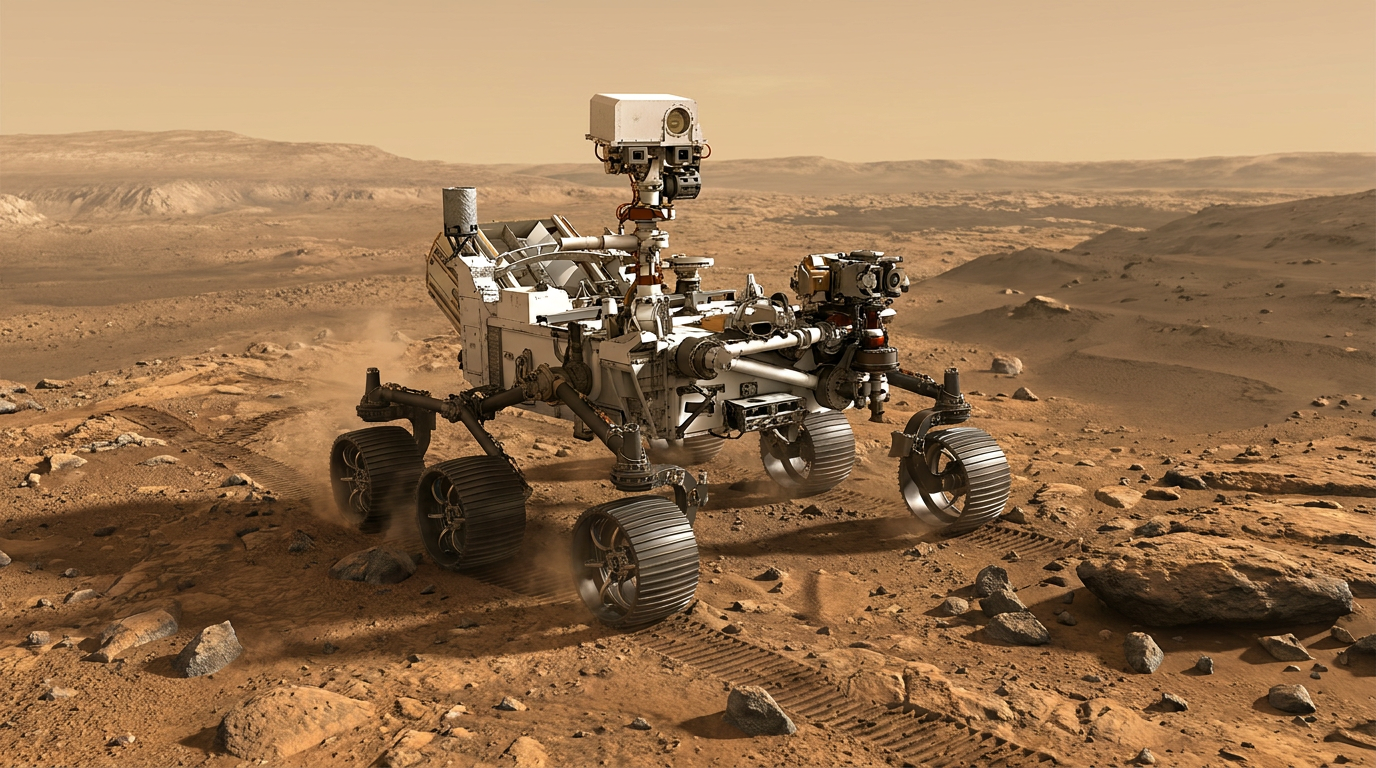
NASA's Perseverance rover has officially traveled 26.2 miles across the Martian surface, completing a marathon in just over five years thanks to advanced autonomous navigation technology.
By Factlen Editorial Team
- Mission Engineers
- Celebrate the software and hardware milestones that enable autonomous planetary exploration.
- Planetary Scientists
- Focus on the geological discoveries and the rapid pace of sample collection.
- Space Industry Observers
- Track the historical context of the mission and its implications for future spaceflight.
What's not represented
- · Mars Sample Return program planners facing budget constraints
- · Commercial spaceflight companies developing autonomous lunar rovers
Why this matters
The rover's unprecedented speed is driven by new autonomous navigation systems that allow it to 'think while driving,' accelerating the search for ancient Martian life and laying the groundwork for self-driving infrastructure on future human missions.
Key points
- NASA's Perseverance rover has traveled 26.2 miles on Mars, completing a marathon distance.
- It reached the milestone in just over five years, less than half the time it took the Opportunity rover.
- The rover's speed is enabled by AutoNav, a system that allows it to 'think while driving.'
- A new software upgrade called Mars Global Localization lets the rover pinpoint its exact coordinates without Earth's help.
- Perseverance is now less than two miles away from breaking the all-time extraterrestrial distance record.
On June 14, 2026, NASA's Perseverance rover crossed an invisible finish line on the surface of Mars. The six-wheeled robotic geologist officially surpassed 26.2 miles—the exact distance of a marathon on Earth—while exploring the rugged terrain west of Jezero Crater.[1][3]
It is only the second human-made vehicle to ever complete a marathon on another world. The first was NASA's Opportunity rover, which achieved the feat in 2015. But while Opportunity took more than 11 years to log 26.2 miles, Perseverance completed the journey in just five years and four months.[1][3]
How did a rover with a top speed of just 0.1 miles per hour manage to traverse an alien desert so quickly? The answer lies not in its motors, but in its electronic brain. Perseverance is equipped with an advanced autonomous navigation system known as AutoNav, which allows the rover to "take the wheel" and make its own driving decisions.[4][8]

Previous generations of Mars rovers possessed limited self-driving capabilities. They operated on a stop-and-go basis: the rover would take a picture, stop moving, process the image to identify hazards, and then calculate a safe path forward. This "thinking while stopped" approach was safe but agonizingly slow.[4]
Perseverance, by contrast, possesses a dedicated computer for navigation that allows it to process images and map the terrain while its wheels are still in motion. This "thinking while driving" capability means the rover can continuously weave around boulders, sand traps, and craters without waiting for instructions from Earth.[4][8]
Rover drivers at NASA's Jet Propulsion Laboratory (JPL) in Southern California still set the ultimate destination. Using 3D glasses and terrain maps, they give the rover a specific waypoint. But instead of plotting every turn, they hand the reins to AutoNav, trusting the software to navigate the hazards along the way.[8]
However, greater autonomy introduces a new challenge: position uncertainty. As Perseverance drives autonomously over long distances, the slight slips and slides of its wheels on the Martian dust accumulate. Over time, the rover's internal estimate of its exact location drifts from reality. If a rover doesn't know exactly where it is, it cannot safely plan a route.[8]
However, greater autonomy introduces a new challenge: position uncertainty.
To solve this, JPL engineers recently implemented a software upgrade called Mars Global Localization (MGL). Described by engineers as a kind of "Martian GPS," MGL allows Perseverance to pinpoint its exact coordinates without human intervention.[8]
Because there are no GPS satellites orbiting Mars, MGL relies on visual matching. The system uses an onboard algorithm to rapidly compare panoramic images taken by the rover's navigation cameras with high-resolution orbital terrain maps stored in its memory. Within two minutes, the rover can figure out its location to within 10 inches.[8]

This localization upgrade has fundamentally changed how the mission operates. Previously, the distance Perseverance could drive autonomously was limited by how quickly its position uncertainty grew. Now that it can stop and re-orient itself, the rover can be commanded to drive potentially unlimited distances without calling home for a position check.[8]
All of this techno-wizardry serves a singular purpose: maximizing scientific discovery. Perseverance was sent to Jezero Crater—the site of an ancient lake and river delta—to hunt for signs of ancient microbial life. The faster the rover can move between geological targets, the more samples it can collect.[5][7]
The marathon milestone occurred as Perseverance ventured beyond the rim of Jezero Crater into a region scientists call "Lac de Charmes." This area features ancient igneous rocks and carbonate minerals that could preserve biological signatures if life ever existed on the Red Planet.[2][6]
As it travels, Perseverance continues to drill into promising rocks, sealing the core samples in titanium tubes. The mission plan calls for a future spacecraft to retrieve these tubes and return them to Earth for intensive laboratory analysis, though the exact timeline and architecture of the Mars Sample Return program remain in flux due to budget constraints.[2][5]

With the marathon behind it, Perseverance is now eyeing the all-time extraterrestrial distance record. Opportunity drove 28.06 miles (45.16 kilometers) over its nearly 15-year lifespan before a global dust storm ended its mission in 2018. Perseverance is less than two miles away from breaking that record.[1][6]
The success of AutoNav and MGL on Perseverance is already shaping the future of space exploration. The algorithms tested in the dust of Jezero Crater will likely serve as the foundation for future autonomous vehicles, from lunar rovers preparing for human habitats to probes exploring the icy moons of Jupiter and Saturn.[5][8]
For now, the six-wheeled robotic geologist continues its steady trek across the Martian desert. While 26.2 miles may not seem far for a five-year road trip, every autonomous meter driven represents a leap forward in humanity's ability to explore the cosmos without a steering wheel.[7]
How we got here
Feb 2021
Perseverance lands in Jezero Crater to begin its search for ancient microbial life.
April 2022
The rover begins heavily utilizing its AutoNav system to autonomously navigate around hazards.
Feb 2026
NASA implements Mars Global Localization, allowing the rover to pinpoint its exact coordinates without Earth's help.
June 14, 2026
Perseverance officially crosses the 26.2-mile mark, completing a Martian marathon.
Viewpoints in depth
Robotics Engineers
Focus on the leap in autonomous capabilities and software resilience.
For the engineers at NASA's Jet Propulsion Laboratory, the marathon milestone is primarily a triumph of software. They view Perseverance not just as a science platform, but as a proving ground for autonomous navigation. By successfully implementing 'thinking while driving' and the Mars Global Localization system, engineers argue they have solved the fundamental bottlenecks of remote planetary navigation. They see these systems as the essential building blocks for future missions, where communication delays make direct human control impossible.
Astrobiologists
Prioritize the speed of sample collection and geological diversity.
Scientists focused on the search for ancient life view the rover's speed as a critical enabler of their work. Astrobiologists note that the faster Perseverance can move, the more distinct geological units it can sample within its operational lifespan. By reaching the 'Lac de Charmes' region beyond Jezero Crater's rim so quickly, the team can now compare the igneous rocks of the crater floor with older crustal materials, significantly increasing the chances of finding preserved biosignatures in the collected samples.
Space Policy Analysts
Weigh the rover's success against the uncertain future of the Mars Sample Return program.
While celebrating the rover's durability, space policy experts point to the looming logistical challenge of the Mars Sample Return (MSR) mission. Perseverance is successfully caching samples, but analysts note that the architecture and budget for the retrieval mission remain highly unsettled. From a policy perspective, the rover's rapid progress puts pressure on space agencies to finalize a cost-effective plan to bring the titanium tubes back to Earth, lest the collected samples remain stranded on the Martian surface indefinitely.
What we don't know
- Exactly when Perseverance will break the all-time extraterrestrial distance record of 28.06 miles, as its route depends on scientific priorities.
- When the Mars Sample Return mission will launch to retrieve the samples Perseverance has collected, due to ongoing budget and architectural reviews.
- Whether the rock samples currently being gathered in the 'Lac de Charmes' region contain actual evidence of ancient Martian microbes.
Key terms
- AutoNav
- An autonomous navigation system that allows the rover to process images and calculate safe driving paths while continuously moving.
- Mars Global Localization (MGL)
- A software system that acts like a Martian GPS, matching the rover's camera images to orbital maps to determine its exact location.
- Jezero Crater
- A 28-mile-wide impact crater on Mars that scientists believe once contained a lake and river delta billions of years ago.
- Biosignatures
- Chemical or physical traces preserved in rock that provide evidence of past or present life.
Frequently asked
How fast does the Perseverance rover drive?
The rover has a top speed of about 0.1 miles per hour. While this seems slow, its ability to drive autonomously allows it to cover up to 300 yards in a single day.
Who holds the record for the longest distance driven on Mars?
NASA's Opportunity rover currently holds the record, having traveled 28.06 miles over nearly 15 years. Perseverance is expected to break this record soon.
Why is the rover collecting rock samples?
Perseverance is drilling and sealing core samples so that a future mission, the Mars Sample Return, can bring them back to Earth for advanced laboratory analysis to look for signs of ancient life.
Sources
Source coverage
8 outlets
3 viewpoints surfaced








[1]IFLSciencePlanetary Scientists
Perseverance Just Completed A Marathon On Mars Twice As Quick As Its Predecessor
Read on IFLScience →[2]Space DailySpace Industry Observers
NASA's Perseverance rover is about to finish its first marathon on Mars
Read on Space Daily →[3]EngadgetMission Engineers
NASA's Perseverance rover has traveled the distance of a marathon on Mars
Read on Engadget →[4]NASA ScienceMission Engineers
AutoNav Drives Perseverance Forward
Read on NASA Science →[5]BioSciencePlanetary Scientists
Perseverance Becomes First Rover to Run a Marathon on Mars, Nears Record
Read on BioScience →[6]GizmodoPlanetary Scientists
How Far Has NASA's Perseverance Rover Traveled on Mars? The Answer May Surprise You
Read on Gizmodo →[7]The Daily GalaxySpace Industry Observers
NASA's Perseverance Just Reached A Major Mars Milestone And Another Record Is Already In Sight
Read on The Daily Galaxy →[8]NASA Jet Propulsion LaboratoryMission Engineers
NASA's Perseverance Now Autonomously Pinpoints Its Location on Mars
Read on NASA Jet Propulsion Laboratory →


Every angle. Every day.
Get technology stories with full source coverage and perspective breakdowns delivered to your inbox.