
Knicks End 53-Year Drought With 2026 NBA Title, Sparking Massive Cultural Celebration
The New York Knicks won their first NBA Championship since 1973, triggering a citywide celebration that deeply intertwined the franchise's victory with New York's hip-hop legacy.
By Factlen Editorial Team
- Hip-Hop Artists & Cultural Figures
- Views the championship as a shared victory for the culture, noting how rappers repped the team through decades of losing and finally got to celebrate a title in the genre's birthplace.
- Long-Suffering Knicks Fans
- Focuses on the sheer relief and generational joy of ending a 53-year drought after decades of rebuilding and heartbreak.
- New York Historians & Media
- Analyzes the parallels between 1973 and 2026, noting how the city has transformed while its passion for the Knicks and hip-hop remained constant.
What's not represented
- · San Antonio Spurs fans
- · Non-basketball fans in New York
Why this matters
The Knicks' first championship in 53 years is more than a sports victory; it is a unifying cultural milestone for New York City that deeply intertwines with the 50-year legacy of hip-hop, bringing together generations of fans and artists.
Key points
- The New York Knicks won the 2026 NBA Championship, ending a 53-year title drought.
- The team's last championship in 1973 coincided with the birth of hip-hop in the Bronx.
- The Knicks mounted a historic 29-point comeback in Game 4, fueled by a halftime performance from the Wu-Tang Clan.
- The championship parade in Manhattan featured floats carrying both the team and legendary New York hip-hop artists.
- Streaming platforms saw massive spikes in plays for classic New York rap anthems following the victory.
The New York Knicks have won the 2026 NBA Championship, defeating the San Antonio Spurs in five games to claim the Larry O'Brien Trophy. The victory ends a torturous 53-year drought for one of the most passionate and long-suffering fanbases in professional sports.[4][6]
But the celebration echoing through the five boroughs extends far beyond basketball. The last time the Knicks reached the mountaintop was 1973—the exact same year a teenage DJ Kool Herc hosted a back-to-school party in the Bronx that is widely credited as the birth of hip-hop.[1][7]
For more than half a century, those two New York institutions grew up alongside each other. As hip-hop evolved from local block parties into a globally dominant cultural force, its artists continually mythologized the Knicks and Madison Square Garden, even as the franchise spent decades mired in rebuilding projects and lottery-pick disappointments.[3][4]
It took the entirety of hip-hop's lifespan for the Knicks to prevail again. Cultural critics have noted how the genre's aspirational, "never say die" attitude perfectly mirrored the working-class ethos of the Knicks' fanbase, creating a bond that transcended the team's on-court struggles.[4]

That intertwined history took center stage throughout the 2026 playoff run. Madison Square Garden's Celebrity Row became a showcase of New York hip-hop royalty, with icons like Fat Joe, Jadakiss, Cardi B, and Nas becoming highly visible fixtures during the team's dominant postseason march.[2][3]
The synergy reached a fever pitch during Game 4 of the Finals against the Spurs. Trailing by 29 points in the second half, the Knicks appeared destined for a blowout loss. However, a halftime performance by Staten Island's Wu-Tang Clan—featuring classics like "C.R.E.A.M." and "Bring Da Ruckus"—electrified the Garden crowd.[2][5]
The synergy reached a fever pitch during Game 4 of the Finals against the Spurs.
Fueled by the surging energy in the arena, the Knicks mounted a historic comeback, stunning the Spurs 107-106. RZA, co-founder of the Wu-Tang Clan, later reflected on the moment, crediting the players' hard work while acknowledging the undeniable "New York energy" that the group brought to the floor.[2][5]

The Knicks ultimately clinched the series on the road in Game 5, wearing their classic cobalt blue away uniforms—the exact same colors they wore when they won the title in Los Angeles in 1973.[4]
The victory triggered an immediate outpouring of emotion across the city and the music industry. Rappers from all five boroughs took to social media to celebrate, with French Montana noting the poetic justice of the 53-year timeline as the city erupted in celebration.[2]
Streaming platforms saw massive spikes in regional anthems. Tracks like Fat Joe and Jadakiss's "New York" and Jay-Z's "Empire State of Mind" experienced play increases ranging from 600% to over 3,000% as fans soundtracked their joy.[3]

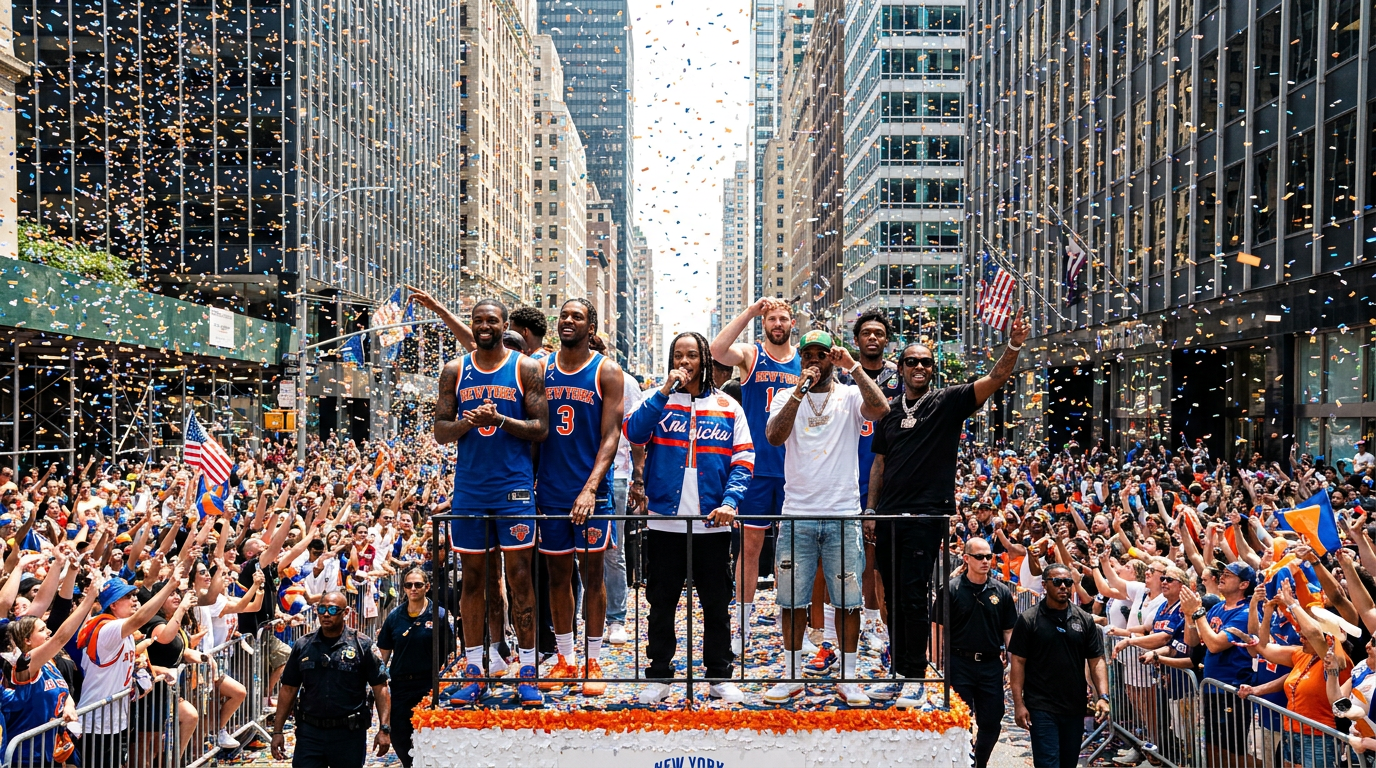
The culmination of the city's elation arrived on Thursday, June 18, with a massive ticker-tape parade down the Canyon of Heroes. The procession from Bowling Green to City Hall served as a dual celebration of basketball supremacy and musical heritage.[2][6]
Alongside the players, the parade featured floats carrying a who's-who of New York hip-hop, including Fat Joe, Remy Ma, Ja Rule, and The LOX. Cameras even captured Mayor Zohran Mamdani doing the "Lean Back" dance alongside the players, cementing the parade as a uniquely New York spectacle.[2][7]
How we got here
1970
The Knicks win their first NBA Championship, with Willis Reed famously playing through injury in Game 7.
1973
The Knicks win their second title; DJ Kool Herc hosts a Bronx party credited as the birth of hip-hop.
1990s
The Patrick Ewing era brings deep playoff runs but ends in heartbreak against the Bulls and Rockets.
2000s–2010s
Decades defined by rebuilding projects, lottery picks, and front-office instability.
June 2026
The Knicks defeat the San Antonio Spurs in five games to claim the 2026 NBA Championship.
June 18, 2026
A massive ticker-tape parade rolls down Broadway, featuring floats with NYC hip-hop legends.
Viewpoints in depth
Hip-Hop Artists & Cultural Figures
Viewing the championship as a shared victory for the culture.
For the hip-hop community, the Knicks' victory was the ultimate poetic justice. Artists and cultural commentators emphasized how rappers had repped the team through decades of losing, treating the franchise as a symbol of working-class aspiration. The fact that the 53-year drought perfectly mirrored the lifespan of hip-hop itself made the championship feel like a joint celebration for the genre's birthplace.
Long-Suffering Knicks Fans
Focusing on the sheer relief and generational joy of ending a 53-year drought.
For lifelong fans, the championship was an emotional release valve. Many pointed to the agonizing heartbreaks of the 1990s and the frustrating rebuilding eras of the 2000s as the crucible that forged their loyalty. They argued that the torturous wait made this championship sweeter and more unifying for the city than titles won by the Yankees or Giants, validating generations of unwavering faith.
New York Historians
Analyzing the parallels between the city in 1973 and 2026.
Historians and local media used the championship to reflect on New York's evolution. They contrasted the gritty, near-bankrupt era of the 1970s with the modern metropolis of 2026. While acknowledging the immeasurable changes in the city's skyline, economics, and demographics, they noted that the passion for the Knicks and the cultural export of hip-hop remained unbroken constants that continue to define New York's identity.
What we don't know
- Whether the Knicks can maintain this championship roster for a repeat run in 2027.
- How the massive cultural and economic boost from the championship will impact the city's broader sports landscape.
Key terms
- Ticker-tape parade
- A traditional New York City celebration held in the Canyon of Heroes in Lower Manhattan, where shredded paper is thrown from office buildings onto the parade route.
- Larry O'Brien Trophy
- The championship trophy awarded annually by the National Basketball Association to the winner of the NBA Finals.
- DJ Kool Herc
- A Jamaican-American DJ credited with originating hip-hop music in the Bronx in 1973 by isolating and extending the instrumental breaks of funk records.
- Canyon of Heroes
- A section of Broadway in the Financial District of Manhattan that serves as the traditional route for ticker-tape parades.
Frequently asked
Who did the Knicks beat in the 2026 NBA Finals?
The Knicks defeated the San Antonio Spurs in five games to win the championship.
Why is 1973 so significant to this championship?
1973 was the last time the Knicks won an NBA title, and it is also widely recognized as the year hip-hop was born in the Bronx.
What happened during Game 4 of the Finals?
The Knicks rallied from a 29-point deficit at Madison Square Garden, a comeback many fans playfully credited to a halftime performance by the Wu-Tang Clan.
Who participated in the championship parade?
The ticker-tape parade featured floats carrying the team alongside New York hip-hop legends like Fat Joe, Wu-Tang Clan, Remy Ma, and Jadakiss.
Sources
Source coverage
7 outlets
3 viewpoints surfaced







[1]ESPNNew York Historians & Media
How the Knicks and hip-hop united New York
Read on ESPN →[2]XXL MagHip-Hop Artists & Cultural Figures
Hip-Hop Reacts to New York Knicks Winning First NBA Championship in 53 Years
Read on XXL Mag →[3]HotNewHipHopHip-Hop Artists & Cultural Figures
Knicks Continue To Influence New York City Hip-Hop
Read on HotNewHipHop →[4]The RingerLong-Suffering Knicks Fans
The Knicks' 53-Year Wait Is Over, and Hip-Hop Finally Gets Its Championship
Read on The Ringer →[5]Revolt TVHip-Hop Artists & Cultural Figures
RZA and Scratch reflect on Knicks fandom and New York pride
Read on Revolt TV →[6]New York Amsterdam NewsLong-Suffering Knicks Fans
Knicks championship shifts the attitude of the entire city
Read on New York Amsterdam News →[7]WNYCNew York Historians & Media
The Knicks last won an NBA championship in 1973. Here's what NYC looked like 53 years ago
Read on WNYC →
More in sports
See all 11 stories →Standings
Mercedes Leads 2026 F1 Standings as Hamilton's Maiden Ferrari Win Ignites Championship Battle
7 sources
Injury
Major NFL Stars Defy Timelines in Uplifting June Injury Returns
6 sources
Women's Soccer
NWSL Shatters Attendance Records as 2026 Expansion Teams Redefine Women's Soccer
9 sources
Standings
Edmonton Elks Surge to Undefeated Start as 2026 CFL Standings Take Early Shape
6 sources
Every angle. Every day.
Get sports stories with full source coverage and perspective breakdowns delivered to your inbox.