
How the Philippines is Building a Global Defense Network to Counter China
Faced with escalating maritime clashes in the South China Sea, Manila is moving beyond its traditional reliance on the U.S. by finalizing sweeping troop-access agreements with Japan, Australia, and France.
By Factlen Editorial Team
- Philippine Defense Establishment
- Argues that a diversified web of security alliances is essential to deter Chinese aggression and protect the country's Exclusive Economic Zone.
- Indo-Pacific Strategists
- Views the agreements as a necessary shift from a US-centric 'hub-and-spoke' model to a resilient 'lattice' of minilateral partnerships.
- Beijing's Security Apparatus
- Condemns the pacts as provocative containment strategies that destabilize the region and introduce external powers into Asian disputes.
What's not represented
- · Southeast Asian Non-Aligned Nations who fear being caught in a great-power conflict.
- · Filipino domestic opposition groups concerned about the loss of sovereignty or being dragged into a foreign war.
Why this matters
By weaving a web of military alliances beyond the United States, the Philippines is fundamentally altering the balance of power in the Indo-Pacific. This multinational deterrence strategy ensures that any future conflict in the South China Sea will immediately entangle Europe, Japan, and Australia, raising the stakes for global trade and security.
Key points
- The Philippines has finalized sweeping defense agreements with France, Japan, and Australia to counter Chinese maritime aggression.
- The pacts allow foreign troops to deploy on Philippine soil and streamline military logistics for joint operations.
- The strategy marks a shift away from relying solely on the U.S., creating a resilient 'lattice' of overlapping alliances.
- China has condemned the agreements as an attempt to build an 'Asian NATO' and responded with combat readiness drills.
The security architecture of the Indo-Pacific is undergoing a fundamental rewiring. For decades, the region's defense relied on a "hub-and-spoke" model, with the United States serving as the central guarantor of security for individual Asian allies who rarely coordinated directly with one another.[6]
But as tensions in the South China Sea reach a boiling point, the Philippines is aggressively moving to rewrite that playbook. Under President Ferdinand Marcos Jr., Manila is finalizing a sweeping network of bilateral defense pacts with Japan, Australia, and France, transforming the archipelago into the anchor of a new, multinational deterrence strategy.[1][6]
The catalyst for this diplomatic offensive is the escalating friction within the Philippines' Exclusive Economic Zone (EEZ). Over the past two years, the Chinese Coast Guard and maritime militia have intensified their harassment of Philippine civilian and government vessels operating in the crucial waterway.[2]
Tactics have escalated from shadowing and radio warnings to the use of military-grade lasers, high-pressure water cannons, and deliberate vessel rammings. These clashes frequently occur near contested features like the Second Thomas Shoal, where Manila maintains a grounded World War II-era ship to assert its territorial claims against Beijing's expansive maps.[2][6]

In response, Philippine Defense Secretary Gilberto Teodoro Jr. has spearheaded a strategy of "security diversification." The goal is to build a "lattice" of overlapping military partnerships that complicate Beijing's strategic calculus and ensure that any conflict in the South China Sea would immediately entangle multiple global powers.[4]
The most significant breakthrough in this strategy occurred in March 2026, when the Philippines and France signed a Status of Visiting Forces Agreement (SOVFA) in Paris. The landmark treaty marks Manila's first such pact with a European nation.[1][4]
The French agreement provides a legal framework for the two militaries to conduct joint exercises on each other's territory. For France, which maintains significant overseas territories and a permanent military presence in the Indo-Pacific, the pact secures vital territorial access to the Philippines during times of regional instability.[4]
This European integration builds upon a rapidly deepening alliance with Japan. In July 2024, Tokyo and Manila signed a Reciprocal Access Agreement (RAA), a historic milestone that allows Japanese Self-Defense Forces to deploy on Philippine soil.[2][5]

This European integration builds upon a rapidly deepening alliance with Japan.
The Japan-Philippines partnership has only accelerated since. In January 2026, the two nations concluded an Acquisition and Cross-Servicing Agreement (ACSA), enabling their militaries to share ammunition, fuel, and supplies on a tax-free basis during joint operations and disaster response efforts.[5]
Tokyo's involvement goes beyond logistics. Having recently lifted its post-war ban on lethal weaponry exports, Japan is now in advanced talks to transfer upgraded destroyers to the Philippine Navy, complementing previous donations of coastal surveillance radars and rigid-hull inflatable boats.[5]
Australia, which has held a SOVFA with the Philippines since 2007, is also upgrading its commitments. In 2026, Canberra and Manila advanced plans for a new defense agreement that includes the construction and maintenance of military infrastructure at five locations on the Philippine island of Luzon.[3]
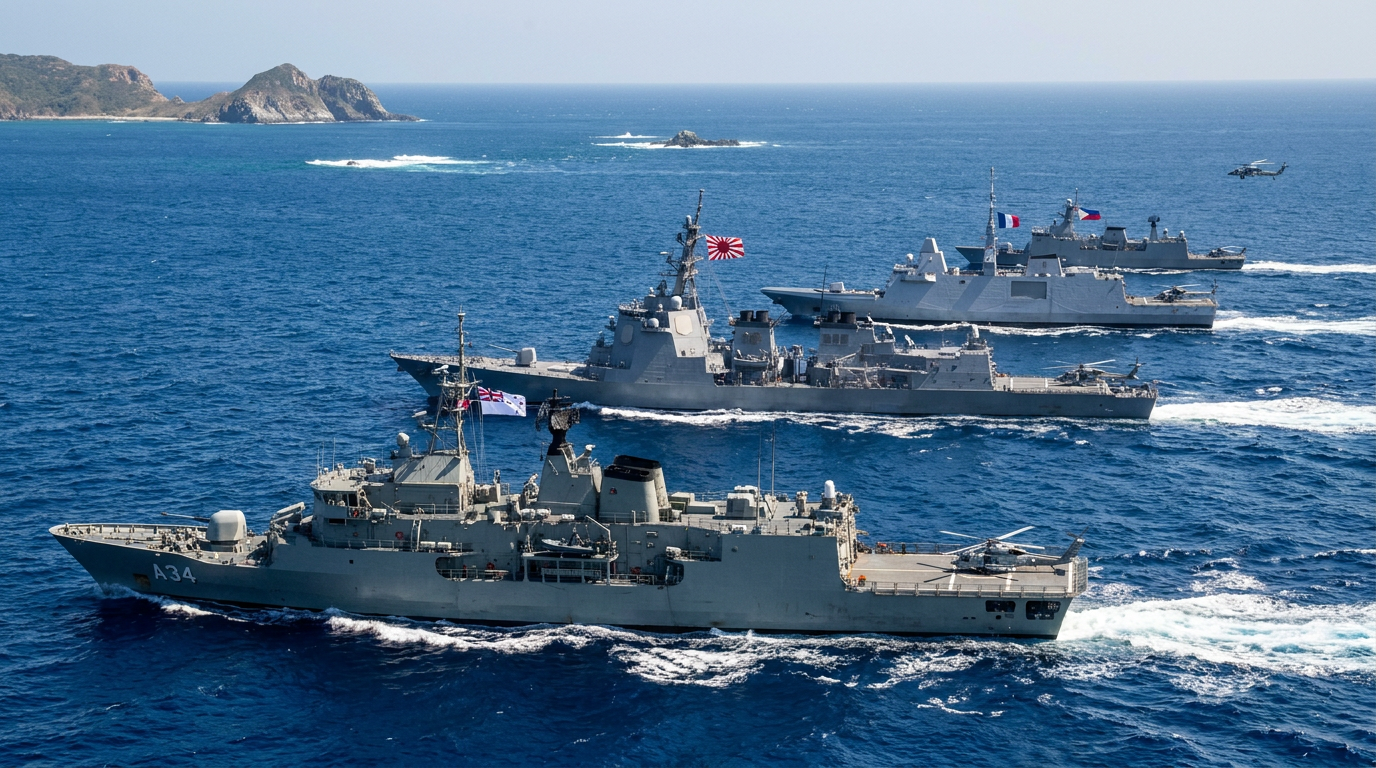
The physical manifestation of this new alliance network was on full display during the Balikatan 2026 military exercises. Traditionally a bilateral drill between the U.S. and the Philippines, this year's iteration transformed into a massive multilateral show of force.[3][5]

Over 10,000 troops participated in full-spectrum operations across the Philippine archipelago. Crucially, Japan deployed troops on Philippine territory for the first time since World War II, transitioning from its historical role as a humanitarian observer to an active participant in combat interoperability drills.[3][5]
France, Canada, and New Zealand also joined the exercises, illustrating the functional reality of Manila's new security network. By bringing these nations into the fold, the Philippines is signaling that the defense of the South China Sea is no longer just a bilateral American concern, but a global imperative.[3]
This diversification also serves as an insurance policy. With the United States increasingly stretched by conflicts in the Middle East and Eastern Europe, and facing domestic political volatility regarding its foreign commitments, Manila is ensuring it has secondary security guarantors.[4]
Beijing has reacted to this diplomatic encirclement with predictable hostility. Chinese officials have repeatedly condemned the agreements, accusing the Philippines of acting as a proxy for Western hegemony and attempting to build an "Asian NATO."[2][3]

During the Balikatan exercises, the People's Liberation Army Southern Theater Command conducted high-profile combat readiness drills. China deployed the Liaoning aircraft carrier and H-6 bombers fitted with supersonic cruise missiles to the region, a clear attempt to maintain a deterrent threshold against the growing coalition.[5]
Despite the intimidation, the Marcos administration shows no signs of reversing course. The Philippines continues to lean heavily on the 2016 international arbitral ruling—which invalidated China's expansive historic claims under the United Nations Convention on the Law of the Sea (UNCLOS)—as the normative foundation for its new alliances.[1][4]
The ultimate test of this "lattice" strategy remains unanswered. While the presence of French, Japanese, and Australian forces undoubtedly raises the geopolitical stakes for Beijing, it is unclear whether these pacts will successfully deter Chinese aggression or simply accelerate the militarization of one of the world's most vital commercial waterways.[6]
How we got here
July 2024
Japan and the Philippines sign a Reciprocal Access Agreement, allowing troop deployments on each other's soil.
January 2026
Tokyo and Manila sign an Acquisition and Cross-Servicing Agreement to streamline military logistics.
March 2026
France becomes the first European nation to sign a Status of Visiting Forces Agreement with the Philippines.
April 2026
The Balikatan military exercises commence, featuring unprecedented participation from Japan, Australia, and France.
Viewpoints in depth
The Philippine Strategic Calculus
Manila views a diversified alliance network as the only viable deterrent against a vastly superior Chinese maritime force.
For the Philippine defense establishment, the traditional reliance on the 1951 Mutual Defense Treaty with the United States is no longer sufficient. Planners in Manila recognize that Washington's attention is divided across multiple global crises. By signing Status of Visiting Forces Agreements with middle powers like France and Australia, and a Reciprocal Access Agreement with Japan, the Philippines is creating a tripwire effect. The logic is that Beijing will be far less likely to use kinetic force against Philippine vessels if doing so risks collateral damage to French, Japanese, or Australian military assets operating in the same theater.
The 'Lattice' Security Model
Strategic analysts see the end of the US-centric 'hub-and-spoke' system in favor of overlapping minilateral partnerships.
Indo-Pacific strategists characterize this shift as the emergence of a 'lattice' security architecture. During the Cold War, the U.S. acted as the central hub, with bilateral alliances extending outward like spokes to individual Asian nations, who rarely cooperated with one another. Today, nations like Japan, Australia, and the Philippines are building direct military ties that bypass Washington entirely. This decentralized network is highly resilient; if domestic politics cause the U.S. to temporarily withdraw from the region, the underlying security architecture between the Asian and European middle powers remains intact.
Beijing's Containment Fears
China interprets the proliferation of defense pacts as a coordinated, US-directed strategy to encircle and contain its rise.
From the perspective of the Chinese Communist Party and the People's Liberation Army, these bilateral agreements are not defensive measures, but aggressive containment. Beijing views the integration of NATO members like France, and AUKUS members like Australia, into South China Sea disputes as an illegitimate external interference in regional affairs. Chinese state media and defense officials frequently warn that the Philippines is acting as a proxy to build an 'Asian NATO,' arguing that the introduction of foreign troops and advanced weaponry into the archipelago fundamentally destabilizes the region and forces China to accelerate its own military readiness.
What we don't know
- Whether these overlapping defense pacts will successfully deter Chinese aggression or provoke a sharper kinetic escalation in the South China Sea.
- How a potential change in Philippine political leadership in 2028 might impact the continuity of these defense agreements.
- The extent to which European nations like France would actually commit forces if a direct conflict broke out between the Philippines and China.
Key terms
- Status of Visiting Forces Agreement (SOVFA)
- A legal treaty that establishes the rights and privileges of foreign military personnel deployed in a host country, streamlining joint exercises.
- Reciprocal Access Agreement (RAA)
- A bilateral defense pact, primarily used by Japan, that allows the militaries of two countries to deploy forces on each other's soil for training and joint operations.
- UNCLOS
- The United Nations Convention on the Law of the Sea, the international agreement that defines the rights and responsibilities of nations regarding the world's oceans.
- Exclusive Economic Zone (EEZ)
- An area of the ocean extending 200 nautical miles from a country's coast, over which it has special rights regarding the exploration and use of marine resources.
Frequently asked
Why is the Philippines signing these agreements now?
Manila is facing increasingly aggressive tactics from the Chinese Coast Guard in the South China Sea, including water cannons and vessel rammings, prompting a need for stronger deterrence.
Does this mean the U.S. is no longer the Philippines' main ally?
No. The U.S. remains Manila's primary treaty ally, but the Philippines is building a 'lattice' of secondary alliances to reduce overreliance on Washington and increase regional resilience.
How has China responded to these defense pacts?
Beijing has condemned the agreements as an attempt to build an 'Asian NATO' and has responded by conducting combat readiness drills and deploying naval assets to the region.
Sources
Source coverage
6 outlets
3 viewpoints surfaced






[1]Naval NewsPhilippine Defense Establishment
Philippines, France sign visiting forces deal amid China tensions
Read on Naval News →[2]EuractivBeijing's Security Apparatus
Philippines and Japan sign reciprocal access agreement
Read on Euractiv →[3]Observer Research FoundationIndo-Pacific Strategists
Balikatan 2026 Showcases the Philippines' Defence Network
Read on Observer Research Foundation →[4]FulcrumIndo-Pacific Strategists
The France-Philippines SOVFA: A Milestone in Manila's Security Diversification
Read on Fulcrum →[5]Atlas Institute for International AffairsIndo-Pacific Strategists
Japan and the Philippines: A New Era of Security Cooperation
Read on Atlas Institute for International Affairs →[6]Factlen Editorial TeamPhilippine Defense Establishment
Synthesis by Factlen editorial team
Read on Factlen Editorial Team →
Every angle. Every day.
Get news politics stories with full source coverage and perspective breakdowns delivered to your inbox.