
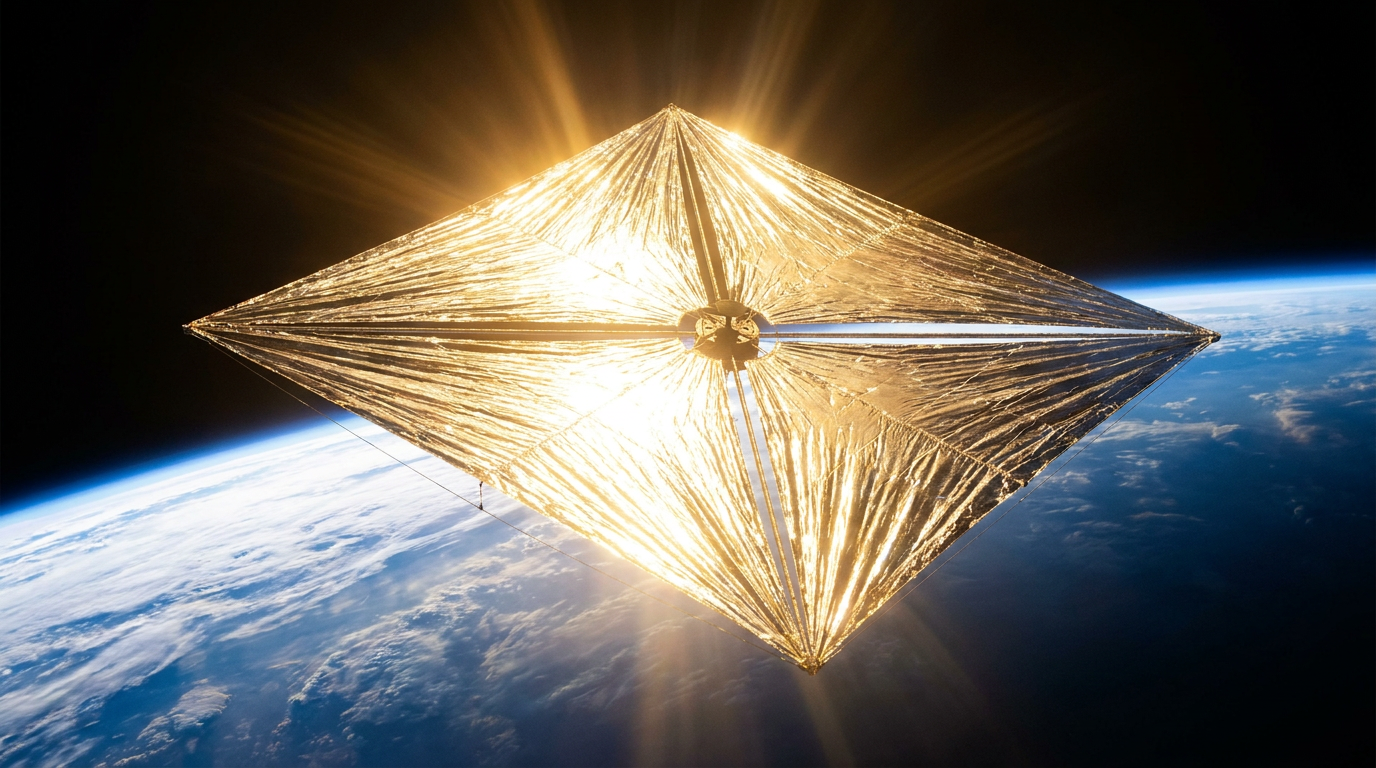
How Solar Sails Harness the Momentum of Light to Navigate Deep Space
By riding the continuous push of radiation pressure, next-generation solar sails are eliminating the need for heavy rocket fuel and opening new frontiers in space exploration.
By Factlen Editorial Team
Space Agencies & Engineers 40%Theoretical Physicists 30%Space Advocacy Groups 30%
- Space Agencies & Engineers
- Focuses on the near-term utility of solar sails for low-cost deep space missions and the material science of composite booms.
- Theoretical Physicists
- Emphasizes the fundamental physics of radiation pressure and the potential for advanced concepts like diffractive sails and laser-driven interstellar probes.
- Space Advocacy Groups
- Highlights the democratization of space exploration, showing how crowdfunded projects paved the way for larger institutional investments.
What's not represented
- · Deep-space mission planners
- · Satellite regulatory bodies
Why this matters
Chemical rockets are fundamentally limited by the weight of their own fuel, restricting how far and fast humanity can explore the cosmos. Solar sails offer a propellant-free alternative that could enable low-cost asteroid reconnaissance, permanent space-weather monitoring stations, and eventually, interstellar travel.

More in science
See all 78 stories →Energy Infrastructure
Renewable Energy Groups Sue Pentagon Over 'Total Halt' of Wind Farm Reviews
6 sources
Stonehenge Origins
Evidence Pack: Neolithic Humans, Not Glaciers, Transported Stonehenge's 6-Ton Altar Stone
8 sources

Planetary Physics
Why Astronomers Are Using 'Earthshine' to Track Climate Change and Hunt for Exoplanets
6 sources
Cellular Imaging
The Laser Phase Plate: A Century-Old Physics Trick Just Unlocked the Human Proteome
5 sources
Stay informed
Every angle. Every day.
Get science stories with full source coverage and perspective breakdowns delivered to your inbox.