
How Physical App Blockers Are Curing the Bedtime Doomscroll
A new wave of hardware devices like ScreenZen's Halo and the Brick use 'intentional friction' to lock distracting apps, helping users reclaim their sleep from addictive algorithms.
By Factlen Editorial Team
- Digital Wellness Advocates
- Argue that physical friction is necessary because human willpower cannot compete with engagement algorithms.
- Sleep & Medical Experts
- Focus on the neurological and physiological impacts of bedtime scrolling, emphasizing technostress over blue light.
- Youth & Student Initiatives
- Highlight the importance of peer-supported behavioral interventions to combat late-night screen addiction.
What's not represented
- · Social Media Companies
- · App Developers
Why this matters
Chronic bedtime doomscrolling is a primary driver of modern sleep deprivation and anxiety. By outsourcing willpower to physical devices, users can reclaim their rest, improve their daytime focus, and break the cycle of algorithmic addiction.
Key points
- A new wave of physical devices, like ScreenZen's Halo and the Brick, are helping users block distracting apps to improve sleep.
- These gadgets rely on 'intentional friction,' requiring users to physically tap a magnet or leave a room to unlock their feeds.
- Built-in software limits often fail because they are too easily bypassed by depleted late-night willpower.
- Sleep experts warn that bedtime scrolling causes 'technostress,' keeping the brain in a state of hyper-arousal that disrupts restorative rest.
- Studies show that physically separating from phones at night can reduce screen time by over an hour and significantly boost daytime energy.
The bleary-eyed scroll has become the default end to the day for millions of people around the globe. Despite widespread awareness of the consequences, the lure of the infinite feed often overpowers the desire for rest, keeping users glued to their screens long past their intended bedtimes. Half of American smartphone users—and a staggering 80 percent of those under the age of 30—report significant anxiety over their device usage, yet find themselves entirely unable to stop when the lights go out [5]. This nightly ritual of doomscrolling has evolved into a modern public health crisis, quietly eroding sleep quality and exacerbating daytime anxiety.[5]
Tech giants have attempted to address this crisis by introducing native software tools like Apple's Screen Time and Google's Digital Wellbeing. These dashboards were supposed to save us from our worst impulses, allowing users to set strict daily limits on their most addictive applications. However, these software barriers rely entirely on depleted late-night willpower. The 'Ignore Limit for 15 Minutes' button is simply too easy to tap, turning what should be a hard boundary into a minor, easily dismissed speed bump. When the barrier to entry is just a single tap, the algorithm almost always wins.
Enter the hardware solution. A rapidly growing sector of the digital wellness industry is moving app-blocking out of the settings menu and into the physical world [1]. Devices like ScreenZen's Halo, the Brick, and the Unpluq tag are designed to save users from their own algorithmic impulses by introducing tangible, real-world barriers. By requiring a physical object to unlock a digital feed, these companies are acknowledging that human discipline is no match for the engineering prowess of the world's largest social media platforms.[1]
The core philosophy driving these gadgets is a behavioral design concept known as 'intentional friction.' Behavioral psychologists note that bad habits thrive on ease, accessibility, and mindlessness. By requiring a physical action to access digital distractions, these devices short-circuit the automatic loop of doomscrolling, forcing the user to make a conscious, deliberate choice. It transforms a passive slide into an active decision, giving the logical part of the brain a crucial few seconds to intervene before the scroll begins.

The mechanics vary by device, but the overarching goal remains identical. The Brick, a $60 palm-sized square, utilizes Near-Field Communication (NFC) technology to enforce its boundaries [2]. Users select their most distracting apps, tap their phone to the physical Brick, and the apps are instantly locked down. To unlock them, the user must physically walk back to the Brick—which is ideally left in the kitchen, the home office, or another room entirely—and tap it again. This physical distance is the key to its effectiveness.[2]
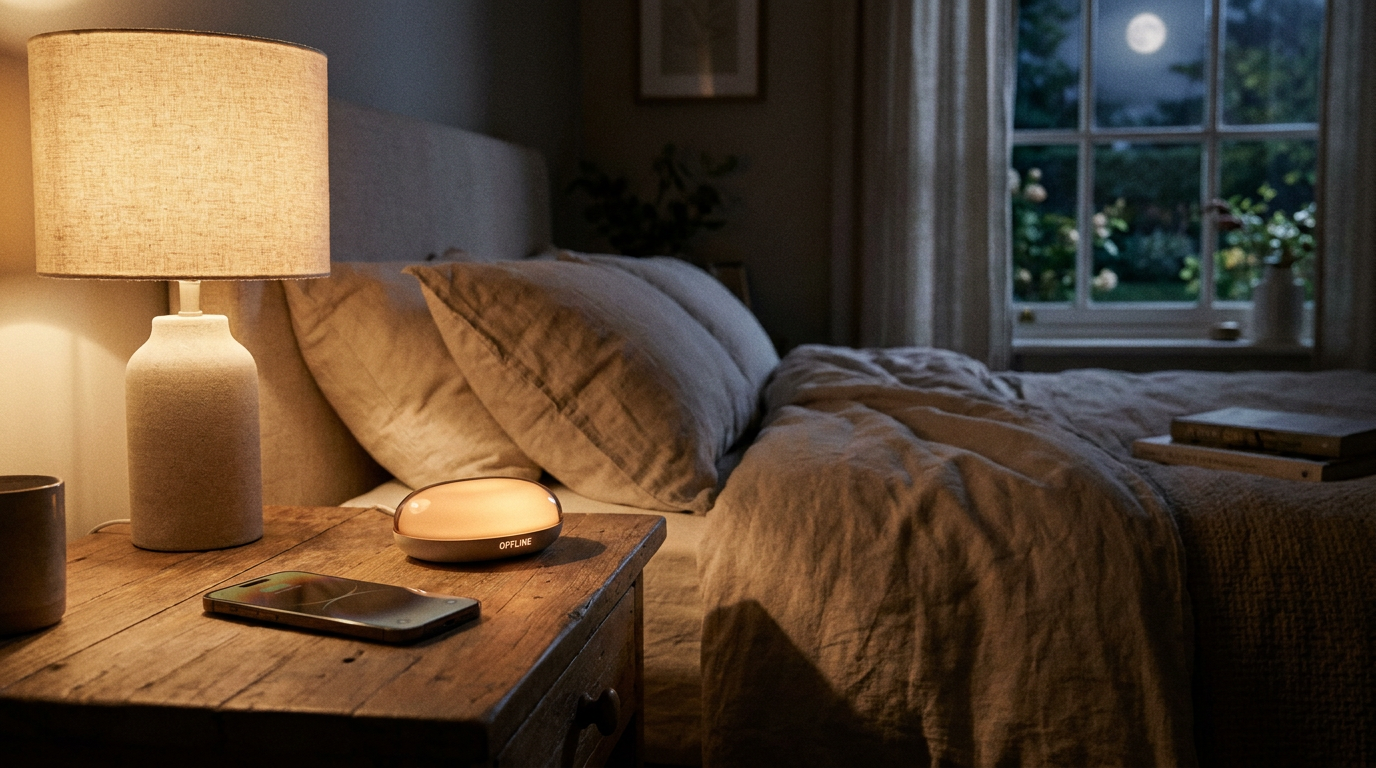
ScreenZen's newly launched Halo device takes a more automated, spatial approach to the problem. Rather than requiring an active tap from the user, the Halo uses Bluetooth proximity to create a location-based app-blocking fortress [3]. It is designed specifically to protect the bedroom environment, recognizing that the bed is where the most damaging and prolonged scrolling sessions typically occur. The device is small, magnetized, and can be placed discreetly on a nightstand or a bedroom wall. By automating the friction, the Halo removes the need for the user to remember to lock their phone before getting under the covers.[3]
When a user walks into their bedroom, the Halo detects the phone's presence and instantly locks down pre-selected applications like TikTok, Instagram, or work email [1]. The bedroom effectively becomes a dead zone for algorithmic feeds, ensuring the space is reserved strictly for rest and analog wind-down activities. The phone remains fully functional for alarms, phone calls, and sleep tracking, but the endless dopamine loops of social media are entirely walled off. This creates a powerful psychological association over time, training the brain to recognize the bedroom as a place of calm rather than a hub of digital stimulation.[1]
To bypass the Halo's block, users must either physically leave the room or navigate a deliberately cumbersome override process within the application [3]. This spatial boundary prevents the mindless, reflexive reach for the phone that so often occurs when sleep proves elusive at two in the morning. If a user truly wants to check their feed, they have to get out of bed and walk into the hallway, a physical hurdle that is usually enough to deter the behavior entirely.[3]

To bypass the Halo's block, users must either physically leave the room or navigate a deliberately cumbersome override process within the application [3].
Why is this physical friction so necessary for modern smartphone users? Counselors and addiction specialists explain that constant digital input triggers the release of neurochemicals in a manner strikingly similar to substance addiction [5]. The brain's neural pathways light up with each swipe, demanding more stimulation and creating a powerful process addiction. When the phone is simply placed face-down on the nightstand without a hard block, the user can experience mild withdrawal symptoms, feeling restless or anxious until they check it again.[5]
When the brain is engaged in a continuous scroll, it enters a state of hyper-arousal that is entirely incompatible with sleep. The barrier to continuing the scroll must be physically demanding enough to break the dopamine reward cycle. A digital passcode fails this test because it requires no physical effort; a physical walk down the hallway passes it. By outsourcing the discipline to a piece of hardware, users are freed from the exhausting mental gymnastics of trying to resist temptation.
The impact of this hyper-arousal on sleep architecture is profound and well-documented. While much of the early conversation around screens and sleep focused on the blue light emitted by displays suppressing melatonin production, sleep experts now emphasize the cognitive load of the content itself [7]. Even with blue-light filters and dark modes activated, the brain is still processing a rapid-fire sequence of information, opinions, and imagery that keeps the nervous system on high alert. This cognitive stimulation tricks the brain into believing it is the middle of the day, completely derailing the body's natural circadian rhythms.[7]
Engaging with emotionally charged content, stressful news cycles, or fast-paced videos right before bed triggers what researchers call 'technostress' [4]. This phenomenon amps up the nervous system, occasionally triggering a mild fight-or-flight response exactly when the body needs to be cooling down for restorative rest. The algorithms designed to maximize engagement are inherently at odds with the biological processes required to fall asleep, creating a nightly tug-of-war that the user almost always loses. By physically blocking these apps, users can finally step off the digital battlefield.[4]

As one sleep specialist noted, you wouldn't take a casserole out of the oven and put it directly into the refrigerator; the brain similarly requires a gradual, uninterrupted cool-down period [4]. Physical app blockers enforce this cool-down by removing the temptation entirely, allowing users to replace doomscrolling with calming analog routines like reading a physical book, stretching, or journaling. Over time, the body begins to associate these new, phone-free cues with rest. This transition is essential for achieving the deep, slow-wave sleep that repairs the body and consolidates memories.[4]
Studies show that enforcing this physical separation yields immediate and measurable dividends. A recent initiative at Singapore's Nanyang Technological University, dubbed the 'Phone Sleeps First' campaign, challenged hundreds of students to physically separate from their devices at night [6]. The project aimed to move beyond mere awareness of screen time and force actual behavioral change through physical boundaries and peer support. Researchers closely monitored the students' sleep onset latency and daytime functioning to gauge the impact of the intervention.[6]
The results of the initiative were striking. Participants reduced their nightly screen time by roughly an hour, reporting that they fell asleep significantly faster and experienced deeper, less fragmented sleep [6]. Furthermore, the students woke up with noticeably more energy and demonstrated better sustained attention during their daytime lectures. The data clearly illustrated that when the option to scroll is physically removed, the body naturally defaults to the rest it desperately needs. These findings echo a growing consensus among public health officials that digital hygiene is as critical to overall well-being as diet and exercise.[6]

The rapid rise of physical app blockers highlights a broader, fundamental shift in consumer technology. Users are increasingly treating algorithmic feeds not as neutral tools, but as environmental hazards that require physical containment strategies. Just as we use physical locks to secure our homes, we are now using physical locks to secure our attention. This hardware-first approach represents a maturation of the digital wellness movement, moving past guilt and willpower into practical, structural solutions. It is an acknowledgment that the digital environment must be actively managed rather than passively consumed.
While these devices require an upfront financial investment—typically ranging from $40 to $60—a growing cohort of users views them as a necessary utility for modern digital hygiene [2]. They represent a structural solution to a structural problem, acknowledging that human willpower was never designed to compete with billion-dollar engagement algorithms engineered by the world's smartest technologists. For many, the one-time cost is a small price to pay for reclaiming hours of lost sleep. The return on investment is measured in clearer mornings, reduced anxiety, and a restored sense of agency.[2]
Ultimately, the goal of devices like the Halo, the Brick, and the Unpluq tag isn't to demonize smartphones, but to restore the boundaries that software slowly eroded. Technology remains an incredible tool, but it requires guardrails to prevent it from consuming the hours meant for recovery. By outsourcing our discipline to a piece of plastic, a magnet, or a Bluetooth beacon, we can finally close our eyes, quiet our minds, and go to sleep. In an age of infinite digital demands, intentional friction might be the ultimate luxury.
How we got here
2018
Apple and Google introduce native Screen Time and Digital Wellbeing dashboards to combat device addiction.
2020
Pandemic lockdowns supercharge social media use, popularizing the term 'doomscrolling'.
2023
Physical NFC-based blockers like the Brick launch, gaining traction among users frustrated by easily bypassed software limits.
2026
Location-based blockers like ScreenZen's Halo automate the friction, turning bedrooms into algorithmic dead zones.
Viewpoints in depth
Digital Wellness Advocates
Argue that willpower is insufficient against billion-dollar algorithms, making physical friction necessary.
This camp emphasizes that software-based screen time limits are fundamentally flawed because they rely on the user's depleted willpower at the end of the day. By introducing physical hardware—like a magnet that must be tapped or a Bluetooth beacon in another room—these advocates believe we can short-circuit the mindless loop of doomscrolling. They view these devices not as a punishment, but as a necessary structural defense against algorithms designed to hijack human attention.
Sleep & Medical Experts
Focus on the physiological damage of bedtime scrolling, emphasizing technostress over blue light.
Medical professionals and sleep researchers argue that the conversation around screens has focused too heavily on blue light and melatonin suppression, missing the larger issue of cognitive arousal. They point out that engaging with emotionally charged content triggers 'technostress,' activating the body's fight-or-flight response. For this camp, physical app blockers are a vital medical intervention to enforce the neurological cool-down period required for restorative sleep.
Youth & Student Initiatives
Highlight the importance of peer-supported behavioral interventions to combat late-night screen addiction.
Focusing on the demographics most affected by digital addiction, this perspective champions community-driven detox programs. Initiatives like university-led campaigns demonstrate that when young adults collectively agree to physically separate from their devices at night, the benefits are immediate and profound. They argue that normalizing physical boundaries around technology is crucial for the mental health and daytime focus of the next generation.
What we don't know
- Whether the novelty of physical app blockers will wear off over time, leading users to abandon the devices.
- How smartphone manufacturers might integrate similar un-bypassable physical friction into future operating systems.
- The long-term neurological benefits of replacing bedtime doomscrolling with analog wind-down routines.
Key terms
- Doomscrolling
- The act of spending an excessive amount of time reading large quantities of highly stimulating or negative content online.
- Technostress
- The psychological and physical arousal caused by constant digital connectivity and engaging algorithms.
- Intentional Friction
- A behavioral design concept where artificial physical barriers are introduced to make a bad habit harder to execute mindlessly.
- NFC (Near-Field Communication)
- A short-range wireless technology that allows devices to communicate when tapped together, used by physical app blockers.
Frequently asked
Why don't built-in screen time limits work?
Built-in limits are easily bypassed with a single tap or passcode, relying entirely on willpower rather than physical friction.
How do physical app blockers actually lock the phone?
They use Apple's Screen Time API or Android's accessibility features, but tie the unlock mechanism to a physical NFC tap or Bluetooth proximity, removing the digital override.
Does blue light filtering fix the sleep problem?
No. While blue light filters reduce eye strain, the cognitive stimulation and 'technostress' from the content itself still disrupt sleep architecture.
Sources
Source coverage
7 outlets
3 viewpoints surfaced







[1]WiredDigital Wellness Advocates
Halo Stops Bedtime Scrolling so You Can Go the F to Sleep
Read on Wired →[2]CNETDigital Wellness Advocates
This $60 Magnet Changed How I Use My iPhone
Read on CNET →[3]Apartment TherapyDigital Wellness Advocates
The Halo is a new physical device that pairs with the ScreenZen app
Read on Apartment Therapy →[4]AP NewsSleep & Medical Experts
It's not just the light that keeps you up: How doomscrolling ruins sleep
Read on AP News →[5]Sanford HealthSleep & Medical Experts
How doomscrolling affects your brain and mental health
Read on Sanford Health →[6]The Straits TimesYouth & Student Initiatives
Phone Sleeps First: NTU student project helps undergrads put phones away for better sleep
Read on The Straits Times →[7]HatchSleep & Medical Experts
How to Break the Doomscrolling Curse for Better Sleep
Read on Hatch →
Every angle. Every day.
Get technology stories with full source coverage and perspective breakdowns delivered to your inbox.