
How AI and Virtual Production Are Resurrecting the Mid-Budget Movie
Advanced generative video tools and affordable LED stages are slashing visual effects costs, allowing independent filmmakers to produce blockbuster-quality cinema on a fraction of the budget.
By Factlen Editorial Team
- Independent Filmmakers
- View AI and virtual production as democratizing forces that lower barriers to entry and allow them to compete visually with major studios.
- Major Studios
- See generative tools as essential mechanisms to control ballooning production budgets and mitigate financial risk on mid-tier projects.
- Below-the-Line Professionals
- Cautiously adapting to the new workflows, focusing on securing compensation frameworks and utilizing AI as a co-director rather than a replacement.
- Theatrical Exhibitors
- Celebrating the resurgence of diverse, mid-budget content that is driving a robust post-pandemic box office recovery.
What's not represented
- · Background actors (extras) whose physical presence is increasingly replaced by AI crowd generation.
- · Traditional set builders and location scouts facing reduced demand due to virtual production.
Why this matters
By drastically lowering the financial barrier to entry for high-end visual storytelling, these technologies are breaking the monopoly of the $250 million blockbuster. This means audiences will see a wider variety of original, visually stunning stories in theaters, rather than just endless franchise sequels.
Key points
- The $10M–$50M mid-budget theatrical movie is experiencing a massive resurgence in 2026.
- AI video models can now generate 120-second, photorealistic scenes with perfect temporal consistency.
- Filmmakers are using 'Dynamic Pre-Vis' to animate storyboards, saving millions in pre-production costs.
- Affordable LED volumes allow indie creators to shoot blockbuster-scale environments without leaving the soundstage.
- Major studios like Amazon MGM and Lionsgate are actively funding and integrating these generative workflows.
The cinematic landscape of 2026 is witnessing a miraculous resurrection. For years, the industry was hollowed out, leaving a polarized market dominated by $250 million superhero behemoths on one end and micro-budget indie films on the other. The traditional mid-budget movie—the $10 million to $50 million original feature—was largely considered dead, relegated exclusively to streaming platforms. But today, the mid-budget theatrical release is roaring back to life, driving a robust post-pandemic box office recovery.[4][5]
The driving force behind this renaissance is not merely a shift in audience taste or franchise fatigue. It is a fundamental revolution in production economics. High-end visual storytelling, once the exclusive domain of major studios with massive visual effects budgets, has been rapidly democratized. Independent creators and mid-tier studios can now execute million-dollar visual sequences without hiring sprawling visual effects teams or renting massive physical soundstages.[1][6]
By leveraging a new stack of accessible technologies, filmmakers are doing more with less. They are fundamentally rewriting the traditional Hollywood production budget from the ground up, proving that compelling cinema does not require a quarter-billion-dollar investment. This shift allows independent filmmakers to operate similarly to nimble tech startups, enjoying greater freedom to establish their procedures and creative direction without the bureaucratic overhead of legacy studio systems.[6]
The primary mechanism powering this shift is the rapid maturation of generative AI video models. In just two years, tools like OpenAI's Sora 2 Pro, Google's Veo 3.1, and Kling 3.0 have evolved from generating glitchy, five-second novelties into production-grade assets. These systems can now render up to 120-second, photorealistic scenes at full 1080p resolution, complete with native audio synchronization and complex physics simulations like fluid dynamics and volumetric lighting.[1][2]

The critical technical breakthrough of 2026 is the eradication of "AI morphing" through a concept known as temporal consistency. Previously, AI-generated characters and environments would awkwardly shift physical traits between camera angles, rendering the footage unusable for narrative filmmaking. Today's models can lock a character's identity and maintain exact physical traits across dozens of separate generations.[1][2]
This allows creators to build coherent narrative sequences with a persistent protagonist. Achieving this level of multi-shot consistency previously required expensive actor motion-capture pipelines and months of manual digital rendering by dedicated animation teams. Now, a solo creator with a laptop and an internet connection can produce content that would have required a full production crew just three years ago.[2]
This allows creators to build coherent narrative sequences with a persistent protagonist.
This newfound stability has birthed a new pre-production standard known as "Dynamic Pre-Vis" (pre-visualization). Instead of relying on static, hand-drawn storyboards or expensive early-stage animations, directors can instantly generate highly accurate, animated scene blocking. By prototyping complex sequences in hours rather than weeks, productions save millions of dollars before a single physical camera ever rolls.[1]

Industry professionals increasingly view these tools not as replacements for human vision, but as an ultimate "AI Co-Director" that slashes pre-production bloat. It allows for rapid creative iteration and ensures that the entire crew shares a unified visual understanding of the film before arriving on set. The time saved becomes a massive competitive advantage for independent productions operating on tight schedules.[1][2]
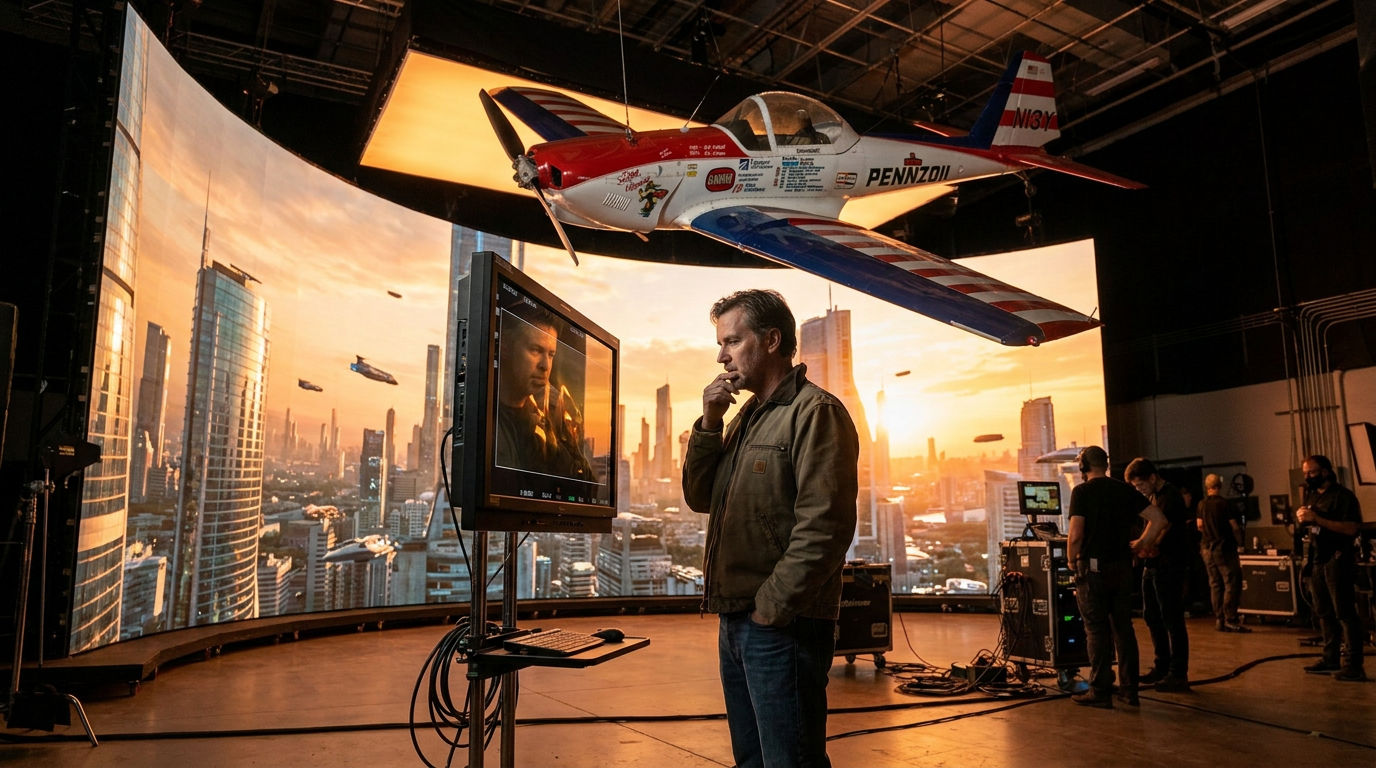
The physical counterpart to this software revolution is the democratization of the LED volume. Popularized by big-budget series like The Mandalorian, virtual production stages allow actors to perform in front of dynamic, real-time digital environments displayed on massive, high-definition screens, effectively eliminating the need for green screens.[5]
In 2026, modular and mobile LED volumes have finally hit the mid-budget market. Smaller production hubs and independent studios can now afford these setups. This means an indie sci-fi film can shoot a sprawling alien cityscape from a warehouse in Atlanta, complete with realistic lighting reflections and instant weather adjustments, making high-end visuals more viable than ever.[5][7]
Major Hollywood studios are not fighting this democratization; they are actively institutionalizing it to manage their own ballooning costs. Recognizing the cost-saving potential, Amazon MGM Studios recently launched a $100 million GenAI Creators' Fund to support AI-assisted production workflows. Similarly, Lionsgate has partnered with Runway to build a custom generative AI model specifically designed for its filmmakers.[3]
The financial results of this leaner, more efficient production model are already materializing at the multiplex. The first quarter of 2026 saw the domestic box office hit $1.77 billion—the strongest start since the pandemic began. Crucially, this surge was driven heavily by original sci-fi and mid-budget features rather than just established franchises. Because production and marketing costs are more manageable, the break-even point for these films is reached much faster.[4][5]

Uncertainty certainly remains, particularly regarding copyright, the use of digital likenesses, and the potential homogenization of art. However, industry guilds like the WGA and SAG-AFTRA have established robust compensation frameworks, ensuring that AI serves as a collaborative tool that respects human contributions and intellectual property.[1][3]
Ultimately, the age of AI cinema has shifted the industry's core scarcity. The barrier to entry is no longer the ability to finance a massive production, but rather the strength of a creator's vision and taste. For storytellers with a unique voice, the tools to bring their imagination to the screen have never been more accessible.[2][6]

How we got here
Late 2024
OpenAI unveils Sora, introducing high-fidelity generative video to the public.
Mid 2025
Runway Gen-3 Alpha introduces multi-shot consistency, allowing for persistent characters.
Late 2025
Disney signs a major partnership with OpenAI to integrate Sora into its production pipeline.
Early 2026
The domestic box office hits $1.77 billion in Q1, driven by a resurgence of original mid-budget films.
Viewpoints in depth
Independent Filmmakers
View AI and virtual production as democratizing forces that lower barriers to entry and allow them to compete visually with major studios.
For independent directors and micro-budget studios, the 2026 tech stack is nothing short of a creative liberation. Historically, a script requiring a sprawling sci-fi cityscape or a massive historical battle would be dead on arrival without a $100 million budget. Today, these creators argue that AI and LED volumes have leveled the playing field. By utilizing generative tools for dynamic pre-visualization and background generation, indie filmmakers can punch far above their weight class, focusing their limited funds on securing top-tier acting talent rather than rendering digital environments.
Major Studios
See generative tools as essential mechanisms to control ballooning production budgets and mitigate financial risk on mid-tier projects.
Studio executives are embracing generative AI not merely as a creative tool, but as a financial necessity. Following a string of high-profile $250 million blockbuster flops in the early 2020s, studios realized that the traditional VFX pipeline had become unsustainably bloated. By institutionalizing AI workflows—evidenced by Amazon MGM's $100 million GenAI Creators' Fund and Lionsgate's custom Runway model—studios can drastically reduce the break-even point for their films. This allows them to greenlight a wider variety of mid-budget projects, diversifying their slates and reducing their reliance on massive, make-or-break franchise tentpoles.
Below-the-Line Professionals
Cautiously adapting to the new workflows, focusing on securing compensation frameworks and utilizing AI as a co-director rather than a replacement.
For visual effects artists, storyboarders, and crew members, the AI revolution presents a complex duality. While there is undeniable anxiety regarding job displacement—particularly for entry-level rotoscoping and static storyboard illustration—many professionals are actively adapting. The prevailing sentiment among guild members is that AI should function as a 'co-director' and prototyping tool rather than a wholesale replacement for human artistry. Following the landmark union negotiations of the mid-2020s, these professionals are focused on enforcing frameworks that ensure fair compensation when their previous work is used to train proprietary studio models.
Theatrical Exhibitors
Celebrating the resurgence of diverse, mid-budget content that is driving a robust post-pandemic box office recovery.
Movie theater owners are perhaps the most unexpected beneficiaries of the AI production boom. For years, exhibitors suffered from a 'tentpole-or-bust' release calendar, where a few massive superhero films propped up the entire year's revenue. The democratization of high-end production has led to a flood of visually compelling, mid-budget original films hitting theaters. Exhibitors argue that this steady, year-round supply of diverse content—which drove the $1.77 billion Q1 2026 box office—is exactly what the theatrical industry needs to survive and thrive in the streaming era.
What we don't know
- How copyright law will ultimately treat AI-generated sequences trained on proprietary studio data.
- Whether the democratization of these tools will lead to a creative renaissance or an oversaturated market of homogenized content.
- The long-term impact on entry-level jobs in the visual effects and storyboarding sectors.
Key terms
- Temporal Consistency
- The ability of an AI video model to maintain a character's exact physical traits and identity across multiple different shots and angles.
- Dynamic Pre-Vis
- The use of AI to generate animated, highly accurate scene blocking and storyboards before physical filming begins.
- LED Volume
- A physical soundstage surrounded by massive, high-definition LED screens that display real-time digital backgrounds during filming.
- Generative Video Model
- An artificial intelligence system trained to create novel, high-fidelity video sequences based on text prompts or image references.
Frequently asked
Will AI replace human actors and directors?
No. Industry consensus in 2026 views AI as a "co-director" and prototyping tool. Guilds like SAG-AFTRA have also established frameworks to protect human likenesses and ensure compensation.
How does virtual production save money?
By using LED volumes, productions eliminate the need for expensive location shoots, travel, and extensive post-production green-screen compositing.
Are audiences actually watching these mid-budget films?
Yes. The first quarter of 2026 saw a massive $1.77 billion box office surge, driven largely by original, non-franchise films that utilized these cost-effective production methods.
Sources
Source coverage
7 outlets
4 viewpoints surfaced







[1]AI JournBelow-the-Line Professionals
The 2026 AI Filmmaking Revolution: Beyond Basic Text-to-Video
Read on AI Journ →[2]Agent CritiqIndependent Filmmakers
From Novelty to Production Tool: The Runway Gen-3 Breakthrough
Read on Agent Critiq →[3]Netflix JunkieMajor Studios
AI in Hollywood: Every Major Studio Betting Big on AI in Film and Television
Read on Netflix Junkie →[4]No Film SchoolTheatrical Exhibitors
The 2026 Q1 box office hits $1.77 billion and everyone is quite happy
Read on No Film School →[5]Screen DollarsMajor Studios
The Future of Film: 7 Trends Reshaping Cinema in 2025 and Beyond
Read on Screen Dollars →[6]Film LocalIndependent Filmmakers
The Hidden Economics Reshaping the Future of Cinema
Read on Film Local →[7]Virtual Production ServicesBelow-the-Line Professionals
Top 10 Trends in Virtual Production
Read on Virtual Production Services →

Every angle. Every day.
Get entertainment stories with full source coverage and perspective breakdowns delivered to your inbox.