
High-Tech Sails Are Bringing Wind Power Back to Commercial Shipping
Major cargo operators are deploying spinning rotors, suction wings, and rigid sails to cut fuel consumption and decarbonize global trade.
By Factlen Editorial Team
- Shipowners & Operators
- Focused on fuel savings, regulatory compliance, and operational reliability.
- Technology Developers
- Focused on maximizing thrust, aerodynamic efficiency, and retrofitting capabilities.
- Maritime Regulators & Analysts
- Focused on safety, stability, and standardizing emissions reductions.
What's not represented
- · Port Authorities
- · Seafarers & Crew Unions
Why this matters
Shipping accounts for roughly 3% of global carbon emissions. By harnessing free wind energy, the maritime industry can immediately reduce its reliance on fossil fuels, lowering the environmental footprint of the goods we buy every day.
Key points
- Commercial shipping is experiencing a resurgence in wind power, utilizing high-tech sails to reduce fuel consumption and greenhouse gas emissions.
- Major operators like Maersk Tankers and MOL are moving beyond pilot projects, committing to fleet-wide deployments of wind-assist technologies in 2025 and 2026.
- Modern systems include suction sails, spinning Flettner rotors, and massive rigid wings that can generate significant forward thrust.
- Depending on the technology and route, wind-assisted propulsion can reduce a ship's main engine fuel consumption by 5% to 25%.
- To avoid interfering with port cranes and bridges, many new sail designs are engineered to tilt or retract when necessary.
The silhouette of the modern cargo ship is changing. After a century of relying almost exclusively on massive diesel engines, commercial shipping is returning to its oldest and most abundant power source: the wind.[7]
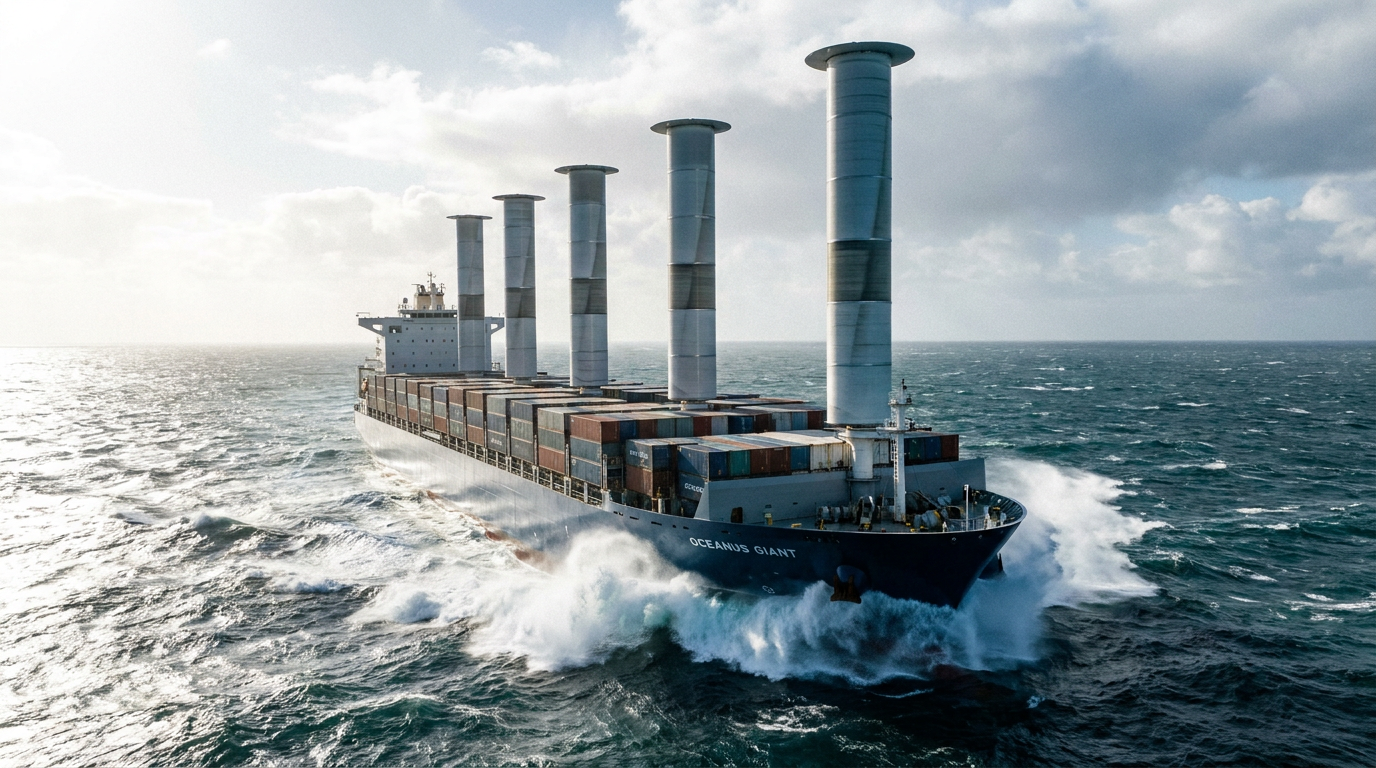
But the new generation of wind-powered vessels looks nothing like the canvas-rigged clippers of the 19th century. Instead, the decks of modern tankers and bulk carriers are being fitted with spinning cylinders, perforated suction wings, and massive rigid sails that resemble airplane wings standing on end.[5][7]
The stakes for this transition are immense. Global shipping accounts for roughly 3% of all anthropogenic greenhouse gas emissions. With the International Maritime Organization (IMO) mandating a transition to net-zero emissions by 2050, shipowners are under intense regulatory pressure to decarbonize their fleets.[5]
While alternative low-carbon fuels like green methanol and ammonia are currently in development, they remain expensive and scarce. Wind, by contrast, is free, abundant, and available immediately anywhere on the open ocean, making it an ideal auxiliary power source.[7]

In 2026, the adoption of Wind-Assisted Ship Propulsion (WAPS) has crossed a critical tipping point. Major operators are moving beyond single-ship pilot projects and committing to fleet-wide deployments of the technology.[1][2]
Maersk Tankers, which manages a fleet of over 240 vessels, is currently executing the largest deployment of suction sail technology to date. Throughout 2025 and 2026, the company is installing 20 autonomous "eSAIL" systems across five of its medium-range tankers.[1][2]
These suction sails, developed by the engineering firm bound4blue, do not catch the wind like a traditional fabric sail. Instead, they utilize a thick aerodynamic profile combined with an active boundary-layer suction mechanism.[1][7]
These suction sails, developed by the engineering firm bound4blue, do not catch the wind like a traditional fabric sail.
By dragging air across the surface and pulling it through small perforations using an internal fan, the system prevents aerodynamic stall. This allows the vertical wing to generate massive amounts of lift, which translates directly into forward thrust for the ship.[1][7]

Another leading technology in the WAPS sector relies on a physics quirk known as the Magnus effect. Companies are building tall, vertical cylinders—often called Flettner rotors—that spin rapidly using a small electric motor.[5]
As the ocean wind blows across the spinning cylinder, the air accelerates on one side and decelerates on the other. This creates a powerful pressure differential that pushes the ship forward, allowing the vessel to throttle back its main engines while maintaining a constant speed.[5][7]

For maximum raw power, some developers are turning to rigid wing sails. Oceanbird, a joint venture between Alfa Laval and Wallenius, has engineered the Wing 560, a rigid sail that stands 46 meters (150 feet) tall on its foundation.[6]
In Japan, Mitsui O.S.K. Lines (MOL) is aggressively deploying its "Wind Challenger" hard sails. In 2026, MOL is taking delivery of the world's first LNG carrier equipped with the technology, and recently secured regulatory approval for a massive liquefied CO2 carrier featuring three of the towering units.[3]
Integrating these systems into existing supply chains is not without challenges. Installing 150-foot towers on a ship's deck can complicate cargo loading, obstruct bridge visibility, and interfere with port cranes or low bridges along trade routes.[5]
To solve these logistical hurdles, engineers have developed tiltable and retractable designs. Econowind's newly launched 5-series VentoFoil, designed specifically for deepsea shipping, can fold down horizontally to the deck during port operations or severe weather.[4][6]

The economics of wind assistance are becoming increasingly undeniable. Depending on the specific technology, the size of the vessel, and the prevailing winds on the trade route, WAPS can reduce a ship's main engine fuel consumption by 5% to 25%.[1][5]
Wind will not replace diesel or alternative fuels entirely—modern global supply chains require strict, predictable schedules that cannot afford to be stalled in the doldrums. But as a hybrid solution, high-tech sails are permanently altering the economics and environmental footprint of global trade.[7]
How we got here
1920s
German engineer Anton Flettner pioneers the rotor ship, but the concept languishes due to cheap oil.
2018
Maersk Tankers installs rotor sails on the Maersk Pelican, marking a modern revival of the technology.
2024
Maersk Tankers announces the largest deployment of suction sails to date across five vessels.
April 2026
Econowind launches its 5-series VentoFoil designed specifically for deepsea shipping.
2026
MOL takes delivery of the world's first LNG carrier equipped with Wind Challenger hard sails.
Viewpoints in depth
Shipowners & Operators
Focused on the economic payback and regulatory compliance of wind technology.
For massive fleet operators like Maersk Tankers and MOL, wind propulsion is primarily a math equation. Fuel is the single largest operating expense for a commercial vessel. By reducing fuel consumption by up to 25%, wind-assist systems offer a clear return on investment while simultaneously helping companies meet the IMO's increasingly stringent Carbon Intensity Indicator (CII) regulations. Their main concern is ensuring the technology does not disrupt strict loading schedules or require excessive maintenance.
Technology Developers
Focused on maximizing aerodynamic efficiency and retrofitting capabilities.
Engineering firms like bound4blue, Econowind, and Oceanbird are racing to build the most efficient and practical sails. They argue that wind is the only zero-emission power source available immediately, without waiting for global green-fuel supply chains to mature. Their engineering focus is on creating autonomous systems that automatically adjust to wind conditions without requiring extra work from the crew, and designing tiltable structures that don't interfere with port infrastructure.
Maritime Regulators
Focused on safety, vessel stability, and standardizing emissions reductions.
Organizations like the IMO and classification societies (such as ClassNK) are tasked with ensuring these massive deck structures are safe. They evaluate how 150-foot sails affect a ship's center of gravity, its ability to navigate severe storms, and bridge visibility. Regulators are also working to standardize how fuel savings from wind are calculated, ensuring that shipowners receive accurate carbon credits for their investments.
What we don't know
- It remains unclear which of the competing technologies—suction sails, rotors, or rigid wings—will ultimately dominate the market.
- The long-term maintenance costs of operating complex mechanical sails in harsh, corrosive saltwater environments are still being evaluated.
- The exact impact of widespread wind-assist adoption on global shipping schedules and route optimization algorithms is still developing.
Key terms
- Wind-Assisted Ship Propulsion (WAPS)
- Technologies that harness wind power to provide auxiliary thrust to motor-driven commercial vessels.
- Magnus Effect
- The observable phenomenon where a spinning cylindrical object drags air with it, creating a pressure difference that generates a sideways force.
- Suction Sail
- A vertical aerodynamic wing that uses an internal fan to draw air through perforations on its surface, preventing aerodynamic stall and generating high lift.
- Boundary-Layer Suction
- An aerodynamic technique used to keep airflow attached to a surface, dramatically increasing the efficiency of a wing or sail.
Frequently asked
Can these ships sail on wind alone?
No, they are wind-assisted. The sails provide auxiliary thrust, allowing the main engines to throttle down and save fuel while maintaining a constant speed.
What happens when there is no wind?
When there is no wind, the ship relies entirely on its primary diesel or alternative-fuel engines, just like a conventional vessel.
How do the sails avoid hitting bridges or port cranes?
Many modern wind-assist systems are engineered to tilt horizontally or retract telescopically when the ship enters port or faces severe weather conditions.
Sources
Source coverage
7 outlets
3 viewpoints surfaced






[1]gCaptainShipowners & Operators
Maersk Tankers to Deploy Suction Sails on Five Vessels in 2025-2026
Read on gCaptain →[2]Riviera Maritime MediaShipowners & Operators
Maersk Tankers inks deal for 20 wind-assisted propulsion systems
Read on Riviera Maritime Media →[3]Mitsui O.S.K. LinesShipowners & Operators
World's First Liquefied CO2 Carrier Equipped with Wind Challenger - Approval in Principle Obtained
Read on Mitsui O.S.K. Lines →[4]EconowindTechnology Developers
Econowind moves into deepsea market with 5-series VentoFoil
Read on Econowind →[5]International Maritime OrganizationMaritime Regulators & Analysts
Wind-assisted propulsion systems (WAPS)
Read on International Maritime Organization →[6]OceanbirdTechnology Developers
Wing 560 tiltable rigid wing sail
Read on Oceanbird →[7]Factlen Editorial TeamMaritime Regulators & Analysts
Synthesis by Factlen editorial team
Read on Factlen Editorial Team →
Every angle. Every day.
Get transportation stories with full source coverage and perspective breakdowns delivered to your inbox.