
First Complete Connectome of an Adult Brain Mapped, Charting 140,000 Neurons in the Fruit Fly
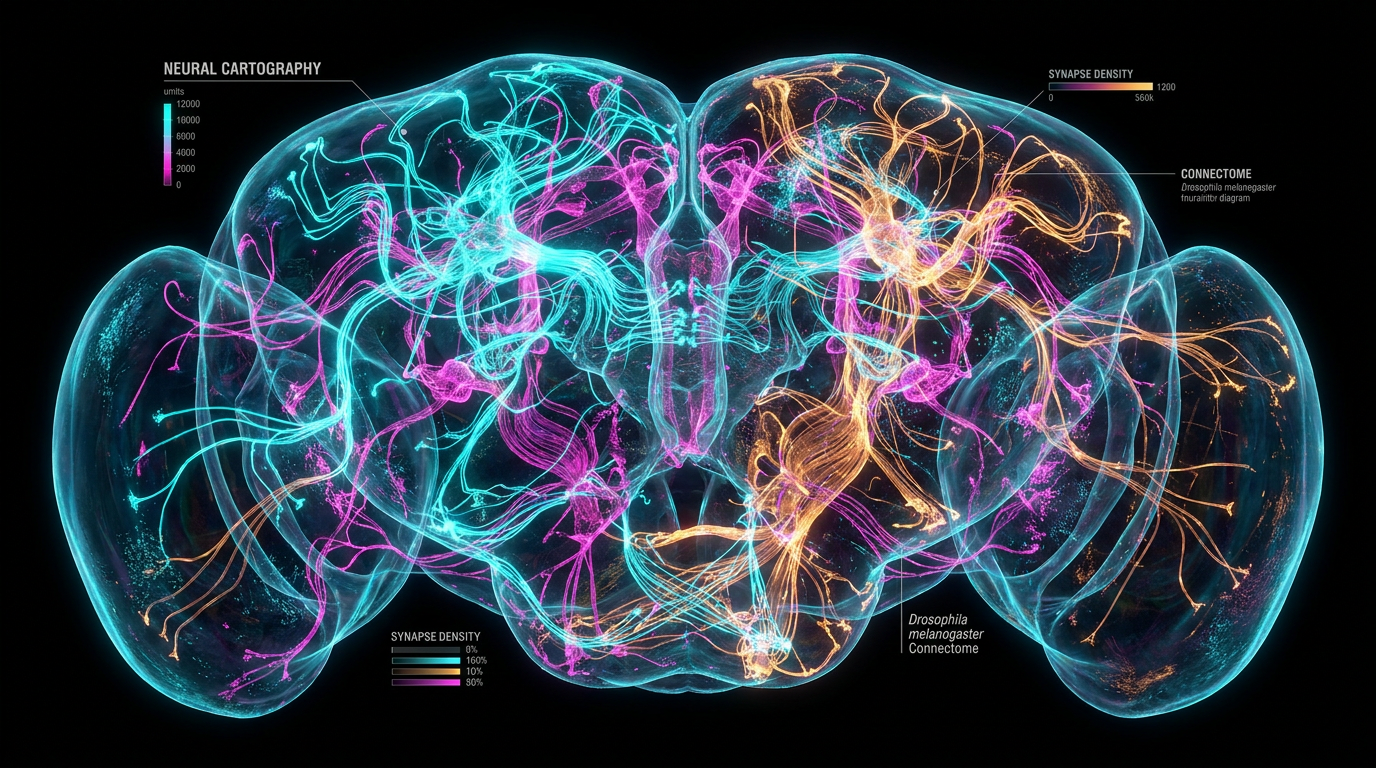
An international consortium has published the first complete wiring diagram of an adult animal brain, mapping 139,255 neurons and 54.5 million synapses in the fruit fly. The landmark achievement provides a foundational 'ground truth' for understanding complex neural circuits and human neurological diseases.
By Factlen Editorial Team
- Fundamental Neurobiologists
- View the connectome as a foundational 'ground truth' that will drastically reduce the time needed to design and execute future neural studies.
- Computational & AI Researchers
- Focus on the role of AI in segmenting the data and the future potential to use this static map to build dynamic, functional computer simulations of a working brain.
- Translational Health Scientists
- Emphasize the 60% genetic overlap between flies and humans, viewing the map as a critical tool for understanding neurodegenerative diseases.
What's not represented
- · Philosophers of mind debating whether structural mapping can ever fully explain consciousness or subjective experience.
- · Researchers studying non-model organisms who argue that focusing heavily on Drosophila may obscure unique neural adaptations in other species.
Why this matters
By mapping the exact physical wiring of a complex brain, scientists now have a 'ground truth' template to understand how neural circuits drive behavior. Because fruit flies share 60% of their DNA with humans, this map provides a crucial baseline for uncovering how miswired circuits lead to neurodegenerative diseases like Alzheimer's and Parkinson's.
Key points
- An international consortium has published the first complete wiring diagram of an adult animal brain capable of complex behavior.
- The map details 139,255 neurons and 54.5 million chemical synapses in the adult fruit fly.
- Researchers identified 8,453 distinct cell types, including over 4,500 that were previously unknown to science.
- The project required 21 million electron microscopy images, AI segmentation, and extensive manual proofreading.
- The connectome provides a foundational 'ground truth' for studying neural circuits, sensorimotor flow, and human neurological diseases.
For the first time in the history of biology, scientists have mapped the complete wiring diagram of an adult animal capable of complex behavior. Published across a suite of nine papers in the journal Nature, the milestone details the full connectome of the adult fruit fly, known scientifically as Drosophila melanogaster.[1][2]
The effort, led by the international FlyWire Consortium, represents a monumental leap in biological scale. Previous complete connectomes were limited to the microscopic roundworm C. elegans, which possesses just 302 neurons, and the larval stage of the fruit fly, which has roughly 3,000. The adult fruit fly brain, by contrast, houses 139,255 neurons connected by 54.5 million chemical synapses.[1][3][4][5]
The adult fly is capable of sophisticated behaviors—including navigation, courtship singing, and associative memory—making its brain a highly relevant model for understanding complex neural networks. Researchers note that there is currently no other full brain connectome for an adult animal of this complexity.[3][5]

The foundation of the connectome relies on high-resolution electron microscopy. Researchers sliced a single female fly brain into 7,000 sections, each just 40 nanometers thick, generating 21 million images and 100 terabytes of raw visual data.[1][6]
Because manually tracing the intricate branches of 140,000 neurons would take an estimated 33 human-years, the team deployed advanced artificial intelligence to segment the images and predict synaptic connections. However, because AI inevitably makes errors, a global network of researchers and citizen scientists meticulously proofread the AI's work, manually correcting tens of thousands of connections to establish a reliable ground truth.[3][6]
Beyond simply mapping the wires, the consortium systematically annotated the biological identity of the cells. The resulting atlas classifies 8,453 distinct cell types within the fly brain.[2]

Beyond simply mapping the wires, the consortium systematically annotated the biological identity of the cells.
Crucially, 4,581 of these cell types are entirely new to science, discovered primarily in brain regions outside the previously mapped "hemibrain" subvolume. This comprehensive cell dictionary allows researchers to query the brain's architecture with unprecedented precision, identifying exactly which neurotransmitters, such as dopamine or serotonin, are secreted by specific circuits.[1][2][4]
The researchers used the connectome to compute a "projectome"—a macro-level map detailing how the brain's 78 distinct regions, or neuropils, communicate with one another.[1][6]
The evidence demonstrates that the fly brain is highly interconnected; within just four synaptic hops, almost any neuron can communicate with any other neuron. By tracing specific pathways, such as those from photoreceptors in the eye down to the motor neurons controlling the wings, scientists can now directly link physical brain structure to sensorimotor behaviors.[1][4][6]

While a fly is not a human, the fundamental principles of neural wiring are highly conserved across species. Fruit flies share approximately 60% of their DNA with humans, including many genes implicated in neurological conditions.[3]
The NIH BRAIN Initiative, which partially funded the project, views the fly connectome as a critical stepping stone. By understanding the baseline healthy wiring of a complex brain, researchers hope to model how miswiring or synaptic degradation leads to conditions like Alzheimer's, Parkinson's, and dementia.[3][4]
Despite its unprecedented detail, the FlyWire connectome is not a complete picture of brain function. The current map exclusively charts chemical synapses, which are only one method of neural communication.[1][7]

It does not capture electrical synapses, known as gap junctions, nor does it account for diffusion-based neuromodulation, where chemicals wash over brain regions without direct point-to-point wiring. Furthermore, the map represents a single female brain at a static moment in time, leaving open questions about individual variability, sexual dimorphism, and how the connectome changes as the animal learns and ages.[2][7]
The completion of the Drosophila connectome marks the end of a decades-long technological hurdle and the beginning of a new era in computational neuroscience. With the data freely available online, the next phase will involve building dynamic, in silico simulations of the brain, testing how electrical signals actually propagate through this newly illuminated labyrinth.[1][5][7]
How we got here
1986
Scientists publish the first complete connectome of the C. elegans roundworm, mapping its 302 neurons.
2020
Researchers release the 'hemibrain' connectome, mapping a large central portion of the fruit fly brain.
2023
The first full connectome of a larval fruit fly is completed, charting roughly 3,000 neurons.
Oct 2024
The FlyWire Consortium publishes the complete adult fruit fly connectome in Nature, detailing nearly 140,000 neurons.
Viewpoints in depth
Neurobiology Researchers
Focus on the connectome as a foundational 'ground truth' that will accelerate experimental design.
For researchers studying the fundamental mechanics of the brain, the connectome is the equivalent of a complete genetic sequence. Instead of spending years tracing the upstream and downstream connections of a single neuron of interest, scientists can now simply look up the exact wiring diagram in the FlyWire database. This allows for immediate hypothesis testing regarding how specific circuits control behaviors like walking, flying, or memory formation.
Computational Modellers
Focus on the potential to use the static map to build dynamic, functional simulations of a working brain.
Computational biologists view the physical wiring diagram as only the first step. Their goal is to use this structural 'hardware' to build in silico software models of the brain. By simulating how electrical signals propagate through the 54.5 million mapped synapses, researchers hope to observe complex behaviors emerging purely from mathematical models, bridging the gap between physical anatomy and functional cognition.
Translational Geneticists
Focus on the 60% genetic overlap with humans and the potential to study neurodegenerative diseases.
Medical researchers emphasize that many of the genes responsible for building and maintaining the fly's neural circuits are identical to those in humans. By establishing what a healthy, fully functioning brain looks like at the synaptic level, geneticists can now introduce mutations associated with Alzheimer's or Parkinson's into fly models. They can then observe exactly where and how the wiring diagram degrades, offering unprecedented insights into the physical progression of human neurological diseases.
What we don't know
- How the connectome varies between individual flies, or between male and female flies.
- The exact role of electrical synapses (gap junctions) and diffusion-based neuromodulators, which are not captured in this chemical synapse map.
- How the physical wiring diagram dynamically changes as the fly learns, forms memories, or ages.
Key terms
- Connectome
- A comprehensive map of neural connections in the brain, often described as a 'wiring diagram'.
- Synapse
- The microscopic junction where an electrical or chemical signal is passed from one neuron to another.
- Neuropil
- A dense network of interwoven nerve fibers and synapses; the fruit fly brain is divided into 78 distinct neuropil regions.
- Electron Microscopy
- A technique that uses a beam of accelerated electrons to illuminate a specimen, allowing scientists to see structures at the nanometer scale.
- Projectome
- A macro-level map derived from the connectome that shows how different brain regions project signals to one another.
Frequently asked
Why did scientists choose to map a fruit fly brain?
The adult fruit fly exhibits complex behaviors like navigation and memory, yet its brain is small enough to be mapped with current technology. Flies also share about 60% of their DNA with humans.
Did artificial intelligence map the brain on its own?
No. While AI was essential for segmenting the 21 million microscopic images, it made errors. A global team of researchers and citizen scientists manually proofread and corrected the AI's predictions.
Does this map show how the brain thinks?
Not entirely. The connectome provides the structural 'hardware' of the brain, but scientists must now build computer simulations to understand how electrical signals actually flow through these wires to create thoughts and behaviors.
Sources
Source coverage
7 outlets
3 viewpoints surfaced





[1]NatureFundamental Neurobiologists
Neuronal wiring diagram of an adult brain
Read on Nature →Whole-brain annotation and multi-connectome cell typing of Drosophila
Read on Nature →[3]Princeton UniversityComputational & AI Researchers
Mapping an Entire (Fly) Brain: a Step Toward Understanding Diseases of the Human Brain
Read on Princeton University →[4]NIH BRAIN InitiativeTranslational Health Scientists
Complete wiring map of an adult fruit fly brain
Read on NIH BRAIN Initiative →[5]MRC Laboratory of Molecular BiologyFundamental Neurobiologists
First complete wiring map of an adult animal brain
Read on MRC Laboratory of Molecular Biology →[6]BrainFactsComputational & AI Researchers
The First Complete Map of an Adult Fruit Fly Brain
Read on BrainFacts →[7]Factlen Editorial TeamTranslational Health Scientists
Synthesis by Factlen editorial team
Read on Factlen Editorial Team →
Every angle. Every day.
Get science stories with full source coverage and perspective breakdowns delivered to your inbox.