
Fed Chair Warsh Signals Hawkish Shift, Sparking Surge in Rate Hike Bets
In his debut meeting, Federal Reserve Chairman Kevin Warsh held rates steady but delivered a blunt warning on inflation, prompting markets to price in a rate hike by year's end.
By Factlen Editorial Team
- Hawkish Policymakers
- Argue that the 4.2% inflation print requires strict vigilance and potential rate hikes to prevent price spirals.
- Bond Market Traders
- Reacting to the removal of forward guidance by rapidly pricing in a 'higher for longer' interest rate environment.
- The White House
- Desires lower borrowing costs to stimulate economic growth but has publicly stepped back to allow Fed independence.
- Main Street Consumers
- Caught between the dual pressures of 4.2% inflation at the register and rising borrowing costs for mortgages and loans.
What's not represented
- · Corporate borrowers facing refinancing walls
- · Emerging market central banks
Why this matters
The Federal Reserve's pivot from expected rate cuts to potential rate hikes directly impacts the cost of borrowing across the economy. For consumers and businesses, this means mortgage rates, credit card APRs, and corporate loan costs are likely to stay elevated—or climb higher—through the end of the year.
Key points
- Federal Reserve Chairman Kevin Warsh held rates at 3.50% to 3.75% during his debut meeting.
- Warsh delivered a hawkish message, stating the Fed will not tolerate inflation remaining above its 2% target.
- U.S. inflation hit a three-year high of 4.2% in May, driven by the energy shock from the Iran war.
- Traders reacted by dumping short-term Treasuries, shifting expectations to price in a rate hike by year's end.
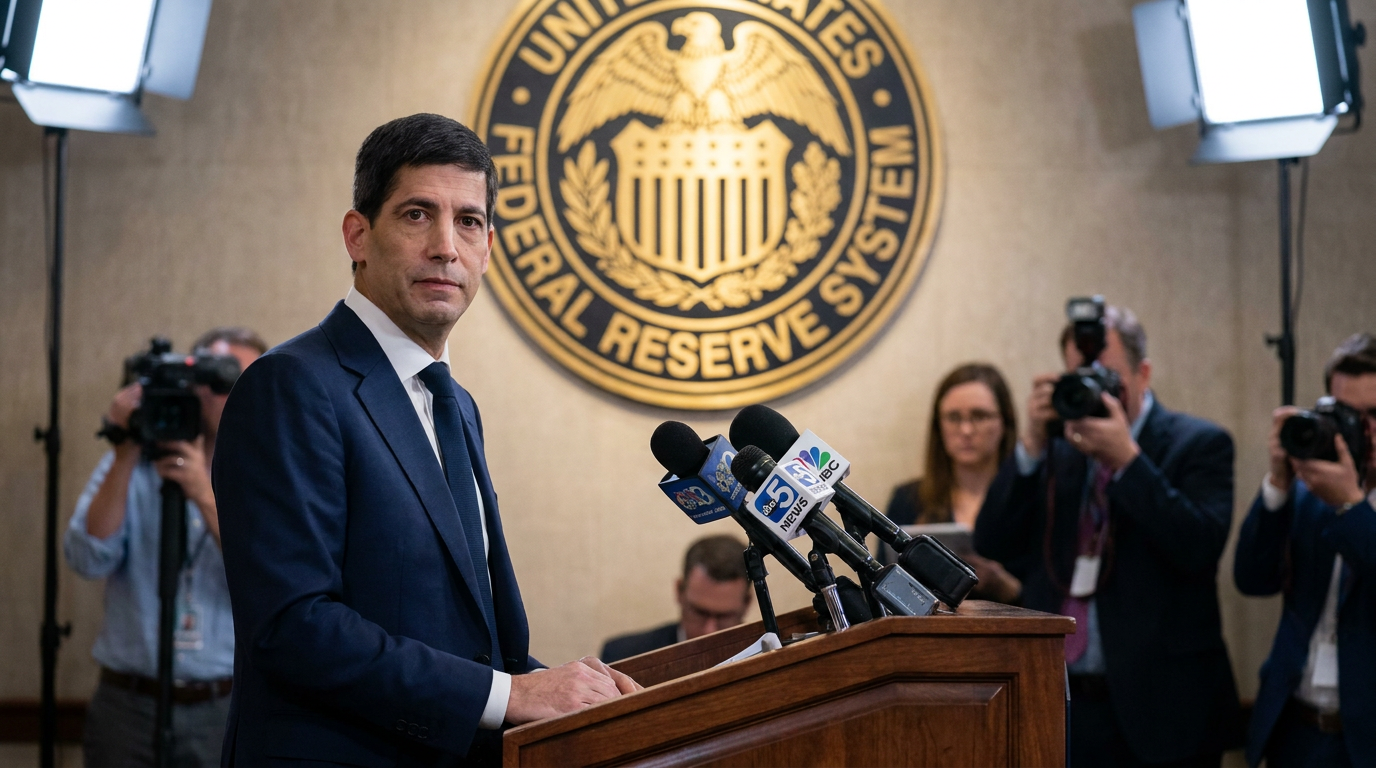
Kevin Warsh wasted no time resetting Wall Street's expectations. In his highly anticipated debut press conference as Chairman of the Federal Reserve on Wednesday, Warsh delivered a blunt and uncompromising message: the central bank will not tolerate inflation remaining above its 2% target. While the Fed's rate-setting committee voted unanimously to hold the benchmark federal funds rate steady at a range of 3.50% to 3.75%, the underlying tone of the meeting marked a profound shift in U.S. monetary policy. Gone was the accommodating posture of the past year; in its place, a resolute focus on price stability that caught many investors off guard.[1][3]
The financial markets reacted violently to the new regime. Traders rapidly dumped short-term U.S. government debt, sending the yield on the policy-sensitive two-year Treasury note surging by 13 basis points to over 4.16%. This marked the largest one-day jump for the two-year yield on a Fed meeting day since the depths of the 2008 financial crisis. The aggressive selloff in the bond market underscores just how sharply Warsh's rhetoric contrasted with the market's prior assumptions about the trajectory of borrowing costs.[4][6]
This selloff reflects a sudden, dramatic repricing of the economic future. Just three months ago, Wall Street was confidently betting on a series of interest rate cuts throughout 2026, anticipating a cooling economy. Now, futures markets are pricing in a near-certainty that the Federal Reserve will actually raise interest rates by December, with some aggressive traders betting on a hike as early as September. The shift represents a massive reallocation of capital as investors scramble to adjust to a 'higher for longer' reality.[6]
The primary catalyst for this hawkish pivot is a stubborn resurgence in consumer prices. In May, U.S. annual inflation accelerated to 4.2%, marking the highest level in over three years and decisively breaking the downward trend policymakers had celebrated in 2025. This inflationary spike was primarily driven by the severe energy shock triggered by the war in Iran, which snarled tanker traffic in the Strait of Hormuz and sent global oil and gasoline prices soaring just as the summer driving season began.[2][3][5]

The mechanics of monetary policy make this specific type of inflation a remarkably difficult needle to thread. The Federal Reserve's primary tool for fighting rising prices is increasing the federal funds rate, which subsequently raises the cost of borrowing across the entire economy. This intentionally cools consumer demand for mortgages, auto loans, and corporate expansion. However, higher interest rates cannot produce more barrels of oil, unclog international shipping lanes, or resolve geopolitical conflicts in the Middle East. The Fed is effectively using a blunt demand-side instrument to address a sharp supply-side shock.[2]
Despite the inherent limitations of monetary policy in solving a supply-driven energy crisis, Warsh made it clear that the central bank feels compelled to act. The primary fear is that if consumers and businesses expect prices to keep rising, those expectations will become entrenched in the broader economy, leading to a self-fulfilling cycle of wage and price hikes. 'Persistently high prices are a burden for the American people,' Warsh told reporters during the press conference, adding that the committee is fully committed to utilizing all available tools to deliver long-term price stability.[4]
Beyond the immediate outlook for interest rates, Warsh's debut signaled a radical overhaul of how the Federal Reserve communicates with the public and the financial sector. For years, markets had grown deeply accustomed to 'forward guidance'—explicit hints and detailed roadmaps from the central bank about its likely future policy moves. Warsh effectively killed that practice on Wednesday, arguing that excessive communication limits the Fed's flexibility and creates artificial market volatility when underlying economic conditions inevitably change. He intends to return the institution to a more traditional, tight-lipped posture.[1][6]
For years, markets had grown deeply accustomed to 'forward guidance'—explicit hints and detailed roadmaps from the central bank about its likely future policy moves.
The official policy statement released by the committee reflected this new, minimalist philosophy. The document was slashed to a mere 130 words, stripping out the predictive language and nuanced caveats that Wall Street analysts traditionally parse for trading clues. Warsh emphasized that the Federal Reserve must remain nimble and strictly data-dependent, rather than boxing itself into a pre-committed path that could be easily derailed by unexpected global economic shocks or sudden shifts in domestic employment data. The era of hand-holding the markets appears to be officially over.[1][3]

In the most symbolic break from recent central bank tradition, Warsh flatly refused to submit his own projection to the Fed's famous 'dot plot'—the quarterly chart where officials anonymously map out their personal expectations for future interest rates. Warsh has long criticized the dot plot as a flawed communication tool, arguing that it creates a false sense of certainty and distracts from the committee's actual policy decisions. By withholding his dot, the Chairman sent a clear message that he will not be bound by long-term forecasts.[2][3][6]
Even without the Chairman's individual dot, the rest of the committee's projections painted a surprisingly hawkish picture of the months ahead. Of the 18 regional presidents and governors who did submit forecasts, nine indicated they expect at least one quarter-point rate increase before the end of 2026, while six projected at least two hikes. This represents a stark and rapid reversal from just three months ago in March, when absolutely no officials anticipated raising rates and the debate was entirely focused on the timing of cuts.[4][6]
The Federal Reserve's aggressive posture sets up a highly complex political dynamic in Washington. President Donald Trump appointed Warsh to the chairmanship following a contentious nomination process, with the explicit hope that the new chief would lower borrowing costs to juice economic growth ahead of the midterm elections. Instead, Warsh has used his very first meeting to assert the central bank's fierce independence, prioritizing the institutional inflation fight over the immediate political preferences of the administration that appointed him.[4][5][6]
Trump, who had previously criticized the Fed's reluctance to cut rates under former Chair Jerome Powell, recently softened his public stance regarding the new leadership. Last month, the President stated he would let Warsh 'do what he wants to do.' However, whether that fragile political truce holds if the Federal Reserve actually executes a rate hike that slows down the economy in the run-up to the November elections remains one of the biggest uncertainties hanging over the financial markets.[3]

The real-world consequences of this monetary policy shift will ripple far beyond Wall Street trading desks and Washington political circles. As Treasury yields rise in anticipation of tighter Fed policy, the consumer rates tied to them—including 30-year fixed mortgages, auto loans, and corporate debt—will inevitably follow suit. For everyday American consumers who are already grappling with a painful 4.2% inflation rate at the grocery store and the gas pump, the cost of financing daily life is about to become significantly more expensive.[1][6]
The U.S. central bank is not acting in total isolation as it confronts this new inflationary wave. Earlier this month, the European Central Bank hiked its own key interest rate, explicitly citing the severe inflationary pressures generated by the Middle East conflict and the resulting global energy crunch. Central bankers globally are coming to the uncomfortable realization that the anticipated return to an era of easy money has been indefinitely postponed by geopolitical instability, fractured global supply chains, and persistently tight labor markets.[5]
Looking ahead, the bond market will be hyper-focused on the incoming economic data, particularly the geopolitical fallout from the recently signed preliminary peace agreement with Iran. If the reopening of the Strait of Hormuz and the resumption of normal tanker traffic leads to a sustained, structural drop in global energy prices, the Federal Reserve may ultimately be spared from having to execute the painful rate hikes that futures markets are currently pricing in. A cooling in energy costs remains the most viable off-ramp for the central bank.[2][4]
Until that relief materializes, however, the message emanating from the Eccles Building in Washington is unambiguous. The Federal Reserve under Kevin Warsh will be a quieter, less predictable, and ruthlessly focused institution. By prioritizing the 2% inflation target above all other economic concerns—no matter how much short-term volatility it causes in the bond market or political frustration it generates in the White House—Warsh has firmly established the uncompromising tone for his tenure as the world's most powerful central banker.[1][4]
How we got here
Early 2026
Financial markets broadly expect the Federal Reserve to cut interest rates multiple times throughout the year.
February 2026
War in Iran begins, causing a severe energy shock and snarling traffic in the Strait of Hormuz.
May 2026
U.S. consumer prices accelerate, hitting a three-year high of 4.2% annually.
June 17, 2026
Kevin Warsh holds his first meeting as Fed Chair, signaling a hawkish pivot and sparking a bond market selloff.
Viewpoints in depth
Hawkish Policymakers
Central bankers who prioritize crushing inflation even if it means slowing economic growth.
This camp argues that the 4.2% inflation print in May is a flashing red warning sign that cannot be ignored. While they acknowledge that the spike is largely driven by a geopolitical supply shock in the Middle East, they fear that allowing prices to remain elevated will cause inflation expectations to become permanently entrenched in consumer psychology. For these officials, the credibility of the central bank is on the line, and raising rates is the only way to ensure the 2% target remains viable.
Bond Market Traders
Investors rapidly adjusting their portfolios to account for a less predictable Federal Reserve.
Traders are reacting not just to the threat of higher rates, but to the sudden removal of 'forward guidance.' By slashing the policy statement and refusing to submit a dot plot projection, Chairman Warsh has introduced a new layer of uncertainty into the financial system. Without explicit hand-holding from the central bank, the bond market is forced to price in a higher risk premium, leading to the sharp selloff in short-term Treasuries and the rapid steepening of borrowing costs.
The White House
The administration navigating the political fallout of high borrowing costs ahead of an election.
President Trump appointed Kevin Warsh with the expectation that new leadership would result in lower interest rates to stimulate the economy. Instead, the administration finds itself dealing with a fiercely independent Chairman who is actively entertaining rate hikes. While the White House has recently adopted a hands-off public posture—stating they will let Warsh operate independently—the internal frustration over the prospect of tightening financial conditions during an election year remains a significant political undercurrent.
What we don't know
- Whether the newly signed preliminary peace agreement with Iran will lower global oil prices enough to cool inflation naturally.
- If Chairman Warsh will ultimately follow through with a rate hike, or if his hawkish rhetoric is merely an attempt to manage market expectations.
- How the White House will react if the Federal Reserve officially raises interest rates in the months leading up to the November elections.
Key terms
- Federal funds rate
- The target interest rate set by the Fed at which commercial banks borrow and lend their excess reserves to each other overnight.
- Basis point
- One-hundredth of a percentage point (0.01%), commonly used to measure changes in interest rates and bond yields.
- Dot plot
- A chart published quarterly by the Federal Reserve showing each official's anonymous projection for future interest rates.
- Forward guidance
- The central bank's public communication about the likely future course of monetary policy, intended to influence market expectations.
- Treasury yield
- The return on investment on the U.S. government's debt obligations, which serves as a benchmark for consumer and corporate borrowing rates.
Frequently asked
What is the current Fed interest rate?
The Federal Reserve held its benchmark federal funds rate steady at a target range of 3.50% to 3.75%.
Why did the Fed change its tone?
U.S. inflation spiked to a three-year high of 4.2% in May, largely driven by an energy shock resulting from the war in Iran.
What is the dot plot and why did Warsh ignore it?
The dot plot is a chart showing each Fed official's projection for future interest rates. Chairman Warsh refused to submit his own projection, arguing the practice limits the Fed's flexibility.
Will my mortgage rate go up?
It is highly likely. As bond markets price in the expectation of a future Fed rate hike, the yields on U.S. Treasuries rise, which directly pushes up consumer borrowing costs like 30-year fixed mortgages.
Sources
Source coverage
6 outlets
4 viewpoints surfaced





[1]BloombergBond Market Traders
Warsh's Debut Sparks Surge in Hike Bets
Read on Bloomberg →[2]NPRMain Street Consumers
3 things to know about the new Fed chief's first meeting
Read on NPR →[3]ForbesHawkish Policymakers
Federal Reserve Holds Rates Steady At 3.5% To 3.75% In First Meeting Under Kevin Warsh
Read on Forbes →[4]Financial TimesBond Market Traders
Kevin Warsh’s Fed debut sparks bond selloff as rate-hike bets surge
Read on Financial Times →[5]MorningstarHawkish Policymakers
What to Expect From Kevin Warsh’s First Fed Meeting
Read on Morningstar →[6]Anadolu AgencyBond Market Traders
US Treasury yields jump as Fed projections signal possible rate hike
Read on Anadolu Agency →

Every angle. Every day.
Get business stories with full source coverage and perspective breakdowns delivered to your inbox.