
Apple and Intel Strike Deal for Domestic Chip Manufacturing
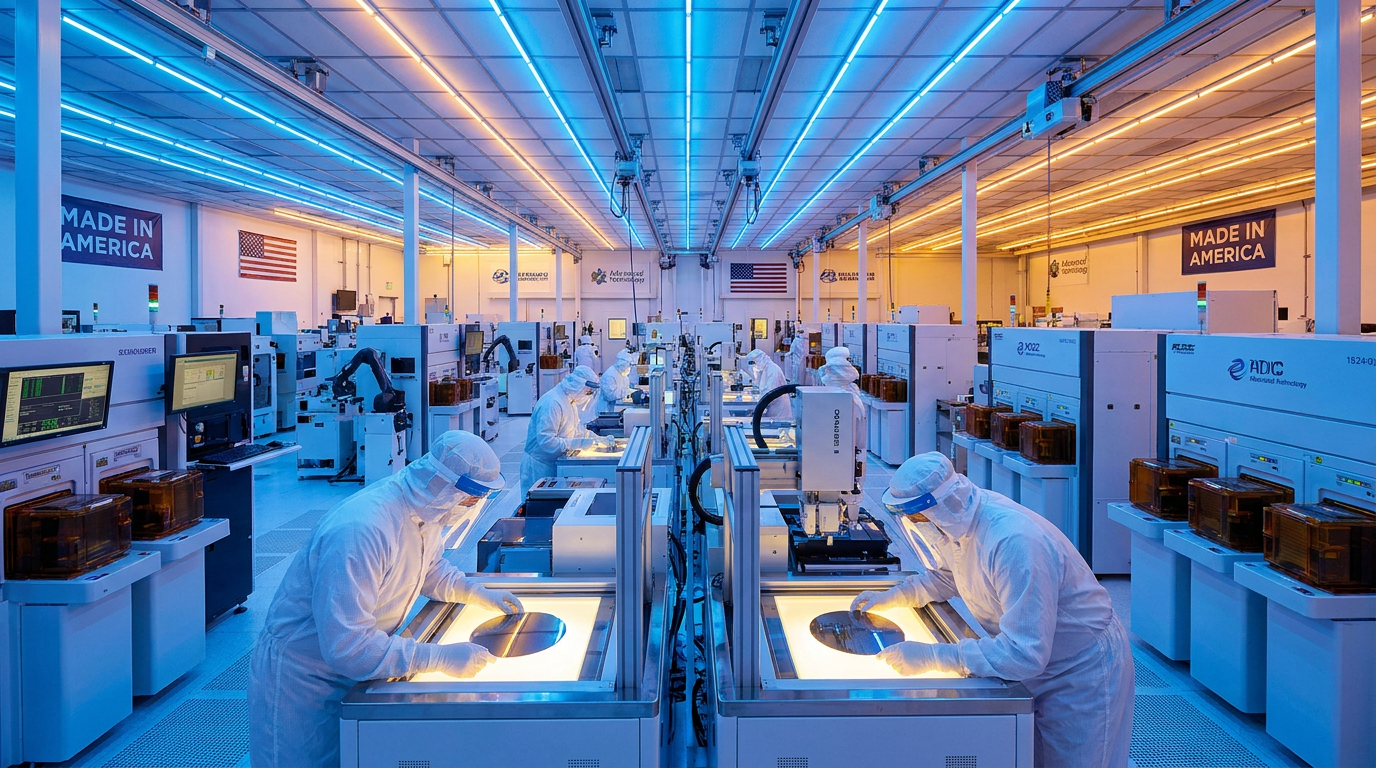
Apple has agreed to partner with Intel to design and manufacture chips in the United States, a major milestone in efforts to onshore semiconductor production. The deal aims to diversify Apple's supply chain while validating Intel's ambitious foundry business.
By Factlen Editorial Team
- Supply Chain Strategists
- Focus on the necessity of diversifying away from a single point of failure in Taiwan.
- Domestic Manufacturing Advocates
- View the deal as a triumph of industrial policy and government intervention.
- Market Analysts
- Evaluate the partnership as a transformative moment for Intel's valuation and credibility.
What's not represented
- · TSMC Executives
- · Taiwanese Economic Officials
Why this matters
This partnership marks a structural shift in the global technology supply chain, reducing reliance on overseas manufacturing for the world's most ubiquitous consumer devices. For consumers and investors, it signals a more resilient hardware ecosystem and a massive revitalization of American industrial capacity.
Key points
- Apple and Intel have agreed to a partnership to design and manufacture chips in the United States.
- The deal helps Apple diversify its supply chain away from TSMC, which is currently overwhelmed by AI chip demand.
- Intel shares surged 9% in premarket trading, extending a 200% year-to-date rally.
- The partnership validates Intel's foundry business and its next-generation 18A manufacturing process.
- The U.S. government, which holds a 10% stake in Intel, actively encouraged the domestic manufacturing alliance.
Apple has agreed to partner with Intel to design and manufacture semiconductors in the United States, marking a watershed moment for the domestic technology supply chain. The collaboration, announced Thursday by President Donald Trump, brings together two of America's most prominent technology giants to onshore the production of critical components. For years, the semiconductor industry has been defined by a heavy reliance on overseas fabrication, but this agreement signals a definitive pivot back to American soil. The deal is expected to reshape the competitive landscape of chip manufacturing, providing a massive boost to the domestic industrial base while securing vital hardware resources for one of the world's most valuable companies.[1][2]
The announcement follows more than a year of quiet, high-stakes negotiations between the two companies. While a preliminary agreement was first reported by the Wall Street Journal in May, the formalization of the partnership confirms that Intel will begin producing chips for future Apple devices at its American fabrication sites. Neither Apple nor Intel immediately issued formal corporate statements detailing the specific product lines or manufacturing nodes involved, but the alignment of government incentives and corporate capacity needs suggests a permanent realignment of how America's most popular consumer electronics will be built.[1][3][6]
Financial markets reacted immediately and aggressively to the news, with Intel shares surging more than 9% in premarket trading on Thursday. The jump extends a historic, momentum-driven rally for the chipmaker, whose stock has climbed over 200% since the start of the year. This remarkable turnaround has pushed Intel's market valuation past the $600 billion mark, a stark contrast to its struggles just a few years prior. Investors are increasingly pricing in the success of Intel's foundry model, viewing the Apple partnership as the ultimate proof of concept for a company that had previously lost ground to international rivals.[4][5]

For Apple, the pivot to Intel is driven by an urgent, pragmatic need to diversify its manufacturing base. The iPhone maker has historically relied almost exclusively on Taiwan Semiconductor Manufacturing Company (TSMC) for its most advanced processors. However, TSMC's production lines are currently facing unprecedented demand from artificial intelligence heavyweights like Nvidia and AMD. This surge in AI hardware development has created a severe capacity bottleneck, forcing Apple to compete aggressively for the same leading-edge manufacturing slots that power the global AI boom.[2][4]
For Apple, the pivot to Intel is driven by an urgent, pragmatic need to diversify its manufacturing base.
Securing domestic manufacturing capacity not only guarantees Apple a steady supply of silicon but also insulates the company from the geopolitical risks associated with concentrated overseas production. Supply chain analysts note that while Intel may initially focus on legacy chips for older Apple devices—such as previous-generation iPads or entry-level Macs—the partnership lays the groundwork for more advanced production in the future. By bringing a second major supplier into the fold, Apple gains crucial leverage in pricing negotiations and ensures a more resilient pipeline for its massive global hardware ecosystem.[3][4]
The deal represents a marquee validation for Intel's ambitious, capital-intensive foundry business. For years, Intel struggled to convince outside fabless clients that its manufacturing capabilities could rival TSMC's industry-leading yield and reliability. Securing Apple as a customer serves as a powerful, highly visible endorsement of Intel's manufacturing roadmap. The timing aligns with Intel's recent announcement that its next-generation "18A" manufacturing process has entered initial production, a technological milestone that the company claims will restore its competitive edge in the global semiconductor market.[2][4]

The U.S. government has played a highly active, hands-on role in brokering these domestic tech alliances. In 2025, the administration took the unprecedented step of converting $8.9 billion in unpaid CHIPS Act grants into a 10% equity stake in Intel. This financial maneuver was paired with commitments to invest roughly $10 billion to expand American factories, effectively intertwining Intel's corporate success with national economic and security interests. This political tailwind gives Intel a commercial pitch that overseas rivals simply cannot match when courting American tech giants.[1][2][4]
President Trump highlighted the Apple agreement as the crown jewel in a broader strategy to rebuild the nation's industrial base. In his announcement, he noted that Intel has also secured recent foundry deals with Nvidia and Elon Musk's Terafab project. "We design everything, but we need to BUILD it here, NOW!" Trump stated on his Truth Social platform, framing the partnership as a victory for American economic sovereignty. As the semiconductor industry enters a new era defined by AI and geopolitical competition, the Apple-Intel alliance stands as a defining milestone in the reshoring of American technology.[2][3]
How we got here
2025
The U.S. government converts CHIPS Act grants into a 10% equity stake in Intel to boost domestic manufacturing.
May 2026
The Wall Street Journal reports that Apple and Intel have reached a preliminary manufacturing agreement after a year of talks.
June 18, 2026
President Trump publicly announces the finalized partnership, sending Intel shares soaring.
Viewpoints in depth
Supply Chain Strategists
Focus on the necessity of diversifying away from a single point of failure in Taiwan.
For supply chain experts, Apple's move is less about patriotism and more about pragmatic risk management. Relying entirely on TSMC for leading-edge nodes has become a corporate liability, especially as AI chipmakers consume vast amounts of TSMC's capacity. By bringing Intel into the fold, Apple creates a competitive dynamic between its suppliers, ensuring better pricing power and guaranteed capacity for its massive consumer electronics portfolio.
Domestic Manufacturing Advocates
View the deal as a triumph of industrial policy and government intervention.
Proponents of U.S. industrial policy see the Apple-Intel partnership as the ultimate vindication of the CHIPS Act and subsequent government investments. By taking a direct equity stake in Intel and aggressively brokering deals with tech giants like Nvidia and Apple, the administration has successfully engineered a renaissance in American semiconductor manufacturing, reversing decades of offshoring.
Market Analysts
Evaluate the partnership as a transformative moment for Intel's valuation and credibility.
Financial analysts emphasize that landing Apple is the ultimate stamp of approval for Intel's foundry business. Even if the initial orders are for older-generation chips, the relationship proves that Intel's manufacturing processes—particularly its new 18A node—are viable alternatives to TSMC. This credibility is what has driven Intel's stock up over 200% this year, transforming it from a struggling legacy tech company into a momentum leader.
What we don't know
- Which specific Apple devices or chip generations will be manufactured by Intel first.
- The exact financial terms and volume commitments of the manufacturing agreement.
- How quickly Intel can scale its 18A process to meet Apple's massive volume requirements.
Key terms
- Foundry
- A semiconductor manufacturing plant that produces chips designed by other companies.
- TSMC
- Taiwan Semiconductor Manufacturing Company, the world's largest contract chipmaker and Apple's primary supplier.
- 18A Process
- Intel's next-generation semiconductor manufacturing technology, designed to compete with the most advanced chips in the industry.
- Node
- A specific generation of semiconductor manufacturing technology, typically measured in nanometers, dictating the size and efficiency of the transistors.
Frequently asked
Will Intel make the chips for the newest iPhones?
Initially, analysts expect Intel to manufacture legacy chips for older or lower-end Apple devices, as TSMC remains ahead in producing the most advanced silicon.
Why is Apple moving away from TSMC?
Apple is not abandoning TSMC, but it needs to diversify its supply chain to secure enough manufacturing capacity, as TSMC is currently overwhelmed with orders from AI companies.
How is the U.S. government involved?
The government has heavily subsidized domestic chip production and currently holds a 10% equity stake in Intel, actively encouraging tech giants to onshore their manufacturing.
Sources
Source coverage
6 outlets
3 viewpoints surfaced






[1]The Wall Street JournalDomestic Manufacturing Advocates
Trump Says Apple, Intel Partnering on U.S. Chip Manufacturing
Read on The Wall Street Journal →[2]Seeking AlphaDomestic Manufacturing Advocates
Apple to work with Intel to build chips in US, Trump says
Read on Seeking Alpha →[3]9to5MacSupply Chain Strategists
Apple and Intel are working together to build chips in America, says President Trump
Read on 9to5Mac →[4]Investing.comSupply Chain Strategists
Apple Intel Chip Deal Signals Shift in Foundry Landscape
Read on Investing.com →[5]The Straits TimesMarket Analysts
Trump says Apple to work with Intel to manufacture chips in US
Read on The Straits Times →[6]Channel News AsiaMarket Analysts
Trump says Apple to work with Intel to manufacture chips in US
Read on Channel News Asia →

Every angle. Every day.
Get business stories with full source coverage and perspective breakdowns delivered to your inbox.