
The WNBA's 2026 Offensive Explosion: How Pace, Space, and Rule Changes Rewrote the Record Books
A combination of generational playmakers, expansion-era spacing, and strict new officiating rules has triggered an unprecedented scoring boom across the WNBA.
By Factlen Editorial Team
- Offensive Innovators
- Coaches and guards who thrive on the fast-paced, space-oriented style of modern basketball.
- Defensive Traditionalists
- Veterans and defensive specialists frustrated by the strict officiating and loss of physical play.
- League Strategists
- Executives and broadcasters who view the scoring boom as essential for the WNBA's commercial growth.
What's not represented
- · International basketball analysts comparing WNBA pace to European leagues
- · Referees tasked with enforcing the new freedom of movement rules
Why this matters
The tactical evolution of the WNBA is transforming the sport into a faster, higher-scoring, and more entertaining product. For fans and aspiring players, understanding these changes provides a deeper appreciation of how modern basketball is played and officiated at the highest level.
Key points
- The 2026 WNBA season is experiencing historic offensive efficiency, with 11 of 15 teams posting offensive ratings over 100.
- A strict enforcement of 'freedom of movement' rules has led to a spike in fouls, giving offensive players more space to operate.
- Generational playmakers are pushing the pace to near-record levels, punishing defenses in transition.
- League expansion has diluted defensive depth, allowing teams with elite spacing to exploit mismatches.
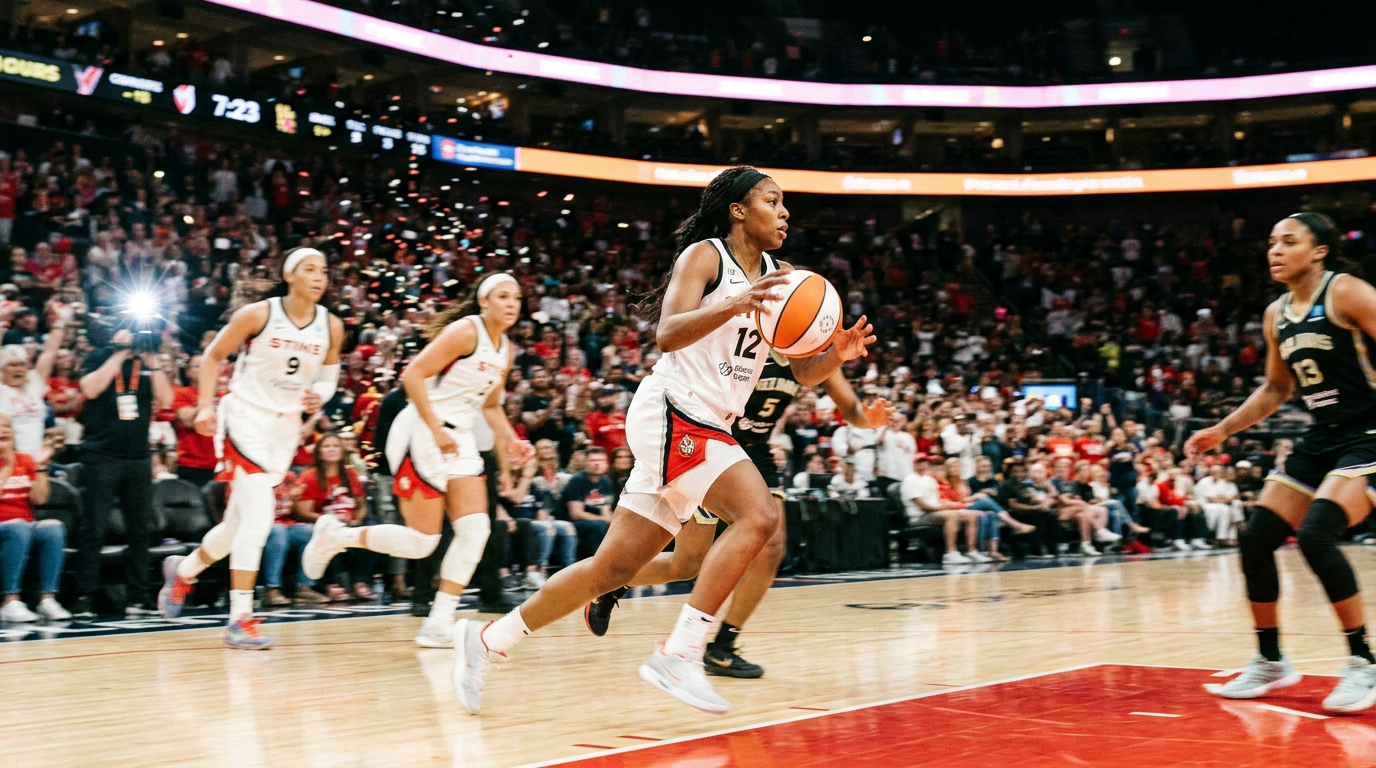
The June 18 clash between the Atlanta Dream and the Indiana Fever was billed as a mid-season test between two rising WNBA powers. It ended up looking like a track meet. The Dream outlasted the Fever 108-101 in a regulation thriller that saw all five Atlanta starters score in double figures, led by Angel Reese's 21 points and 11 rebounds. On the other side, Caitlin Clark and Kelsey Mitchell poured in 26 points apiece, trading transition threes and high-speed layups in a dizzying display of shot-making. Just a few years ago, a 108-101 scoreline in a 40-minute WNBA game would have been a generational anomaly. In 2026, it is rapidly becoming the new normal.[4]
The WNBA is in the midst of an unprecedented offensive explosion. Across the league, teams are playing faster, shooting from deeper, and scoring with a ruthless efficiency that is rewriting the record books. A quick glance at the early-season metrics reveals a fundamentally altered landscape. By mid-June, 11 of the league's 15 teams boasted offensive ratings north of 100 points per 100 possessions. To put that in perspective, during the same window in 2025, only one team had crossed that threshold. The ceiling has not just been raised; it has been completely blown off.[1]
The Minnesota Lynx currently lead the offensive charge with a staggering 115.0 offensive rating, a number that would rank among the most efficient in basketball history. Close behind are the Las Vegas Aces and New York Liberty, both operating above 111.0. This surge in scoring is not simply a hot shooting streak. It is the result of a perfect storm: a generational influx of playmaking talent, the strategic ripple effects of league expansion, and a deliberate mandate from the WNBA front office to open up the floor.[5]

The most visible driver of this boom is the sheer speed at which the game is now played. The Indiana Fever, engineered around Clark's transcendent passing, are operating at a pace of 99.22 possessions per 40 minutes—putting them on track to be the speediest WNBA team since 2019. When a team pushes the ball that relentlessly, it forces opponents into uncomfortable, scrambled defensive rotations. Defenses are rarely allowed to set up in the half-court, leading to early-clock three-pointers and driving lanes that simply did not exist in previous eras.[2]
This pace is weaponized by a new wave of floor generals who process the game at light speed. Clark recently became the fastest player in WNBA history to reach 250 points and 100 assists in a single season, hitting the milestone in just 13 games. The previous record holder needed 16 games. By averaging 8.3 assists per game, Clark is punishing teams that attempt to trap her, finding cutters and shooters before the defensive rotation can arrive. Alongside young stars like Dallas's Paige Bueckers and Minnesota's Olivia Miles, the league is flush with guards who can single-handedly dictate the geometry of the court.[2][3]

This pace is weaponized by a new wave of floor generals who process the game at light speed.
But talent alone does not explain a league-wide statistical leap. The WNBA's offseason rule changes have acted as an accelerant. Following the 2025 season, Commissioner Cathy Engelbert announced a task force dedicated to evaluating officiating, resulting in a strict new mandate to enforce "freedom of movement." Referees were instructed to crack down on the physical holding, grabbing, and off-ball impeding that traditionally defined WNBA defenses. The goal was clear: let the league's most skilled players operate without being wrestled to the floor.[6]
The immediate consequence of this mandate has been a dramatic spike in foul calls. Last season, the Connecticut Sun led the league by committing 19.6 fouls per game; this year, 10 different teams are averaging at least 20 fouls per night. The adjustment period has frustrated some veterans—New York's Breanna Stewart recently called the whistle volume "insane" after a game featured 58 combined fouls. However, the strict officiating has achieved its intended effect. Defenders are forced to give ball-handlers more space, and the resulting parade to the free-throw line has artificially inflated scoring efficiency while discouraging aggressive half-court traps.[1]
The expansion of the league to 15 teams in 2026—adding the Portland Fire, Toronto Tempo, and Golden State Valkyries—has also subtly shifted the tactical balance. Expansion drafts inherently dilute the concentration of elite defensive stoppers across the league. With talent spread slightly thinner, offensive superstars are finding themselves matched up against weaker perimeter defenders or backup rim protectors more frequently. Teams that prioritized spacing and shooting in their roster construction are feasting on the resulting mismatches.[7]

Defenses are scrambling to adapt to this new reality. Traditional drop coverage—where a center sags into the paint to protect the rim—is practically obsolete against guards who can pull up from 30 feet in transition. Instead, coaches are demanding "high pick-up points," requiring defenders to meet ball-handlers at the opposite free-throw line. As veteran forward DeWanna Bonner noted, guarding the modern elite point guard requires defending "the whole 94 feet." But extending the defense that far stretches the floor to its breaking point, opening up massive cutting lanes for bigs and wings.[6]
If a defense chooses to aggressively trap the ball-handler to get the ball out of her hands, they expose themselves to the precise passing that defines this new era. Indiana's offensive rating climbed to a league-leading 109.7 during their recent four-game winning streak precisely because they mastered this counter-punch. When opponents commit two bodies to the perimeter, the resulting four-on-three advantage almost always ends in an open corner three or an uncontested layup.[3]

For the WNBA front office, this offensive explosion is a resounding victory. As the league navigates its 30th season and capitalizes on unprecedented viewership, entertainment value is paramount. High-scoring, fast-paced basketball is universally more appealing to casual fans and television executives than physical, low-scoring slugfests. The league wanted a product that highlighted the extraordinary skill and shooting range of its athletes, and the 2026 season is delivering exactly that.
The 108-101 shootout in Indianapolis was not a defensive failure; it was a showcase of the WNBA's future. The combination of elite playmaking, expansion-era spacing, and freedom of movement has permanently altered the math of women's basketball. The grind-it-out era has faded into the archives. In its place is a breathtaking track meet, where the only way to survive is to keep running, keep shooting, and keep scoring.
How we got here
2024-2025
A new wave of generational playmakers enters the WNBA, beginning to push the league's pace.
Offseason 2025
The WNBA announces a task force on officiating, emphasizing 'freedom of movement' to reduce physical holding.
May 2026
The WNBA expands to 15 teams, diluting defensive depth and increasing the premium on floor spacing.
June 18, 2026
The Atlanta Dream and Indiana Fever combine for 209 points in a regulation game, highlighting the league's new offensive ceiling.
Viewpoints in depth
The Offensive Innovators' View
Embracing the skill and speed of the modern game.
For the new generation of guards and offensive-minded coaches, the 2026 season is a tactical utopia. By prioritizing shooting and transition speed, these innovators argue that the game has finally evolved to reward pure skill over brute strength. They view the high offensive ratings not as a defensive failure, but as the natural result of better spacing, elite passing, and a deeper talent pool that can punish any defensive mistake.
The Defensive Traditionalists' View
Concerns over the loss of physical, grind-it-out basketball.
Veterans and defensive purists argue that the league's strict enforcement of 'freedom of movement' has tilted the scales too far in favor of the offense. By calling fouls on nearly every physical interaction on the perimeter, traditionalists believe the league has artificially inflated scoring and removed the grit that defined WNBA defense for decades. They point to the staggering number of free throws and disrupted game flow as evidence that the whistle, rather than just talent, is driving the boom.
The League Strategists' View
Prioritizing entertainment value and commercial growth.
From a business perspective, the offensive explosion is exactly what the WNBA ordered. League executives and broadcast partners know that high-scoring, fast-paced games generate more viral highlights, attract casual viewers, and drive higher television ratings. As the league expands and negotiates lucrative new media rights deals, strategists argue that a highly aesthetic, offense-first product is the key to cementing the WNBA's status as a premier global sports property.
What we don't know
- Whether the high foul rates will normalize as defenders adjust to the new officiating standards, or if the whistle-heavy games will persist into the playoffs.
- How traditional, defense-first teams will retool their rosters in future offseasons to counter the league's new pace-and-space reality.
Key terms
- Offensive Rating
- A metric that measures a team's scoring efficiency, calculated as points scored per 100 possessions.
- Pace
- The estimated number of possessions a team has per 40 minutes, indicating the speed at which they play.
- Freedom of Movement
- Officiating guidelines designed to prevent defenders from holding or grabbing offensive players off the ball.
- High Pick-up Point
- A defensive strategy where a defender begins guarding the ball-handler far from the basket, often in the backcourt, to prevent transition threes.
- Drop Coverage
- A defensive scheme where the center sags into the paint to protect the rim during a pick-and-roll, often leaving the perimeter open.
Frequently asked
Why are WNBA scores so much higher in 2026?
A combination of faster pace, elite playmaking talent, league expansion, and strict new officiating rules has created an unprecedented offensive boom.
What is the 'freedom of movement' rule?
It is an officiating directive that penalizes defenders for holding, grabbing, or physically impeding offensive players, resulting in more space and more foul calls.
How did league expansion affect scoring?
Adding three new teams diluted the concentration of elite defensive players across the league, allowing offensive stars to exploit weaker matchups and better spacing.
Who is leading the WNBA in offensive efficiency?
The Minnesota Lynx currently lead the league with a historic 115.0 offensive rating, followed closely by the Las Vegas Aces and New York Liberty.
Sources
Source coverage
7 outlets
3 viewpoints surfaced







[1]The IX SportsDefensive Traditionalists
Early trends to watch in the 2026 WNBA season: Offense is up, physical play is down
Read on The IX Sports →[2]Just Women's SportsOffensive Innovators
Top 2026 WNBA Scores and Player Stats: Historic starts and breakneck speeds
Read on Just Women's Sports →[3]StatSniperOffensive Innovators
Caitlin Clark Becomes Fastest to 250 Points and 100 Assists, Sharpening 2026 WNBA MVP Case
Read on StatSniper →[4]CBS SportsLeague Strategists
Reese has 21 points, 11 rebounds, and all Dream starters score 16-plus in 108-101 win over Fever
Read on CBS Sports →[5]StatMuseLeague Strategists
WNBA League Rankings and Betting Trends 2026
Read on StatMuse →[6]EssentiallySportsDefensive Traditionalists
The Tactical Evolution of Defending in the WNBA's New Era
Read on EssentiallySports →[7]DefectorOffensive Innovators
The WNBA's Expansion Era Brings New Tactical Realities
Read on Defector →

Every angle. Every day.
Get sports stories with full source coverage and perspective breakdowns delivered to your inbox.