
The Science of Temperature Therapy: When to Use Heat vs. Cold for Optimal Recovery
While ice baths and saunas have both surged in popularity for athletic recovery, recent science reveals they serve entirely different physiological purposes. Cold water is best for immediate pain relief, while heat therapy drives long-term muscle repair and growth.
By Factlen Editorial Team
- Hypertrophy Researchers
- Scientists focused on maximizing muscle growth and strength adaptations.
- Sports Performance Analysts
- Experts prioritizing immediate functional recovery and game-day readiness.
- Therapeutic Rehabilitation Experts
- Clinicians focused on tissue healing, flexibility, and systemic wellness.
What's not represented
- · Recreational exercisers with limited time
- · Physical therapists treating acute injuries
Why this matters
Understanding the distinct biological effects of heat and cold allows you to stop guessing and start optimizing your recovery. Choosing the wrong temperature modality can actively sabotage your fitness goals, while choosing the right one accelerates healing and performance.
Key points
- Cold water immersion reduces acute inflammation and numbs pain, making it ideal for immediate game-day recovery.
- Ice baths taken immediately after resistance training actively blunt muscle hypertrophy and protein synthesis.
- Heat therapy increases local blood flow by up to 50 percent, accelerating nutrient delivery to damaged tissues.
- Saunas and hot baths activate heat shock proteins, which repair cellular damage and improve long-term resilience.
- Contrast water therapy (alternating hot and cold) effectively reduces perceived soreness and fatigue in team sport athletes.
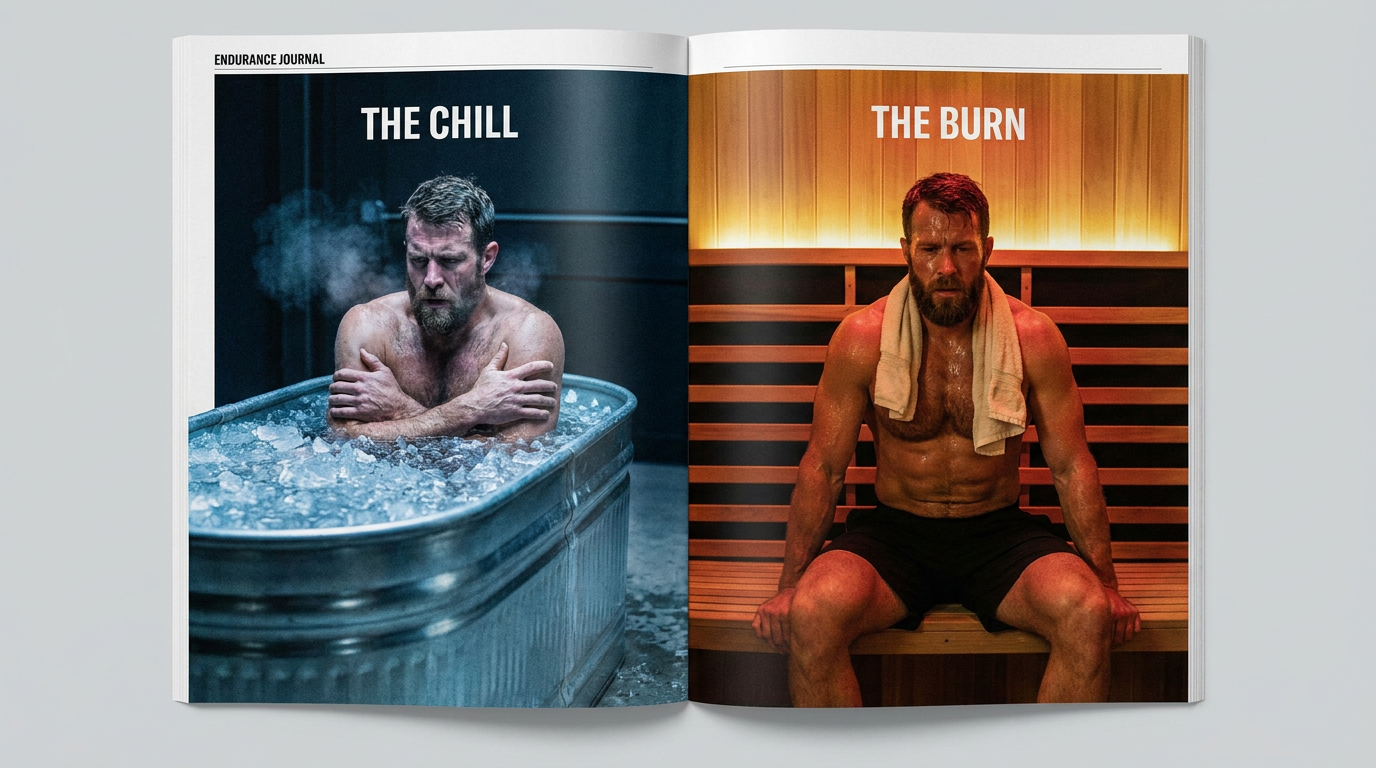
The rise of temperature therapies has fundamentally changed how we approach physical recovery. Ice baths and saunas have transcended elite locker rooms to become ubiquitous fixtures in commercial gyms and backyard wellness setups. Athletes and casual exercisers alike are plunging into near-freezing tubs or sweating in infrared cabins, all in the pursuit of faster recovery. Yet, as the popularity of thermal stress explodes, a divide has emerged in the fitness community. Some swear by the numbing relief of cold water, while others champion the soothing embrace of heat. The scientific consensus, however, reveals that this is not a binary choice. Temperature is a highly specific physiological tool, and choosing between hot and cold dictates entirely different adaptations within the human body.[6]
To understand how thermal therapies work, one must first look at the vascular system. The human body tightly regulates its core temperature, and exposing the skin to extreme heat or cold triggers immediate cardiovascular responses. Cold water immersion induces profound vasoconstriction, rapidly narrowing the blood vessels in the extremities. This shunts blood away from the muscles and toward the vital organs to preserve heat. Conversely, heat therapy—whether through a traditional sauna, hot tub, or infrared cabin—causes vasodilation. The blood vessels expand, dramatically increasing peripheral blood flow and cardiac output. These opposing vascular mechanisms form the foundation of how each therapy impacts muscle recovery.[6]
For decades, cold water immersion has been the gold standard for acute athletic recovery, particularly in high-impact and team sports. When an athlete steps into a bath chilled below 15 degrees Celsius, the immediate vasoconstriction acts as a physiological tourniquet. This process flushes out metabolic waste products, such as lactate, and significantly blunts the acute inflammatory response that follows intense physical exertion. Furthermore, the cold temperature slows nerve conduction velocity, effectively numbing the micro-tears in the muscle tissue and providing immediate analgesic relief. For a tennis player in a multi-day tournament or a running back facing a short week, this rapid reduction in perceived soreness is invaluable.[3][6]

A wealth of clinical data supports the use of cold therapy for mitigating Delayed Onset Muscle Soreness (DOMS). Systematic reviews have consistently shown that athletes who utilize cold water immersion report significantly less fatigue and muscle stiffness in the 24 to 48 hours following strenuous exercise compared to those who rely on passive rest. By artificially suppressing the body's natural inflammatory cascade, cold therapy allows athletes to return to peak performance faster. It is a tool designed for immediate functional restoration, prioritizing short-term readiness over long-term cellular adaptation.[3][6]
However, the very mechanism that makes cold water so effective for acute pain relief is precisely what makes it detrimental to long-term muscle growth. Inflammation is not inherently bad; in fact, the acute inflammatory response triggered by resistance training is a crucial signaling pathway for muscle hypertrophy. When an athlete lifts heavy weights, they create micro-trauma in the muscle fibers. The body responds by sending blood, nutrients, and repair cells to the site of the damage, initiating the process of rebuilding the muscle to be larger and stronger. By plunging into an ice bath immediately after a lifting session, an athlete effectively short-circuits this essential biological signal.[1][2]
Recent sports science has provided stark evidence against the use of post-workout cold exposure for strength athletes. A comprehensive meta-analysis published in the sports medicine literature examined the effects of cold water immersion on resistance training adaptations. The researchers found that applying cold immediately following a bout of lifting significantly attenuated muscle hypertrophy in both trained and untrained individuals. By constricting blood vessels and reducing local tissue temperature, the cold blunts the anabolic signaling pathways required for protein synthesis.[1]
Further supporting this, a landmark study from Maastricht University demonstrated that immersing limbs in near-freezing water after resistance training drastically reduces blood flow to the muscles. This vascular restriction hinders the absorption of dietary amino acids, which are the fundamental building blocks needed for muscle repair. The takeaway for the fitness community is clear: if the primary goal of a training session is to build muscle mass or increase absolute strength, an ice bath is counterproductive. The cold prioritizes immediate recovery at the direct expense of long-term muscular adaptation.[2]

This vascular restriction hinders the absorption of dietary amino acids, which are the fundamental building blocks needed for muscle repair.
On the opposite end of the thermal spectrum, heat therapy offers a completely different suite of recovery benefits, operating primarily through the enhancement of blood flow. When the body is exposed to the high temperatures of a sauna or a hot bath, cardiac output increases to pump blood to the skin for cooling. Research published in the Journal of Applied Physiology found that local heat therapy can increase muscle blood flow by up to 50 percent. This massive influx of oxygen-rich blood acts as a delivery system, transporting essential nutrients to damaged muscle tissue while simultaneously accelerating the removal of metabolic byproducts.[4]
Beyond simple circulation, heat exposure triggers a profound cellular defense mechanism known as Heat Shock Proteins (HSPs). These specialized molecules function as cellular chaperones; they seek out proteins that have been damaged or misfolded by the stress of intense exercise and actively repair them. The activation of HSPs accelerates tissue regeneration and protects cells from further oxidative stress. For athletes dealing with the lingering effects of heavy training, the upregulation of these proteins translates to enhanced cellular resilience and a faster return to baseline muscle function.[6]
Heat therapy also plays a vital role in mechanical recovery by altering the physical properties of muscle and connective tissue. Warming the muscles increases their viscoelasticity, making them more pliable and less resistant to stretching. Research in physical rehabilitation has consistently shown that heat application significantly decreases muscle stiffness and improves overall range of motion. For individuals suffering from chronic tightness or the late stages of DOMS, heat provides a soothing, relaxing effect that cold simply cannot match. It essentially melts the tension out of overworked fibers.[5]

Furthermore, the systemic effects of whole-body heat therapy extend to the autonomic nervous system. Intense training often leaves athletes in a prolonged state of sympathetic arousal—the "fight or flight" mode. Sauna bathing has been shown to help restore autonomic balance by reducing circulating cortisol levels and shifting the body toward parasympathetic dominance, or the "rest and digest" state. This neurological shift is critical for true recovery, as it lowers pain perception, improves sleep architecture, and fosters a systemic environment conducive to healing.[6]
For those unwilling to choose between the two extremes, Contrast Water Therapy (CWT) offers a compelling middle ground. This ancient practice involves alternating between hot and cold water immersion, typically spending a few minutes in heat followed by a brief plunge into cold. The theory behind contrast therapy is that the rapid alternation between vasodilation and vasoconstriction creates a "pumping" action in the blood vessels. This vascular gymnastics is thought to flush out metabolic waste more efficiently than either temperature alone, while still providing the analgesic benefits of the cold.[3]
The empirical evidence supporting contrast therapy is robust, particularly for subjective measures of recovery. A systematic review published in PLOS One analyzed pooled data from multiple trials and concluded that contrast water therapy resulted in significantly greater improvements in muscle soreness compared to passive rest. While it may not drastically alter objective physiological markers like creatine kinase levels more than cold water alone, athletes consistently report feeling vastly more recovered and less fatigued after a contrast session. This psychological boost is often just as important as the physiological reality.[3]

Ultimately, the decision to use heat, cold, or a combination of both should be dictated by the specific phase of training and the desired outcome. Cold water immersion is a tactical weapon; it should be deployed during intense competitive seasons, multi-day tournaments, or whenever immediate pain relief and functional readiness are the absolute highest priorities. It is the ideal choice for a marathon runner the day after a race or a basketball player during the playoffs, where adaptation takes a backseat to survival.[1][6]
Conversely, heat therapy is the strategic choice for long-term development. It should be the primary thermal tool during off-season training, hypertrophy blocks, and periods dedicated to building strength and muscle mass. By enhancing blood flow, activating heat shock proteins, and preserving the natural inflammatory signals required for growth, heat supports the body's adaptive processes rather than suppressing them. Temperature therapy is not a one-size-fits-all solution, but rather a nuanced science. By aligning the thermal stimulus with the physiological goal, athletes can stop guessing and start optimizing their recovery.[4][5][6]
Viewpoints in depth
Hypertrophy Researchers
Scientists focused on maximizing muscle growth and strength adaptations.
This camp emphasizes that the acute inflammatory response following resistance training is not an enemy to be defeated, but a necessary biological signal. They point to recent meta-analyses showing that cold water immersion blunts anabolic signaling and reduces the absorption of dietary amino acids. For these researchers, any intervention that artificially lowers tissue temperature post-workout is counterproductive to long-term muscular development.
Sports Performance Analysts
Experts prioritizing immediate functional recovery and game-day readiness.
Performance analysts working with field and endurance athletes view recovery through the lens of immediate turnaround. When a basketball player has back-to-back games, the long-term blunting of hypertrophy is irrelevant compared to the immediate need to clear lactate and numb micro-tears. This camp heavily advocates for cold water immersion and contrast therapy to artificially suppress fatigue and keep athletes on the field.
Therapeutic Rehabilitation Experts
Clinicians focused on tissue healing, flexibility, and systemic wellness.
Rehabilitation experts champion heat therapy for its profound ability to increase localized blood flow and alter the viscoelastic properties of muscle tissue. By driving oxygen-rich blood to damaged areas and activating heat shock proteins, they argue that heat provides a superior environment for actual cellular repair. They also highlight the systemic benefits of heat, such as shifting the autonomic nervous system into a restorative, parasympathetic state.
What we don't know
- The exact minimum temperature and duration required to trigger heat shock proteins without causing systemic fatigue.
- Whether the blunting effect of cold water on muscle growth diminishes if the immersion is delayed by several hours post-workout.
- How individual genetic differences in thermoregulation alter the efficacy of contrast water therapy.
Key terms
- Vasoconstriction
- The narrowing of blood vessels, typically in response to cold, which restricts blood flow to the extremities.
- Vasodilation
- The widening of blood vessels, typically in response to heat, which increases blood flow and oxygen delivery to tissues.
- Hypertrophy
- The increase in the size of skeletal muscle fibers, typically achieved through resistance training.
- Heat Shock Proteins (HSPs)
- A family of proteins produced by cells in response to exposure to stressful conditions, such as high heat, which help repair damaged cellular structures.
- Delayed Onset Muscle Soreness (DOMS)
- The muscle pain and stiffness that typically peaks 24 to 72 hours after unfamiliar or intense exercise.
Frequently asked
Should I take an ice bath immediately after lifting weights?
No. If your goal is to build muscle or increase strength, cold water immersion immediately after resistance training blunts the inflammatory signals required for muscle growth.
When is the best time to use an ice bath?
Cold therapy is best used during intense competitive seasons, multi-day tournaments, or when immediate pain relief and functional readiness are more important than long-term muscle adaptation.
Does alternating hot and cold water work?
Yes. Contrast water therapy has been shown to significantly reduce perceived muscle soreness and fatigue, making it highly effective for team sport athletes needing rapid recovery.
How does a sauna help with muscle recovery?
Heat therapy dilates blood vessels, increasing oxygen and nutrient delivery to damaged muscles by up to 50 percent. It also activates heat shock proteins that repair cellular damage.
Sources
Source coverage
6 outlets
3 viewpoints surfaced






[1]SportRxiv / Sports MedicineHypertrophy Researchers
Throwing cold water on muscle growth: A systematic review with meta-analysis
Read on SportRxiv / Sports Medicine →[2]Maastricht UniversityHypertrophy Researchers
Cold water immersion blunts muscle protein synthesis
Read on Maastricht University →[3]PLOS OneSports Performance Analysts
Contrast Water Therapy and Exercise Induced Muscle Damage: A Systematic Review and Meta-Analysis
Read on PLOS One →[4]Journal of Applied PhysiologyTherapeutic Rehabilitation Experts
Passive heating and muscle blood flow
Read on Journal of Applied Physiology →[5]Archives of Physical Medicine and RehabilitationTherapeutic Rehabilitation Experts
Heat application and muscle stiffness
Read on Archives of Physical Medicine and Rehabilitation →[6]Factlen Editorial TeamSports Performance Analysts
Synthesis by Factlen editorial team
Read on Factlen Editorial Team →

Every angle. Every day.
Get fitness stories with full source coverage and perspective breakdowns delivered to your inbox.