
Hub Motor vs. Mid-Drive: The Ultimate E-Bike Motor Comparison
The most consequential decision when buying an electric bicycle is choosing between a hub motor and a mid-drive system. This comprehensive guide breaks down the trade-offs in torque, maintenance, efficiency, and cost to help you match the right technology to your daily ride.
By Factlen Editorial Team
- Commuter & Casual Riders
- Prioritize value, simplicity, and sweat-free transportation.
- Mountain & Performance Cyclists
- Demand natural ride feel, balance, and maximum torque for steep terrain.
- E-Bike Mechanics & Engineers
- Focus on the physical trade-offs of power delivery and long-term repairability.
What's not represented
- · Traditional acoustic cyclists who feel both motor types fundamentally alter trail access and cycling culture.
- · Cargo delivery riders who push these motors to their absolute weight limits in commercial applications.
Why this matters
Choosing the wrong e-bike motor can lead to hundreds of dollars in unnecessary maintenance, a bike that struggles on your local hills, or a ride feel that doesn't match your cycling style. Understanding this single component ensures your investment actually fits your daily commute.
Key points
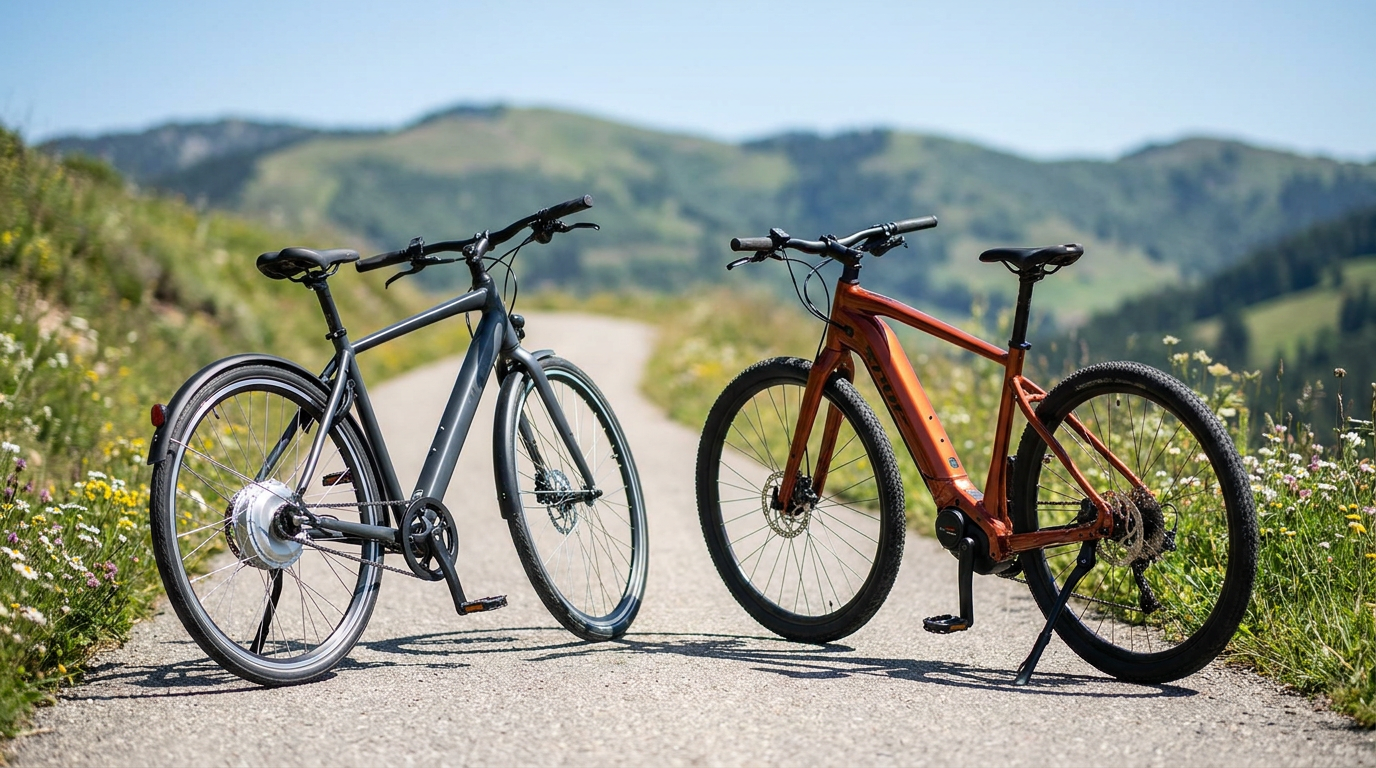
- Hub motors are located in the wheel, while mid-drive motors sit between the pedals.
- Mid-drives leverage the bike's gears, making them vastly superior for climbing steep hills.
- Hub motors bypass the chain, significantly reducing drivetrain wear and maintenance costs.
- Mid-drives provide a natural, responsive ride feel via torque sensors.
- Hub motors are generally more affordable and often include a throttle for pedaling-free acceleration.
- The choice depends entirely on the rider's local terrain, budget, and desired riding style.
The electric bicycle market has matured from a niche novelty into a mainstream transportation juggernaut, but for first-time buyers, the underlying technology can still feel like a maze. The single most consequential decision a rider will make is not the battery capacity, the frame geometry, or the brand name on the downtube. It is the location of the motor. The divide between hub-drive and mid-drive systems dictates everything from how the bike handles a steep hill to how often it will need to visit the repair shop.[1][2]
At a fundamental level, these two engineering approaches solve the exact same problem—moving a rider forward with less physical exertion—but they do so through entirely different mechanical pathways. The industry has effectively split into two distinct camps, each with its own dedicated engineering philosophy. Understanding these pathways is the key to matching a bicycle to a rider's actual, rather than aspirational, daily routine.[2]
A hub motor is housed directly inside the center of the front or rear wheel, operating entirely independently of the bicycle's standard drivetrain. When the motor engages, it simply spins the wheel casing around the central axle, pushing the bike forward. Because it does not interact with the chain or the gears, the hub motor is a self-contained ecosystem. If the bicycle's chain were to snap mid-ride, a hub-motor e-bike with a throttle could still power the rider all the way home.[3][6]
A mid-drive motor, by contrast, is integrated directly into the bottom bracket of the frame, sitting exactly between the rider's pedals. Instead of turning the wheel directly, the mid-drive motor turns the front chainring. This sends the electrical power through the bike’s existing chain and rear gears. In essence, the motor is doing exactly what the human legs do, just with significantly more force.[2][6]

This architectural difference creates a stark divergence in hill-climbing capability. Because a hub motor drives the wheel directly, it has no mechanical advantage; a motor rated for 50 Newton-meters of torque delivers exactly that amount of force, regardless of the incline. When faced with a steep 15 percent gradient, a hub motor can bog down, converting excess electrical energy into heat rather than forward motion. On prolonged, steep climbs, this lack of leverage can even cause direct-drive hub motors to overheat.[2][7]
Mid-drive motors, however, leverage the bicycle's rear cassette to multiply their force. Just as a driver shifts a manual transmission into first gear to crawl up a mountain, a cyclist on a mid-drive e-bike can shift into a low gear, multiplying the motor's torque at the rear wheel. This allows the internal electric motor to spin at its optimal, highly efficient revolutions per minute, even when the bicycle is moving at a walking pace up a steep fire road.[2][3]
That gearing advantage translates directly into battery efficiency, though the exact margins depend heavily on the topography of the ride. On demanding, hilly routes or off-road trails, a mid-drive motor can extract significantly more range from a battery pack. Industry testing suggests that a mid-drive system can deliver 10 to 15 more miles per charge than a hub motor of equivalent battery size when navigating sustained climbs, simply because it avoids the massive energy drain of low-RPM, high-load scenarios.[3][4]
However, on perfectly flat urban commutes, that mid-drive advantage evaporates. In fact, independent engineering tests have shown that direct-drive hub motors can actually be up to 11 percent more efficient on flat ground. Because the hub motor applies force directly to the wheel, it bypasses the frictional losses of pulling a chain through a derailleur and around a cassette. For a rider cruising along a beach boardwalk, the hub motor is quietly maximizing every watt of electricity.[8]
However, on perfectly flat urban commutes, that mid-drive advantage evaporates.
The physical sensation of riding these two systems is equally distinct, largely due to the sensors that control them. Mid-drive motors are almost universally paired with torque sensors, which measure exactly how hard the rider is pushing on the pedals and amplify that exact effort in real time. The resulting power delivery feels entirely natural, effectively giving the rider bionic legs. If you push hard to accelerate, the motor instantly surges with you; if you ease off, the motor immediately softens its output.[1][3]
Hub motors, particularly on budget-friendly models, often rely on cadence sensors that simply detect whether the pedals are turning, regardless of how much effort the rider is exerting. This can create a sensation of being pushed from behind by an invisible hand. Some riders find this effortless cruising thrilling, while others find the slight delay in power delivery to be slightly disconnected or herky-jerky, especially when navigating tight corners or riding alongside unpowered bicycles.[1][3]

Maintenance costs and long-term durability present another major trade-off, and here, the hub motor reclaims significant ground. Because a mid-drive motor channels all of its power—often peaking at over 750 watts—directly through a standard bicycle chain and cassette, the drivetrain experiences accelerated wear. Mechanics note that mid-drive e-bikes typically require chain replacements every 1,500 to 3,000 kilometers. If a rider neglects to shift gears properly, they can snap a chain under the combined torque of their legs and the motor.[2][7]
Hub motors bypass the bicycle's drivetrain entirely, meaning the chain only handles the human rider's leg power. As a result, hub-drive chains and cassettes can easily last 3,000 to 5,000 kilometers, drastically reducing routine maintenance costs. Furthermore, because the motor is sealed inside the wheel hub, it is largely impervious to the mud, grit, and grime that can foul a mid-drive's external chainring.[2][7]
There is, however, a notorious exception to the hub motor's maintenance advantage: the dreaded rear flat tire. Removing a rear wheel equipped with a hub motor requires disconnecting heavy-gauge electrical cables, wrestling with a wheel that can weigh upwards of 15 pounds, and carefully realigning torque washers during reassembly. For a commuter stranded on the side of a rainy road, this can be a daunting task. Mid-drive e-bikes use standard bicycle wheels with quick-release or thru-axles, making tire changes identical to those on a traditional unpowered bicycle.[5][7]
Another unique feature of the hub motor architecture is the ability to incorporate a throttle. Because the motor operates independently of the pedals and gears, many hub-drive e-bikes feature a thumb or twist throttle that allows the bike to move from a dead stop without any pedaling at all. This is a massive selling point for riders with knee issues, commuters who want to accelerate quickly across busy intersections, or those who simply want a break from pedaling. Mid-drive systems rarely offer throttle-only operation, requiring active pedaling to engage the assist.[3][4]

Weight distribution also plays a subtle but important role in how the bicycle handles. A mid-drive motor places its heaviest component low and dead-center in the frame, preserving the bicycle's natural center of gravity. This balanced weight distribution is crucial for mountain bikers navigating technical descents or riders maneuvering through tight city traffic. A rear hub motor places a significant mass at the very back of the bike, which can make the rear end feel planted but occasionally cumbersome when lifting the bike over a curb or onto a vehicle rack.[2][6]
Ultimately, the divide between these two technologies is reflected most sharply in their retail prices. Hub motors have been manufactured at scale for over a decade and feature simpler internal designs, allowing them to dominate the entry-level and mid-tier markets. A reliable hub-drive e-bike can easily be found between $1,200 and $2,500. Mid-drive motors require specialized, custom-designed frames to house the motor unit, driving up manufacturing costs. Consequently, mid-drive e-bikes typically start around $2,000 and can easily exceed $4,000 for premium models.[3][4]

When synthesizing these trade-offs, a clear picture emerges of where each system fits best. A hub-drive motor is the undisputed champion for budget-conscious buyers, casual weekend riders, and urban commuters whose routes consist primarily of flat or gently rolling paved paths. It fits perfectly when a rider wants the option of a throttle, prefers to minimize routine drivetrain maintenance, and does not need to conquer aggressive mountain trails. For the vast majority of recreational cyclists, the hub motor provides more than enough capability at a highly accessible price point.[1][4]
Conversely, the mid-drive motor is the necessary choice for riders who face steep, sustained hills on their daily routes, or those who plan to venture off-road onto dirt trails. It fits perfectly when a rider prioritizes a natural, responsive cycling feel, needs to haul heavy cargo up inclines, or wants to maximize battery range through active gear management. While the upfront cost and drivetrain wear are higher, the mid-drive system rewards the engaged cyclist with superior balance, climbing leverage, and a seamless integration of human and electric power.[2][7]
How we got here
Early 2010s
Hub motors dominate the early e-bike market due to their simplicity and ability to be retrofitted onto standard bicycle frames.
2014
Bosch and Yamaha begin popularizing integrated mid-drive systems, shifting the focus toward natural ride feel and mountain biking applications.
2018
Direct-to-consumer brands explode in popularity, utilizing affordable rear hub motors to bring e-bike prices below the $1,500 threshold.
2022
Mid-drive technology becomes lighter and more compact, allowing for 'stealth' e-bikes that look nearly identical to traditional bicycles.
2026
The market settles into a clear bifurcation: hub motors for budget and urban commuting, and mid-drives for premium, off-road, and cargo applications.
Viewpoints in depth
Commuter & Casual Riders
Prioritize value, simplicity, and sweat-free transportation.
For riders using e-bikes primarily as car replacements for flat urban commutes or weekend leisure rides, the hub motor is widely viewed as the superior tool. This camp values the lower upfront cost and the drastically reduced drivetrain maintenance, noting that a hub motor's independence from the chain saves hundreds of dollars in shop fees over the bike's lifespan. Furthermore, the inclusion of a throttle is seen as a critical accessibility feature, allowing riders to accelerate safely from traffic lights or power through a headwind without arriving at their destination drenched in sweat.
Mountain & Performance Cyclists
Demand natural ride feel, balance, and maximum torque for steep terrain.
Enthusiasts who tackle off-road trails or live in highly mountainous regions universally favor mid-drive systems. This perspective emphasizes that an e-bike should still feel like a bicycle, praising the torque sensors that perfectly amplify human effort without the 'ghost pedaling' sensation of a cadence-sensed hub motor. For this camp, the ability to leverage the bike's cassette to climb 20-percent grades is non-negotiable, and the centered weight distribution is considered essential for safely navigating technical descents and maintaining traction on loose dirt.
E-Bike Mechanics & Engineers
Focus on the physical trade-offs of power delivery and long-term repairability.
From a purely mechanical standpoint, technicians view both systems as a series of calculated compromises. Engineers point out that while mid-drives are highly efficient climbers, they subject standard bicycle chains to motorcycle-levels of torque, leading to premature wear and snapped chains if riders shift poorly under load. Conversely, mechanics often dread servicing hub-motor bikes due to the complex wiring and sheer weight involved in fixing a simple rear flat tire. This camp advocates for matching the motor architecture strictly to the rider's local topography rather than brand hype.
What we don't know
- How long-term battery degradation differs between the two systems when subjected to identical daily commuting loads.
- Whether emerging automatic-shifting technologies will eventually mitigate the drivetrain wear issues currently associated with mid-drive motors.
Key terms
- Torque Sensor
- A mechanism that measures exactly how hard the rider is pushing on the pedals and delivers electric assistance proportionally, creating a natural cycling feel.
- Cadence Sensor
- A simpler sensor that detects whether the pedals are turning, delivering a set amount of power regardless of how hard the rider is actually working.
- Bottom Bracket
- The part of the bicycle frame where the pedal arms (cranks) attach, which is also where a mid-drive motor is housed.
- Newton-meter (Nm)
- A unit of torque used to measure the rotational twisting force a motor can apply to help push the bike forward.
- Cassette
- The cluster of gears attached to the rear wheel of a bicycle, which a mid-drive motor utilizes to gain mechanical advantage on hills.
Frequently asked
Can a hub motor climb steep hills?
Yes, but with limitations. Hub motors perform well on moderate hills, but on long, steep climbs (above 10% grade), they lack the mechanical advantage of gears and can bog down or overheat.
Why do mid-drive e-bikes cost more?
Mid-drive motors require specialized, custom-designed bicycle frames to securely house the motor at the bottom bracket, which significantly increases manufacturing and engineering costs compared to bolting a motor into a standard wheel hub.
Which motor type is better for riding in the rain?
Both are generally well-sealed against the elements, but hub motors are entirely enclosed within the wheel casing, making them slightly more impervious to the mud and grit that can accumulate on a mid-drive's external chainring.
Can I ride an e-bike if the battery dies?
Yes. However, a mid-drive bike will feel exactly like a heavy traditional bicycle, whereas a direct-drive hub motor may introduce a small amount of magnetic drag, making it slightly harder to pedal without power.
Sources
Source coverage
8 outlets
3 viewpoints surfaced








[1]Factlen Editorial TeamE-Bike Mechanics & Engineers
Synthesis by Factlen editorial team
Read on Factlen Editorial Team →[2]Bike Yard OnlineMountain & Performance Cyclists
Hub Motor vs Mid-Drive E-Bikes - A Complete Comparison
Read on Bike Yard Online →[3]HimiwayCommuter & Casual Riders
Which is more efficient: hub motor or mid-drive?
Read on Himiway →[4]MeloYeloCommuter & Casual Riders
Mid Drive vs Rear Hub Motors: Which Electric Bike Motor is Best?
Read on MeloYelo →[5]eBikes.orgCommuter & Casual Riders
Hub Motor vs Mid-Drive E-Bikes
Read on eBikes.org →[6]Gazelle BikesMountain & Performance Cyclists
Hub Drive vs Mid Drive Motor Overview
Read on Gazelle Bikes →[7]EVELOMountain & Performance Cyclists
Mid-Drive vs Hub Motor eBikes
Read on EVELO →[8]EMTB ForumsE-Bike Mechanics & Engineers
Hub motor vs Mid drive strictly from an efficiency stand point
Read on EMTB Forums →

More in shopping
See all 5 stories →Motorcycle Tech
The Trickle-Down of Flagship Safety: Why 2026 is the Safest Year to Buy a Beginner Motorcycle
7 sources
Appliance Tech
The Rise of the All-in-One Heat Pump Washer-Dryer: How It Works and Why It's Changing Laundry
7 sources
Skincare Tech
The Evidence on Red Light Therapy Masks: What Clinical Trials Actually Show
8 sources

Every angle. Every day.
Get shopping stories with full source coverage and perspective breakdowns delivered to your inbox.