
The Hidden Mechanics of the SpaceX IPO: Why Index Funds Are Forced to Buy
As the initial retail frenzy around SpaceX's record-breaking IPO cools, a second wave of mandatory buying from passive index funds is set to test the plumbing of the stock market.
By Factlen Editorial Team
- Retail & Thematic Investors
- Focused on capturing early momentum and securing day-one exposure to generational tech monopolies.
- Index Rule Traditionalists
- Argue that benchmark integrity requires strict profitability and seasoning screens, regardless of a company's size.
- Market Structure Pragmatists
- Argue that benchmarks must reflect the actual market, necessitating fast-track rules for mega-cap IPOs to avoid tracking errors.
- Neutral Market Observers
- Focused on explaining the mechanical realities of index flows without taking a side on the rule changes.
What's not represented
- · Active fund managers who must decide whether to front-run the passive index flows.
- · Retail investors who bought at the IPO peak and are waiting for index funds to provide an exit.
Why this matters
Millions of Americans hold their retirement savings in passive index funds. Understanding how and when these funds are forced to buy mega-cap IPOs like SpaceX is crucial for navigating the hidden mechanics that drive stock market volatility.
Key points
- SpaceX's $1.77 trillion IPO is forcing major stock market indices to rewrite their inclusion rules.
- The Nasdaq-100 and CRSP indices have adopted fast-track rules, forcing passive funds to buy SpaceX shares within weeks of its debut.
- The S&P 500 committee refused to alter its criteria, meaning SpaceX will not enter the benchmark until at least mid-2027.
- Because SpaceX only floated roughly 4% to 5% of its shares, the forced buying from index funds could trigger extreme price volatility.
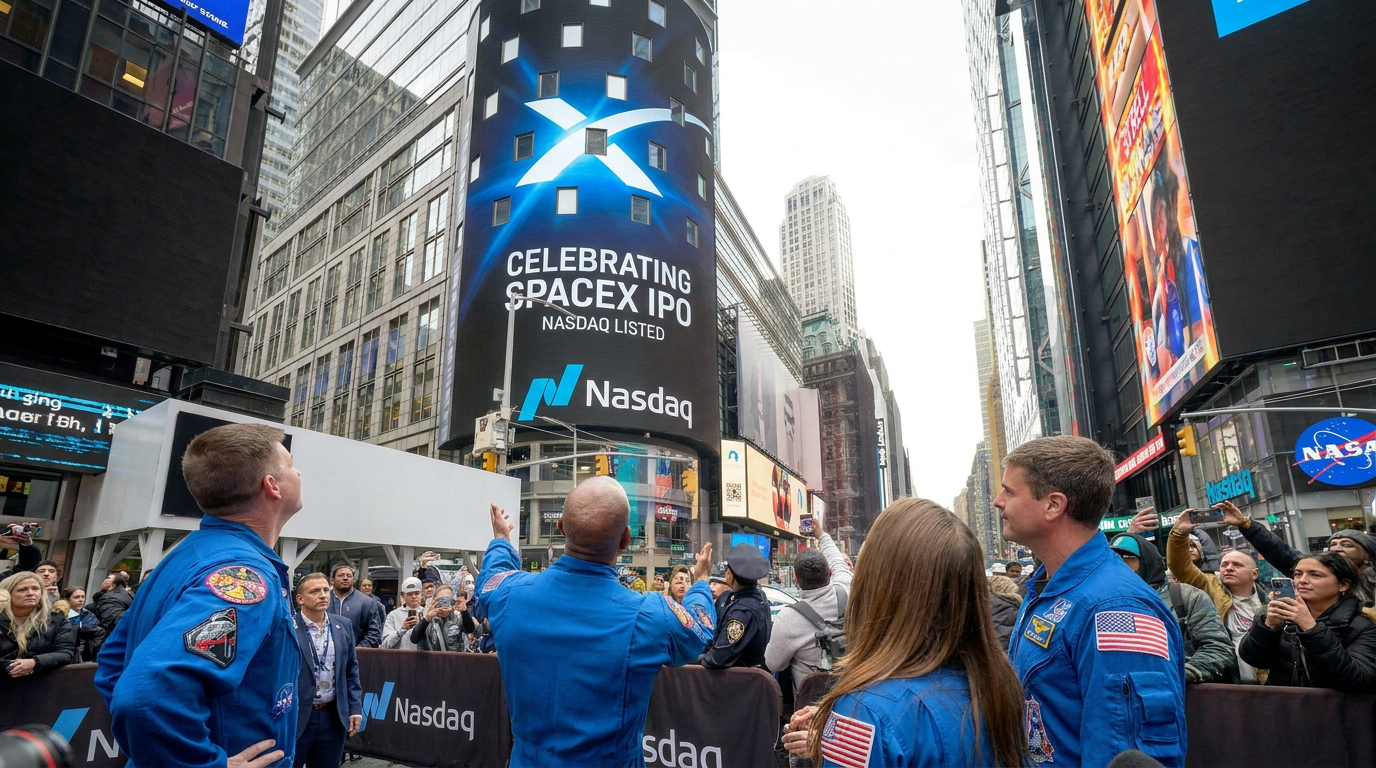
The June 12, 2026, initial public offering of SpaceX rewrote the financial record books. Debuting at a staggering $1.77 trillion valuation, the aerospace and artificial intelligence conglomerate instantly became the sixth most valuable publicly traded company in the United States.[6]
In the days following the listing, retail investors poured billions into the stock, driving shares up as much as 67% from their $135 offering price. But as this initial retail frenzy begins to cool, market structure analysts are warning of a second, much larger wave of capital preparing to strike.[1]
This looming wall of money comes from passive index funds—the automated portfolios that hold trillions of dollars in American retirement accounts. Unlike retail day-traders, index funds do not buy a stock simply because it goes public; they are legally mandated to wait until the company is officially added to the specific benchmark index they track.[2][4]
The mechanics of "index inclusion" are typically an afterthought for average investors, but SpaceX's unprecedented size has turned it into a high-stakes battle over market rules. When a company is added to a major index like the Nasdaq-100 or the S&P 500, every passive fund tracking that benchmark is forced to buy shares simultaneously to match the index's new composition.[2][3]
For a typical IPO, this process takes months or even years. But index providers have faced immense pressure to adapt to the era of the "mega-cap IPO." If a benchmark fails to include a nearly $2 trillion company, it risks no longer accurately representing the broader market, which is its primary purpose.[4][7]

In response, several major index providers altered their rulebooks specifically to accommodate SpaceX. Nasdaq, for instance, removed its historical minimum free-float requirement and instituted a "fast entry" rule for companies of this scale.[2][4]
As a result, SpaceX is scheduled to be added to the Nasdaq-100 index on July 6, 2026—just 15 trading days after its IPO. On that day, funds tracking the Nasdaq-100, such as the massive Invesco QQQ Trust, will be forced to execute billions of dollars in automated buy orders.[2][6]
The Center for Research in Security Prices (CRSP), which manages the indices tracked by Vanguard's most popular broad-market ETFs, moved even faster. CRSP tweaked its eligibility requirements to allow mega-cap IPOs to enter its U.S. Total Market Index after just five trading days, ensuring early exposure for millions of passive investors.[2]
The Center for Research in Security Prices (CRSP), which manages the indices tracked by Vanguard's most popular broad-market ETFs, moved even faster.
Thematic ETFs are also rewriting their rulebooks to capture the momentum. The VettaFi Space Index, a benchmark for space-economy stocks, explicitly updated its methodology to allow for "Day One" exposure to mega-cap space companies, bypassing traditional waiting periods entirely.[5]
However, the most powerful index in global finance—the S&P 500—has explicitly refused to bend. On June 4, S&P Dow Jones Indices rejected a proposal to fast-track SpaceX, announcing that it would strictly maintain its traditional inclusion criteria.[3]
The S&P 500 requires a company to trade publicly for a "seasoning period" of at least 12 months before it can be considered for inclusion. More importantly, it requires four consecutive quarters of positive GAAP (Generally Accepted Accounting Principles) profitability.[3][4]
Because SpaceX reported a net loss of $4.94 billion in 2025 as it aggressively built out its Starship and xAI infrastructure, it fails the profitability test. Consequently, SpaceX will not enter the S&P 500 until at least mid-2027, leaving the trillions of dollars parked in funds like the Vanguard S&P 500 ETF (VOO) on the sidelines.[3][6]
This divergence in index rules creates a fascinating, and potentially volatile, market dynamic. The core issue is SpaceX's "free float"—the percentage of its total shares that are actually available for public trading.[4][7]
Despite its nearly $2 trillion valuation, SpaceX only floated roughly 4% to 5% of its shares in the IPO. The vast majority of the equity remains locked up by founder Elon Musk, early employees, and private institutional backers.[4][6]

This means that when the Nasdaq-100 and CRSP index funds execute their mandatory buy orders in July, they will be hunting for shares in a severely restricted pool. Chasing a tiny float with billions of dollars in forced buying pressure is a classic recipe for extreme price volatility.[2][7]
To mitigate this, index providers weight companies based on their float-adjusted market capitalization rather than their total valuation. Even so, the sheer volume of capital tied to these benchmarks means that SpaceX's stock price could experience significant turbulence as passive funds compete with retail investors for the few available shares.[2][4]
The outcome of this index-inclusion saga will likely set the precedent for the next wave of generational tech monopolies. With artificial intelligence giants like Anthropic and OpenAI heavily rumored to be eyeing their own mega-cap public debuts, the financial plumbing of the stock market is being tested like never before.[3][7]

For everyday investors, the lesson is clear: in the modern stock market, the most consequential trading days often happen not when a company rings the opening bell, but when the invisible hand of passive index funds is finally allowed to strike.[1]
How we got here
Dec 2025
Elon Musk officially confirms plans to take SpaceX public.
May 2026
S&P Dow Jones Indices opens a consultation on fast-tracking mega-cap IPOs, but ultimately rejects the proposal.
June 12, 2026
SpaceX debuts on the Nasdaq at a record-breaking $1.77 trillion valuation.
June 19, 2026
CRSP indices add SpaceX to their total market benchmarks just five days post-IPO.
July 6, 2026
Expected date for SpaceX to be added to the Nasdaq-100 index, triggering massive passive fund buying.
Viewpoints in depth
Index Rule Traditionalists
Argue that benchmark integrity requires strict profitability and seasoning screens, regardless of a company's size.
Traditionalists maintain that indices like the S&P 500 derive their prestige from strict quality controls. They argue that waiving the 12-month seasoning period or the GAAP profitability requirement simply because a company is massive sets a dangerous precedent. In their view, forcing passive investors to buy into unproven or unprofitable companies undermines the safety and reliability that index funds are supposed to provide.
Market Structure Pragmatists
Argue that benchmarks must reflect the actual market, necessitating fast-track rules for mega-cap IPOs to avoid tracking errors.
Pragmatists point out that the primary job of a broad-market index is to accurately represent the universe of investable stocks. When a company debuts at a $1.77 trillion valuation, excluding it from a benchmark creates a massive tracking error. They argue that legacy rules designed for an era of smaller IPOs are no longer fit for purpose, and that fast-tracking mega-caps is a mathematical necessity to keep indices relevant.
Retail & Thematic Investors
Focused on capturing early momentum and securing day-one exposure to generational tech monopolies.
For retail investors and thematic fund managers, the focus is entirely on growth and momentum. They view traditional index rules as bureaucratic hurdles that lock everyday investors out of a company's highest-growth phase. This camp strongly supports specialized indices and fast-track rules that allow them to gain immediate exposure to transformative technologies like commercial spaceflight and artificial intelligence.
What we don't know
- Exactly how much tracking error S&P 500 index funds will suffer by excluding the sixth-largest U.S. company for over a year.
- Whether the intense passive buying pressure in July will cause a temporary price bubble that collapses once the index funds finish their mandatory purchases.
- How index providers will handle the upcoming mega-cap IPOs of AI giants like Anthropic and OpenAI.
Key terms
- Passive Index Fund
- An investment fund designed to automatically track the performance of a specific market benchmark, rather than relying on a manager to pick stocks.
- Free Float
- The portion of a company's outstanding shares that is freely available for the public to trade, excluding locked-in shares held by insiders.
- Seasoning Period
- A mandatory waiting period required by some index providers before a newly public company can be considered for inclusion.
- GAAP Profitability
- Earnings calculated according to Generally Accepted Accounting Principles, a standard set of accounting rules used in the United States.
Frequently asked
Why isn't SpaceX in the S&P 500 yet?
The S&P 500 requires companies to trade publicly for 12 months and post four consecutive quarters of GAAP profitability, criteria SpaceX does not currently meet.
What is a 'free float'?
Free float refers to the percentage of a company's total shares that are actually available to be traded by the public, excluding shares locked up by insiders.
How does index inclusion affect stock price?
When a stock is added to a major index, passive funds tracking that index are forced to buy shares, which can drive up the price due to a sudden surge in demand.
When will the Nasdaq-100 add SpaceX?
Under its new fast-track rules, the Nasdaq-100 is expected to add SpaceX 15 trading days after its IPO, landing on July 6, 2026.
Sources
Source coverage
7 outlets
4 viewpoints surfaced







[1]MarketWatchRetail & Thematic Investors
The initial SpaceX frenzy is cooling off — but a new wave of cash is waiting to strike
Read on MarketWatch →[2]The Motley FoolRetail & Thematic Investors
Index Investors: Here's How Much SpaceX Stock You're About to Own
Read on The Motley Fool →[3]SpotGammaIndex Rule Traditionalists
SpaceX index inclusion 2026
Read on SpotGamma →[4]Hargreaves LansdownIndex Rule Traditionalists
How do index funds treat IPOs?
Read on Hargreaves Lansdown →[5]VettaFiRetail & Thematic Investors
SpaceX IPO and the VettaFi Space Index
Read on VettaFi →[6]WikipediaMarket Structure Pragmatists
Initial public offering of SpaceX
Read on Wikipedia →[7]Factlen Editorial TeamNeutral Market Observers
Synthesis by Factlen editorial team
Read on Factlen Editorial Team →



Every angle. Every day.
Get finance stories with full source coverage and perspective breakdowns delivered to your inbox.