
How 2026 Became a Watershed Year for Video Game Accessibility
Driven by standardized storefront tags, facial-recognition controls in blockbuster titles, and new adaptive hardware, the video game industry is making unprecedented strides in accommodating disabled players.
By Factlen Editorial Team
- Accessibility Advocates
- Pushing for universal standards, system-level features like co-pilot mode, and eliminating reliance on purely visual cues.
- Hardware & Software Developers
- Focusing on inclusive design cycles, integrating third-party tools like Cephable, and expanding adaptive controller ecosystems.
- Disabled Gamers
- Celebrating the newfound independence in gaming while highlighting remaining gaps in UI scaling and audio cues.
What's not represented
- · Neurodivergent gamers who require specific cognitive accessibility features, such as sensory overload toggles.
- · Esports tournament organizers grappling with how to standardize adaptive hardware in competitive play.
Why this matters
For decades, millions of disabled individuals were locked out of one of the world's primary social and cultural mediums. The standardization of accessibility tech in 2026 means gaming is finally becoming a universal space, improving social connection and mental health for a massive underserved population.
Key points
- 2026 is marking a major turning point for video game accessibility through hardware, software, and storefront innovations.
- Xbox introduced new 3D-printable Adaptive Thumbstick Toppers to help players with limited hand mobility.
- Call of Duty: Black Ops 7 integrated Cephable, allowing players to control the game using facial expressions and head movements.
- The Accessible Games Initiative is standardizing storefront tags so players know what accessibility features a game has before buying.
- 84% of surveyed players reported that accessible gaming improved their social interactions and connections.
- Advocates are still pushing for universal adoption of features like 'co-pilot mode' across all major consoles, including the Switch 2.
Video games are often described as a universal language, but for decades, the medium’s rigid hardware and software requirements locked millions of disabled players out of the conversation. In 2026, the industry is undergoing a structural transformation that advocates are calling a watershed moment. Driven by a combination of standardized digital storefronts, groundbreaking facial-recognition software in blockbuster titles, and highly customizable adaptive hardware, developers are finally shifting accessibility from a post-launch afterthought to a foundational pillar of game design. The momentum, which reached a crescendo during this year's Global Accessibility Awareness Day, signals that the medium is actively tearing down the barriers that have historically marginalized players with mobility, visual, and cognitive disabilities.
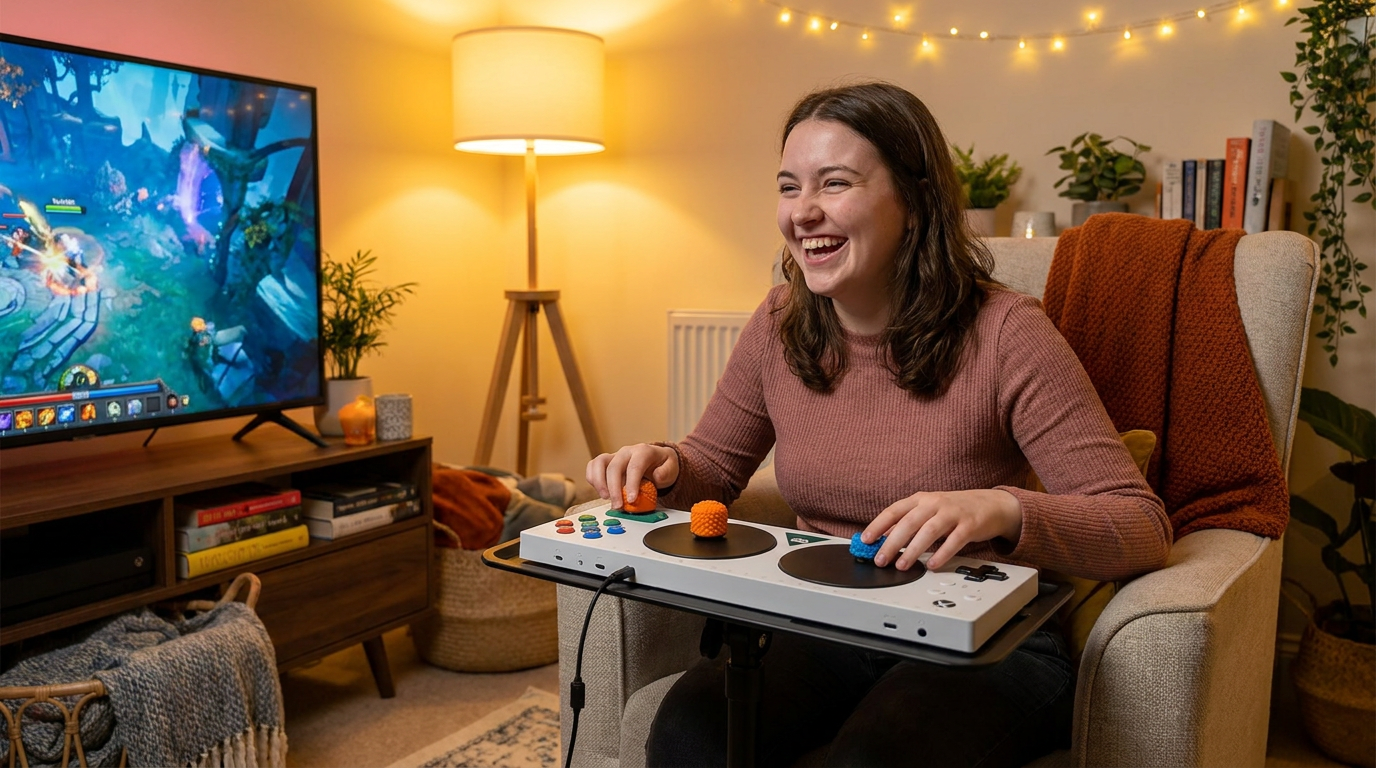
The most visible advancements have emerged in the hardware space, where companies are moving beyond one-size-fits-all solutions to offer hyper-personalized inputs. In May, Microsoft expanded its Xbox Design Lab with new Adaptive Thumbstick Toppers, including a highly requested "Goal Post" shape designed specifically to attach to the Xbox Adaptive Joystick. These modular components allow players with limited hand or finger mobility to manipulate thumbsticks using different parts of their hands, arms, or chin. By making these parts easily customizable and 3D-printable, hardware manufacturers are acknowledging that disability is a spectrum, and effective solutions require a deeply individualized approach to controller ergonomics.[1]
But hardware is only half the equation; the software running on the screen must also be built to receive non-traditional inputs. This year, the blockbuster shooter Call of Duty: Black Ops 7 made headlines by natively integrating Cephable, a third-party accessibility platform that translates alternative physical inputs into in-game actions. Through a mobile or desktop app, players can now control their in-game avatars using voice commands, subtle head movements, and even specific facial expressions.[1][4]
The integration of Cephable into a fast-paced, highly competitive franchise like Call of Duty represents a massive leap forward for the industry. Historically, mobility-impaired players who could not use traditional dual-analog controllers were forced to rely on complex, expensive, and often lag-heavy third-party workarounds to play AAA titles. By baking facial and voice recognition directly into the game's architecture, developers are allowing players with severe motor impairments to compete on an even playing field, executing complex maneuvers like reloading or crouching simply by tilting their head or raising an eyebrow.[4]

Beyond the games themselves, the industry is finally addressing one of the most persistent frustrations for disabled players: the digital storefront. For years, players have had to purchase games blindly, hoping the title contained the specific subtitle options, colorblind filters, or control-remapping features they needed to actually play it. To solve this, a coalition of major publishers formed the Accessible Games Initiative, a collective designed to create a universal, standardized vocabulary for accessibility features across all gaming platforms.[2][5]
Beyond the games themselves, the industry is finally addressing one of the most persistent frustrations for disabled players: the digital storefront.
The initiative has already begun bearing fruit. Xbox recently overhauled its digital storefront to include these standardized tags, allowing users to filter games by specific accessibility criteria before they spend their money. Industry advocates are now mounting pressure on PlayStation and Nintendo to adopt the exact same standardized language for their respective stores. The goal is to create a unified ecosystem where a "high contrast mode" or "audio aim assist" tag means the exact same thing regardless of whether a player is browsing on a PC, a PlayStation 5, or a Nintendo Switch 2.[2][5]
The stakes for these technical improvements extend far beyond mere entertainment. For many disabled individuals, online gaming serves as a vital lifeline for social connection and community building. A recent internal study published by Activision highlighted this profound social impact, revealing that 84 percent of surveyed players reported improved social interaction through accessible gaming, while 87 percent cited significant stress relief. By removing the friction of inaccessible design, developers are directly facilitating friendships, teamwork, and a sense of belonging that might otherwise be difficult to achieve in physical spaces.[1]

While mobility innovations often dominate the headlines, 2026 has also seen crucial advancements for the visually impaired community. According to the Direct Access Consultancy, approximately 250 million gamers worldwide identify as visually impaired, representing a massive demographic that has historically been underserved by an inherently visual medium. For these players, the industry's historical reliance on tiny user-interface text, color-coded puzzle mechanics, and purely visual threat indicators has been a constant source of frustration.[3]
To bridge this gap, developers are increasingly leaning into complex audio-spatial design. Rare’s pirate simulator Sea of Thieves, which has implemented over 100 accessibility updates since its launch, recently introduced a highly praised "Audio Aim Assist" feature. This tool uses dynamic audio cues to help players with low or no vision track targets and navigate the game's chaotic naval battles entirely by sound. Combined with the rising standardization of high-contrast visual modes and menu screen readers, blind and low-vision players are gaining unprecedented independence in navigating expansive virtual worlds.[1][7]
Despite these sweeping victories, accessibility advocates caution that the industry still has significant blind spots. Many high-profile releases continue to ship with critical accessibility gaps, particularly regarding user-interface scaling and the lack of audio descriptions for crucial visual cues. Direct Access Consultancy notes that while dedicated accessibility menus are becoming standard, core gameplay loops in many titles still fundamentally rely on complex visual environments that cannot be bypassed or translated into audio, leaving completely blind players at a severe disadvantage.[3]

The hardware ecosystem also faces lingering fragmentation. While Nintendo's recently launched Switch 2 has been a massive commercial success, accessibility advocates have pointed out the console's lack of a system-level "co-pilot" mode. This feature, which is already standard on Xbox and PlayStation, allows two separate controllers to be registered as a single input device. Co-pilot mode is essential for players who need a friend to handle complex button combinations while they manage movement, or for those who need to combine a standard controller with a specialized adaptive joystick to play effectively.[2][6]
Nevertheless, the trajectory of the gaming industry is unmistakably positive. The advancements of 2026 prove that inclusive design does not compromise the artistic vision or mechanical depth of a game; rather, it expands the audience capable of experiencing that vision. As standardized tags become the norm and tools like facial-recognition controls are integrated into the biggest franchises on the planet, the medium is finally living up to its promise of being a truly universal playground.
How we got here
2020
The modern wave of video game accessibility progress begins, marked by major first-party studios prioritizing inclusive design.
2025
The Accessible Games Initiative is announced to standardize accessibility language across the industry.
May 2026
Xbox releases new Adaptive Thumbstick Toppers and Call of Duty integrates Cephable facial tracking.
June 2026
Advocates push for system-level accessibility features, like co-pilot mode, to be added to the newly released Nintendo Switch 2.
Viewpoints in depth
Accessibility Advocates
Pushing for universal standards and system-level features across all platforms.
Advocacy groups argue that while individual games are making great strides, true accessibility requires system-level standardization. They point to the Accessible Games Initiative as a crucial first step, but stress that hardware manufacturers must mandate these features. Their primary focus in 2026 is pressuring Nintendo and PlayStation to adopt standardized storefront tags and implement universal features like co-pilot mode, ensuring no player is left behind simply because of their console choice.
Hardware & Software Developers
Focusing on inclusive design cycles and integrating third-party tools.
For developers, the challenge lies in integrating accessibility without compromising the core gameplay loop or ballooning development budgets. Studios are increasingly partnering with third-party platforms like Cephable to offload the complex engineering required for facial and voice recognition. Developers argue that building these features into the engine from day one—rather than patching them in post-launch—ultimately creates a better, more customizable experience for all players, not just those with disabilities.
Disabled Gamers
Celebrating newfound independence while highlighting remaining gaps.
The disabled gaming community is largely celebrating 2026 as a monumental year for independence. Players who previously relied on expensive workarounds or the physical assistance of friends can now navigate AAA titles autonomously. However, the community remains vocal about lingering blind spots, particularly the industry's over-reliance on tiny text and visual cues that lack screen-reader support, reminding developers that accessibility is an ongoing process rather than a final destination.
What we don't know
- Whether PlayStation and Nintendo will fully adopt the Accessible Games Initiative's standardized tags on their digital storefronts.
- When system-level features like co-pilot mode will be integrated into the Nintendo Switch 2 ecosystem.
- How quickly smaller indie studios will be able to adopt advanced tools like facial-recognition controls given their limited budgets.
Key terms
- Adaptive Controller
- A highly customizable video game controller designed specifically to meet the needs of players with limited mobility.
- Co-pilot Mode
- A console feature that links two separate controllers so they function as a single player's input, allowing for shared control or combined hardware setups.
- Audio Aim Assist
- An in-game feature that uses dynamic sound cues to help blind or low-vision players locate and target enemies without relying on visual information.
- High Contrast Mode
- A visual setting that alters the game's color palette to make characters, enemies, and interactive objects stand out clearly against the background.
Frequently asked
What is the Accessible Games Initiative?
It is a coalition of major video game publishers working to create standardized accessibility tags for digital storefronts, making it easier for players to know if a game meets their needs before purchasing.
How does Cephable work in video games?
Cephable is a platform that allows players to control in-game actions using alternative inputs like voice commands, head movements, and facial expressions, which is now integrated into major titles like Call of Duty.
What is co-pilot mode?
Co-pilot mode is a system-level feature that allows two separate controllers to act as a single input device, enabling a second person to assist with complex controls or allowing a player to combine different adaptive hardware.
Sources
Source coverage
7 outlets
3 viewpoints surfaced






[1]Xbox WireHardware & Software Developers
XBOX Celebrates Global Accessibility Awareness Day with Improved Adaptive Thumbstick Toppers and More
Read on Xbox Wire →[2]Access-AbilityAccessibility Advocates
2026 Gaming Accessibility Predictions / Questions
Read on Access-Ability →[3]Direct Access ConsultancyAccessibility Advocates
Still Not Playing Fair: Accessibility Gaps in Gaming and Digital Entertainment
Read on Direct Access Consultancy →[4]IGNHardware & Software Developers
Call of Duty: Black Ops 7's Facial Recognition Controls Are a Massive Leap for Accessibility
Read on IGN →[5]PolygonDisabled Gamers
The Accessible Games Initiative is finally fixing how we buy games
Read on Polygon →[6]GameSpotAccessibility Advocates
Advocates Urge Nintendo to Bring 'Co-Pilot' Mode to Switch 2
Read on GameSpot →[7]EurogamerDisabled Gamers
How Sea of Thieves' Audio Aim Assist is empowering blind pirates
Read on Eurogamer →

Every angle. Every day.
Get entertainment stories with full source coverage and perspective breakdowns delivered to your inbox.