
European Automakers Pivot to Compact City Cars to Solve the EV Affordability Crisis
Legacy brands like Renault, Stellantis, and Volkswagen are shrinking their electric vehicles to challenge bloated SUVs and compete with low-cost imports. The new wave of A-segment cars promises to make sustainable mobility accessible for under €20,000.
By Factlen Editorial Team
- European Automakers
- Legacy brands view small EVs as a critical defense against Chinese imports and a way to revitalize local manufacturing.
- Urban Planners
- City advocates see the shift away from SUVs as a victory for urban livability and infrastructure preservation.
- Cost-Conscious Consumers
- Everyday drivers are demanding a return to the affordable city car to make the EV transition financially viable.
What's not represented
- · Chinese Automakers
- · Public Transit Advocates
Why this matters
By dropping the price of entry-level EVs to under €20,000, automakers are finally making electric mobility accessible to average households. The shift also promises to reclaim narrow city streets from oversized SUVs, reducing infrastructure strain and improving urban safety.
Key points
- European automakers are pivoting back to compact city cars to make EVs more affordable.
- Renault's Twingo EV and Volkswagen's small EV are slated for a 2026 release.
- Stellantis is developing a stripped-down €15,000 electric car for 2028.
- The shift is driven by the need to compete with low-cost Chinese imports.
- Smaller batteries are sufficient for the average 35-kilometer European daily commute.
- Urban planners welcome the move away from heavy, space-consuming electric SUVs.
The winding backstreets of London, Paris, and Rome are a large part of their historic charm, but they were never built for two-and-a-half-ton electric SUVs. For the first half of the 2020s, the electric vehicle transition was dominated by massive, heavy vehicles. Squeezing large battery packs into smaller, cheaper cars was deemed too difficult and economically unviable, pushing manufacturers to focus on bloated SUVs that delivered higher profit margins. This left cost-conscious drivers with fewer new-car options and cluttered European cities with oversized vehicles.[1]
Now, a profound correction is underway across the continent. European automakers are finally shrinking the electric car, pivoting back to the region's historic strength: the compact, affordable city car. Advances in battery technology and dedicated electric platforms are allowing legacy brands to build smaller vehicles without sacrificing essential range or safety. This shift represents a deliberate move away from the SUV-heavy lineups of recent years, aiming to democratize electric mobility for households that have been priced out of the market.[1]
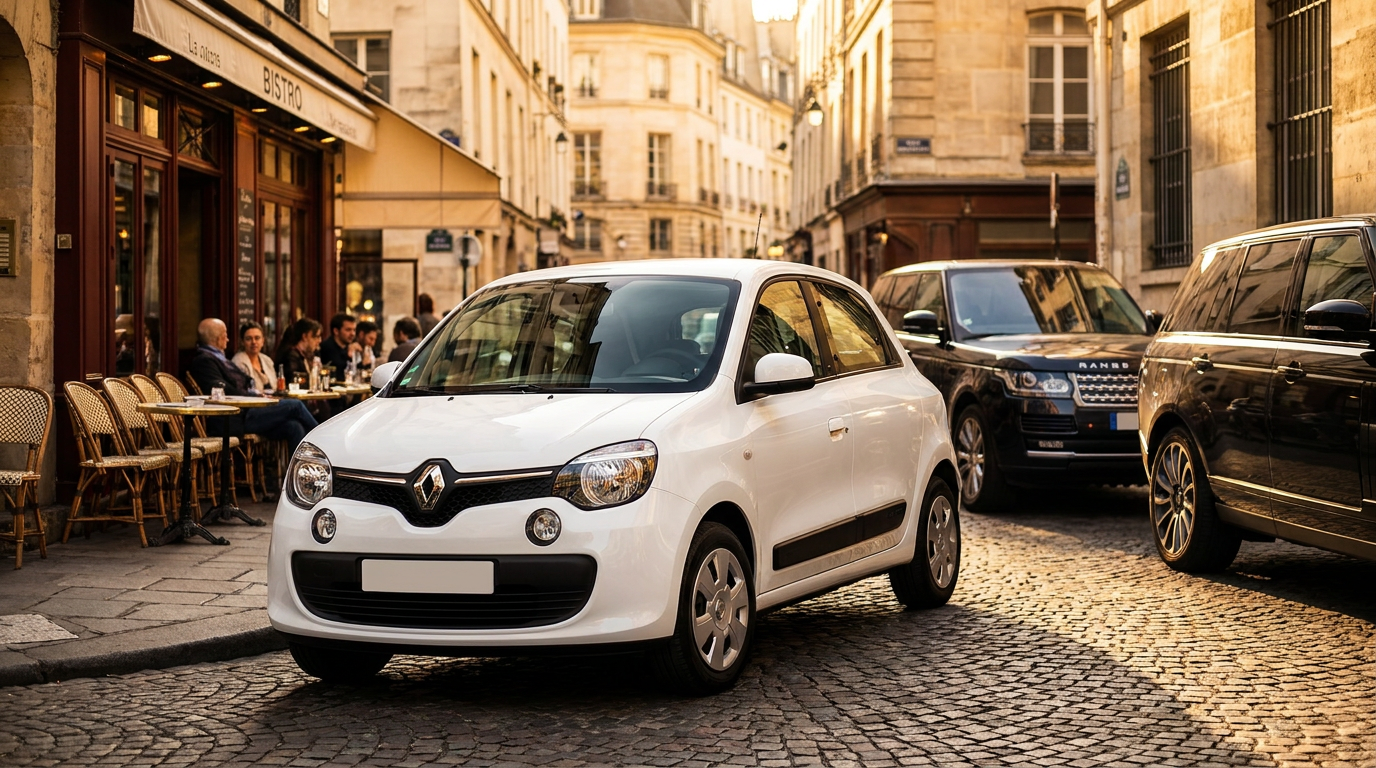
Leading the charge is Renault with its revived Twingo EV, slated for a 2026 release. Priced at roughly €20,000 (around £17,000), the fourth-generation Twingo is a deliberate nostalgia play that echoes the semi-circular headlights and one-box silhouette of the iconic 1990s original. Based on the new Ampere A platform, the vehicle is designed to invoke the magic of the original city car while offering a fully modern, zero-emission powertrain. It is a strategic attempt to win over both new buyers and previous generations of customers.[2][5]
Under the hood, the engineering logic of the new Twingo is strictly utilitarian. The vehicle packs a modest 27.5-kilowatt-hour battery and a front axle-mounted electric motor producing 82 brake horsepower. This configuration delivers a targeted range of about 163 miles (over 250 kilometers) on a single charge. While the maximum charge speed is a relatively slow 50 kilowatts, the small battery capacity means a 10-to-30 percent top-up can be completed in roughly 30 minutes, making it perfectly suited for urban environments.[2][6]

While a 163-mile range will not conquer continents, Renault's engineers calculated that the average European driver covers just 35 kilometers (about 22 miles) a day. For daily city commuters, carrying around a massive 80-kilowatt-hour battery is simply dead weight that inflates the purchase price and reduces overall vehicle efficiency. By right-sizing the battery capacity to match actual A-segment driving habits, automakers can drastically cut production costs while still allowing drivers to commute all week on a single charge without any range anxiety.[2]
Stellantis is pushing the price floor even lower. The automotive conglomerate behind Fiat, Opel, and Citroen is developing a stripped-down "E-Car" targeting a remarkable €15,000 (about $17,500) price tag by 2028. If Stellantis reaches that aggressive target, the model will sit far below almost all electric cars currently sold in Europe. The project aims to answer one of the continent's biggest EV problems—price—by reviving the entry-level car segment for households that once relied on basic, affordable city cars.[3]
The automotive conglomerate behind Fiat, Opel, and Citroen is developing a stripped-down "E-Car" targeting a remarkable €15,000 (about $17,500) price tag by 2028.
Stellantis executives explicitly compare this new class of vehicles to Japan's famous "kei cars"—ultra-compact, strictly regulated urban vehicles that benefit from lower taxes and insurance costs. The company believes a similar European category could dramatically accelerate EV adoption among cost-conscious buyers while supporting better city mobility. By drawing on strategic partnerships and utilizing shared platforms across its multiple brands, Stellantis hopes to spread development costs and make the notoriously difficult economics of manufacturing cheap electric cars viable for the mass market.[3]
Volkswagen is also entering the fray with its own small electric vehicle expected in 2026. Rather than focusing on luxury materials or high-performance specifications, the German automaker is prioritizing clean design, aerodynamic efficiency, and everyday usability. The upcoming model is designed for people who want a simple, practical, and affordable EV for daily urban driving. With a compact hatchback shape and user-friendly technology, Volkswagen aims to capture first-time EV buyers who prioritize reliability and easy handling over premium features.[4]

This industry-wide shift is not purely about European street aesthetics; it is a matter of corporate survival. Chinese automakers, such as BYD and Leapmotor, have been aggressively targeting the lower end of the European market with highly competitive, low-cost electric vehicles. This rapid influx has forced legacy European brands to compress their development timelines and radically rethink their manufacturing strategies to avoid losing their home turf to foreign competitors who are currently offering significantly better value propositions to budget-conscious consumers.[1][6]
To keep costs down, automakers are getting increasingly creative with their global supply chains. The new Renault Twingo's development was compressed into just over two years, utilizing engineering from a Chinese development center for the electric motor and battery components, while keeping the final vehicle assembly in Slovenia. This strategic blend of Chinese engineering efficiency and European assembly highlights a highly pragmatic approach aimed at keeping retail costs in check without losing focus on execution or sacrificing local manufacturing priorities.[2][6]
The Stellantis project similarly aims to revitalize underused European production capacity. The €15,000 E-Car is expected to be built at the Pomigliano d'Arco plant in Italy, providing a critical lifeline to local manufacturing jobs and regional economies. Italian labor unions have warmly welcomed the plan, noting that a high-volume small EV could help dramatically improve factory utilization and eventually help the historic plant reach full employment. This dynamic gives the budget EV project a much wider economic role beyond just providing affordable transportation.[3]

For urban planners and environmentalists, the arrival of A-segment EVs is a massive, long-awaited victory. Smaller cars mean significantly less wear and tear on aging infrastructure, far more parking availability in dense historic neighborhoods, and demonstrably safer streets for pedestrians and cyclists. By directly challenging the bloat of the SUV era, these compact vehicles align perfectly with the broader goals of sustainable city living, drastically reducing the overall physical footprint of personal transportation while still maintaining convenient individual mobility for millions of residents.[1]
The electric revolution is finally being right-sized for the people who actually use it. By embracing the 'big little car' philosophy, Europe's legacy automakers are proving that the future of sustainable mobility does not have to be oversized to be highly effective. As these affordable, city-friendly models prepare to hit showrooms over the next two years, they promise to fundamentally reshape the automotive landscape. Ultimately, this shift will make zero-emission driving a realistic, everyday option for the masses rather than a premium luxury reserved exclusively for the wealthy.[2][5]
How we got here
Early 2020s
The European EV market is dominated by large, expensive electric SUVs due to battery packaging constraints.
2024
Chinese automakers aggressively enter the European market with low-cost, compact electric vehicles.
Late 2025
Renault plans to officially unveil the production version of the new all-electric Twingo.
2026
The Renault Twingo EV and Volkswagen's new small electric car are slated to hit European streets.
2028
Stellantis aims to launch its ultra-affordable €15,000 "E-Car" across multiple brands.
Viewpoints in depth
European Automakers
Legacy brands view small EVs as a critical defense against Chinese imports and a way to revitalize local manufacturing.
For companies like Renault, Stellantis, and Volkswagen, the pivot to small EVs is a matter of survival. Chinese automakers have proven they can build highly capable electric vehicles at a fraction of the cost, threatening to hollow out Europe's domestic auto industry. By compressing development timelines, sharing platforms across multiple brands, and strategically sourcing components, European legacy brands are fighting back. They argue that maintaining local assembly—such as Stellantis's plans for Italy and Renault's use of Slovenian plants—is essential for preserving the continent's industrial base while still meeting aggressive price targets.
Urban Planners
City advocates see the shift away from SUVs as a victory for urban livability and infrastructure preservation.
Urban planners and environmentalists have long criticized the EV transition for simply replacing heavy gas-guzzling SUVs with even heavier battery-powered ones. These massive vehicles cause disproportionate wear on roads, pose greater risks to pedestrians, and consume excessive public space in dense, historic European cities. Planners argue that the return of the A-segment city car aligns perfectly with sustainable urban development. By right-sizing the vehicle to the actual needs of a daily commuter, cities can reclaim street space, reduce infrastructure maintenance costs, and create safer environments for cyclists and pedestrians.
Cost-Conscious Consumers
Everyday drivers are demanding a return to the affordable city car to make the EV transition financially viable.
For years, the high upfront cost of electric vehicles has locked average households out of the transition, forcing them to hold onto older, polluting combustion-engine cars. Consumer advocates argue that a €40,000 electric SUV is fundamentally useless to a family that previously relied on a €15,000 basic hatchback. The promise of vehicles like the €20,000 Twingo EV and the €15,000 Stellantis E-Car finally bridges this gap. These buyers prioritize low purchase prices, cheap home charging, and easy parking over massive range figures or luxury interiors, viewing the car strictly as a utilitarian tool for daily life.
What we don't know
- Whether European automakers can actually maintain profit margins on vehicles priced under €20,000.
- How upcoming tariffs or trade regulations might impact the cost of Chinese-sourced components used in these European EVs.
- If consumer demand for small cars will remain strong enough to justify the massive factory retooling investments.
Key terms
- A-segment
- The European vehicle classification for the smallest category of passenger cars, often referred to as city cars.
- Kei car
- A Japanese vehicle category for ultra-compact cars that are strictly regulated in size and engine capacity, benefiting from tax and insurance breaks.
- LFP battery
- Lithium iron phosphate battery, a cheaper and more durable type of EV battery commonly used in entry-level electric vehicles.
- WLTP range
- The Worldwide Harmonised Light Vehicle Test Procedure, a global standard for determining the range and efficiency of electric vehicles.
Frequently asked
When will these new small EVs be available?
The Renault Twingo EV and Volkswagen's small EV are expected to launch in 2026, while Stellantis is targeting 2028 for its €15,000 model.
How far can these small EVs drive on a single charge?
The 2026 Renault Twingo EV is expected to offer a range of about 163 miles (250+ km), which is more than enough for the average European's 35-kilometer daily commute.
Why are automakers moving away from electric SUVs?
While SUVs remain popular, automakers are introducing smaller EVs to meet the demand for affordable cars, comply with urban space constraints, and compete with low-cost Chinese imports.
How are manufacturers keeping the costs so low?
Automakers are right-sizing battery capacities, sharing platforms across multiple brands, and sometimes utilizing Chinese engineering for components while keeping final assembly in Europe.
Sources
Source coverage
6 outlets
3 viewpoints surfaced






[1]The GuardianUrban Planners
How Europe’s EV makers shrank their product to challenge the bloated SUVs
Read on The Guardian →[2]EV PoweredEuropean Automakers
From blank sheet to reality in just over two years, here's everything you need to know about the new, all-electric Renault Twingo
Read on EV Powered →[3]Arab WheelsCost-Conscious Consumers
Stellantis plans €15,000 budget EV for 2028 to answer Europe's price problem
Read on Arab Wheels →[4]StarxtecCost-Conscious Consumers
Volkswagen small electric car expected in 2026
Read on Starxtec →[5]Motor1European Automakers
Renault returns to the past with technology from the present
Read on Motor1 →[6]SpeedMeEuropean Automakers
Renault Twingo EV (2026): specs, range, price, launch timeline
Read on SpeedMe →


Every angle. Every day.
Get technology stories with full source coverage and perspective breakdowns delivered to your inbox.